Palace of Versailles
The Moon and the SunThe Palace of Versailles is a center of royal life whose brilliant ceremony rests on a less comfortable reality: the chateau stands over a marsh and is described as hot and close in summer, smoky and cold in winter. Its corridors and apartments organize court access by rank, while processions, candlelit gardens, and carefully furnished rooms make royal power visible. The Palace is therefore not merely a backdrop to court life; its physical discomfort and social choreography expose the cost of the King’s magnificence and the rules governing who may approach him.
Setting and physical conditions
The chateau’s splendor does not disguise the discomfort of its setting. Built over a marsh, it becomes hot and close in summer and smoky and cold in winter. The King of France pays for his glory, in the narrator’s formulation, with the sacrifice of his comfort. This contrast complicates the Palace’s image as an effortless display of wealth: magnificence is present, but it does not overcome the conditions of the dwelling.
The grounds extend the royal setting beyond the chateau itself. From Apollo’s Fountain to Latona’s, the Green Carpet forms an expanse of lawn bordered by gravel paths and marble statues of gods and heroes. During the nighttime scene, candles trace the edges of the lawn and climb the hill toward the chateau. An enormous tent covers the Fountain of Apollo; candlelight shining through its silk walls makes it glow like a vast lantern. The garden is thus arranged as a ceremonial approach, its lit path linking the fountain to the royal residence. The spectacle of this route is striking, but the precise placement of paths, statues, and lights also directs movement through the royal landscape.
Rooms, routes, and access
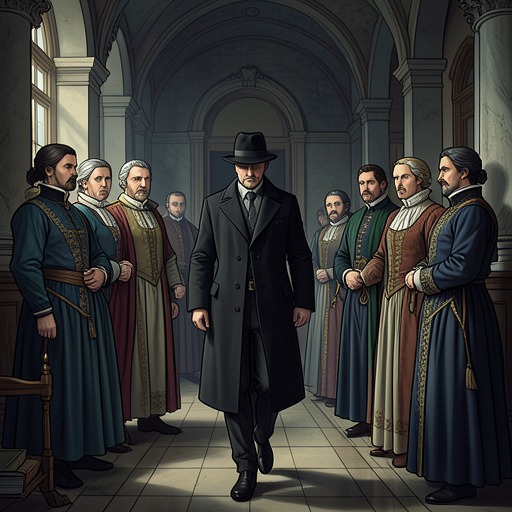
The Palace’s interior is divided by status as well as by function. Lucien de Barenton, Count de Chrétien, reaches the first floor, identified as the royal floor, after leaving his grey Arabian, Zelis, with a groom. Musketeers bow and stand aside as he passes into the hallway behind Louis XIV’s bedroom. The private entrance is not generally available: Louis XIV permits only his sons and a few highly favored noblemen to use it. The scene makes access a visible measure of favor. The hallway’s proximity to the royal bedroom marks a boundary that rank alone does not automatically remove; admission depends on the King’s particular permission.
Other routes carry their own social meaning. Lucien crosses the black-and-white marble of the courtyard and enters through the chateau’s central doors, beneath the balcony of the King’s apartment, before following his usual route to the royal bedroom. The repeatedness of this journey makes the Palace seem navigable to a favored courtier, yet the contrast with the guarded private entrance shows that familiarity and privilege do not abolish its thresholds. Access is managed through doors, guards, and established paths, with the King’s rooms at the center of this hierarchy.
Ceremony and everyday court life
Royal ceremony turns the Palace into a public stage. In the first chamber, dozens of less-favored courtiers wait among paintings, frescoes, carved marble, and gilded representations of Apollo and the sun. Their surroundings have become so familiar that they yawn, gossip, and trade insults disguised as compliments. When Louis XIV appears, the room falls silent and the courtiers salute him. The shift from bored conversation to collective deference shows how the King’s arrival alters the room’s behavior, even where the decorations themselves no longer command attention.
The procession continues through repeated court ritual. Louis XIV’s gout troubles him, but he conceals his discomfort; Lucien accompanies the procession from the official bedchamber and leaves it when the King approaches the chapel. Marie-Josèphe de la Croix, by contrast, watches Louis XIV in open awe. Lucien recognizes her excitement as that of a newcomer to court and hopes she will learn not to reveal her feelings so plainly. The same ceremonial space therefore means different things to its observers: for a seasoned courtier, it demands disciplined restraint; for Marie-Josèphe, it still carries the force of spectacle.
Apartments and private life
The Palace’s rooms also distinguish personal taste and household practice. Marquise de Maintenon’s apartment is reached by a great stone staircase, past forced blooms in gilded pots, and through double doors opened by a guard. Inside, its furnishings are austere, almost like those of a convent cell. Marquise de Maintenon refuses flowers and jewels despite Louis XIV’s lavish gifts, and even the King’s council table is plain black lacquer with only moderate gilt and inlay. The restraint of these rooms contrasts with the elaborate public spaces of court and shows that royal proximity does not require every apartment to reproduce the same display.
Taken together, the Palace’s settings reveal a court structured by contrasts: marshland discomfort beneath magnificence, familiar rooms that become ceremonial when the King appears, and restricted routes that separate favored access from ordinary presence. The gardens stage royal spectacle outdoors; guarded doors and interior processions regulate it within. Versailles’s grandeur is inseparable from the labor of maintaining its rituals and the hierarchy that gives each room, route, and encounter its meaning.