Pope Innocent
The Moon and the SunPope Innocent is the Church’s highest authority in the court’s disputes over the sea people, and his decisive role is to make their status a matter of doctrine, obedience, and historical record. He rejects the possibility that they are people, yet ultimately permits their classification to change from demons to beasts. That concession does not end their subordination: at the close of the story, he demands silence from Marie-Josèphe de la Croix and helps erase evidence of the sea people from public memory.
Doctrine and the Sea People
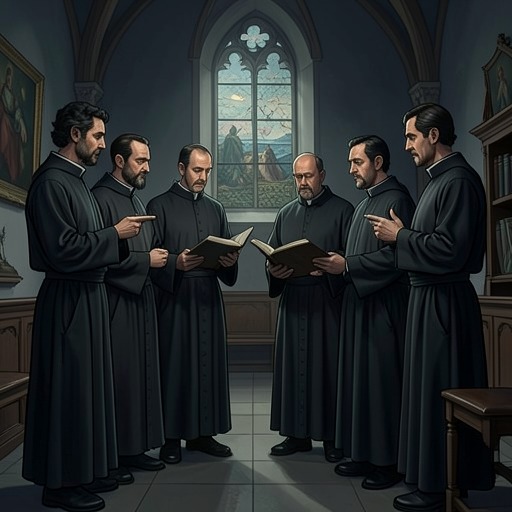
Pope Innocent defends the Church’s earlier treatment of the sea people as demonic. When Lucien de Barenton, Count de Chrétien argues that the Church once mistook beasts for demons and could revise its judgment again, Pope Innocent refuses the premise that the earlier classification was an error. He insists that the beings were products of demonic possession and that the Inquisition drove out the satanic influence. His position makes the question more than a dispute over observation: it is a defense of the Church’s past actions and the authority that justified them.
The dispute turns on what kind of proof should count. Lucien argues that Marie-Josèphe has demonstrated that the sea monster understands her, but Pope Innocent dismisses that evidence as insufficient. He maintains that the unresolved test is whether the creature speaks a human language and therefore cannot be treated simply as a creature. By appealing to the need for proof, Lucien asks Louis XIV to allow Marie-Josèphe to demonstrate her claim; Pope Innocent calls the proposal ridiculous. His resistance exposes the unequal terms of the debate: Marie-Josèphe’s knowledge must overcome not only skepticism but a doctrinal framework that has already made the sea people’s humanity difficult to acknowledge.
Pope Innocent eventually accepts a change in classification, but not the recognition Lucien seeks. The Church’s decree raises the sea people from demons to beasts. That revision withdraws one theological accusation while retaining a category that permits their treatment as lesser beings. The movement from demon to beast is therefore both a reversal and a limit: the Church can correct its account of what the sea people are, while still withholding the status that would make their testimony and claims difficult to dismiss.
Judgment of Sherzad
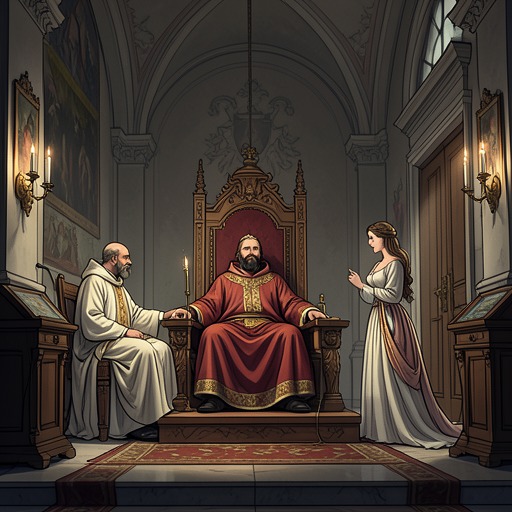
Pope Innocent’s encounter with Sherzad shows how quickly that classificatory power becomes a judgment about conduct. After Sherzad is injured in the struggle at the King’s feet, Pope Innocent interprets the incident as an attempted suicide and declares that suicide is a mortal sin. He requires Sherzad to vow obedience and repent before dying, threatening to identify her as a demon if she does not. The demand converts a wounded captive’s immediate peril into a test of submission and religious status.
Marie-Josèphe sees the danger in the two men’s competing interpretations: Pope Innocent believes Sherzad tried to kill herself, while Louis XIV may believe she tried to murder him. Sherzad then rises and sings furiously, blood streaking her face. The scene leaves Pope Innocent’s demand unanswered by repentance. Later, when he asks whether the sea woman repented, Louis XIV says no; Marie-Josèphe reports instead that Sherzad declared war on the men of land and disappeared. Pope Innocent’s question seeks a religious conclusion to her resistance, but the answer confirms that she has not accepted the terms he imposed.
Authority over Marie-Josèphe
Pope Innocent also exercises authority directly against Marie-Josèphe. After making her wait until he has finished the rosary, he forbids her to compose music. He explicitly frames the prohibition not as protection of her modesty but as punishment, and commands that she be silent. The timing and stated purpose make the restriction an exercise of discipline rather than a general judgment about her musical ability: her work and speech are treated as privileges he can withdraw.
Their confrontation also touches on Marie-Josèphe’s mother. Marie-Josèphe protests that her mother submitted entirely to Pope Innocent; he begins to answer that she refused, then falls silent as his expression grows sad and his eyes fill with tears. The exchange exposes a personal wound without resolving it. His visible grief complicates the image of an impersonal authority, but it does not undo the force of his present commands or clarify the history behind the unfinished reply.
Censorship and Final Judgment
Pope Innocent’s final actions extend his authority from doctrine over the living to control over what may be remembered. After Louis XIV has spared those before him, Pope Innocent asks whether Sherzad repented and hears that she did not. Marie-Josèphe supplies a different ending: Sherzad declared war on the men of land and vanished. The contrast places religious judgment beside a declaration of continuing resistance, rather than a conversion or surrender.
Pope Innocent then insists that history must be corrected. He opens a drawing box containing Marie-Josèphe’s dissection sketches, crumples one, and thrusts its edge into a candle flame; when it burns his fingers, he drops the ashes into a golden Aztec dish. The physical destruction gives his demand a concrete form: evidence is not merely disputed but deliberately made unusable. His wider order calls for the disappearance of every painting, myth, and memory of the creatures, along with the record of the Church’s decree that reclassified them from demons to beasts. The decree that once changed their official status is itself among the things to be erased.
Pope Innocent’s arc is therefore not a simple passage from error to recognition. He permits a doctrinal revision while denying the sea people the human standing Marie-Josèphe seeks for them, demands obedience from Sherzad, and punishes Marie-Josèphe by silencing her music. Finally, he turns correction into censorship, attempting to control both the evidence and the history through which the sea people might be understood. His authority can alter the official name imposed on them; its limits become visible in Sherzad’s refusal to repent and in the story Pope Innocent cannot make disappear.