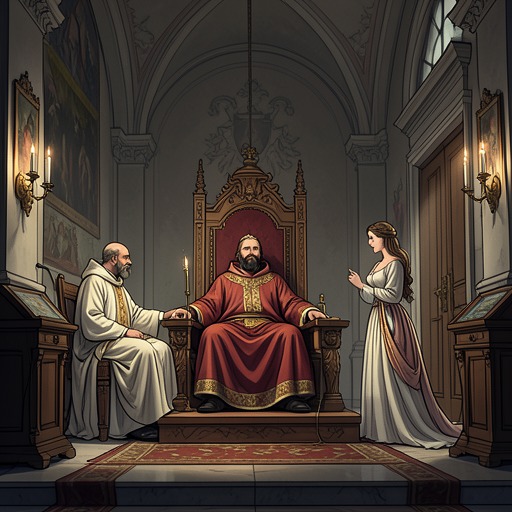
Religious authority versus scientific inquiry
The Moon and the SunReligious authority versus scientific inquiry is not presented as a simple contest between faith and reason. The conflict concerns who is permitted to ask questions, interpret the natural world, and decide what evidence means. At court, observation and dissection can challenge inherited categories, but their public acceptance remains entangled with the Catholic Church, royal patronage, gendered rules, and the interests of those who control the inquiry.
Knowledge and Its Boundaries
The novel distinguishes natural philosophy from alchemy even as its characters repeatedly confuse or politically combine them. When a courtier associates Yves de la Croix’s studies with alchemy, Marie-Josèphe de la Croix corrects him: her brother studies natural philosophy, while she studies mathematics. The exchange establishes that their work is not an occult pursuit of transformation. Yet the distinction becomes harder to maintain when Louis XIV’s interest in the sea monster turns toward a supposed organ of immortality, a question that draws on alchemical hopes even as Yves approaches it through anatomical investigation.
Yves’s scientific identity is therefore defined both by his methods and by his dependence on royal favor. During a dissection, he reports that the sea monster has neither gills nor a swim bladder and that its internal organs resemble those of mammals. When Louis XIV demands to know about an organ of immortality, Yves answers that he has found no evidence for one and places immortality, like the transmutation of gold, outside the claims of natural philosophy. His answer separates observed anatomy from a desired conclusion. Louis XIV nevertheless presses the possibility that the creature might grant everlasting life, while Pope Innocent offers a theological counterpoint: earthly immortality would be a burden, though he hesitates over whether someone called to continue God’s work might accept it. The exchange shows that religious and royal claims do not simply oppose science; they can also appropriate its questions for different ends.
Authority over Women’s Expression
The conflict is also enforced through rules about women’s speech and art. After Marie-Josèphe’s composition is performed, Pope Innocent condemns it as indecent and invokes the Church’s edict that women should remain silent. He extends the prohibition beyond church, declaring music injurious to her modesty and urging Louis XIV to censor what he calls pagan excess. The dispute is not about evidence from nature, but it exposes the same struggle over who has authority to judge knowledge and expression: Marie-Josèphe’s work is assessed not only as music but as a woman’s public act.
Her response reveals how thoroughly such authority can be internalized. Despite knowing that the silence rule had made convent life miserable, she wonders whether Pope Innocent may be right. His apparent holiness unsettles her confidence; the rebuke recalls the convent, where punishment had answered her questions instead of explanation. The scene makes religious power more than a decree imposed from above. It can shape the subject’s own judgment, causing a questioner to doubt her work before she can defend it. Her earlier insistence that neither she nor Yves studies alchemy similarly asserts the right to describe her intellectual activity accurately rather than accept a courtier’s ornamental dismissal of it as an alchemy of beauty.
Yves between Inquiry and Discipline
Pope Innocent’s private conversation with Yves makes the limits on inquiry explicit. He says he is distressed by Yves’s worldly concerns and by the natural philosopher’s desire to seek God’s truth in nature; Yves replies that this is precisely what he seeks. Pope Innocent answers that determining God’s truth and will is not Yves’s place. His concern also encompasses Marie-Josèphe’s composition and the court surrounding the siblings, which he characterizes as a realm of debauchery, heresy, atheists, and monsters. The warning binds intellectual suspicion to moral and political danger.
The proposed remedy is not a refutation of Yves’s observations but the possibility of removing him from the work. Pope Innocent suggests confession and a year of meditation in a monastery, including a year of silence. Yves restrains his protest because departure could cost him Louis XIV’s patronage and everything it enables in his research. His submission—kneeling to kiss the Pope’s ring—coexists with his commitment to inquiry. The scene shows that knowledge depends on material conditions as well as intellectual conviction: a researcher may be free to investigate only while powerful patrons permit him to remain at work.
Anatomy, Evidence, and Public Credibility
The sea monster’s body gives this conflict a material form. After the dissection, Marie-Josèphe finds its organs preserved in spirits in heavy glass jars. She prepares and draws samples, using Yves’s old microscope, and observes that the anomalous lung tissue is firmer and denser than ordinary lung. Under magnification, it differs sharply from ordinary lung: instead of air sacs, it consists of delicate overlapping leaves. These are specific observations, produced through dissection, preservation, instruments, and drawing. They do not establish immortality, but they make the unusual organ available for description and further investigation.
Public scientific authority, however, does not guarantee that every finding will be disclosed or credited. Before the King’s philosophers, Yves presents the sea people as natural creatures and describes their lungs as large, adding that one remained underwater for ten or twelve minutes. He does not mention the anomalous lobe. Marie-Josèphe later names that feature before the scholars, speaking in Latin, but Yves dismisses her comments. A senior scholar treats her as mistaken and jokes that her studies have addled her mind. Her claim is anatomically precise, yet her standing as a woman and assistant weakens its reception. The episode distinguishes having evidence from possessing the authority to make evidence count.
The dispute then shifts from anatomy to the sea monster’s capacity to understand. Lucien de Chrétien urges Louis XIV to consider Marie-Josèphe’s claim, pointing out that she has proved the creature understands her. Pope Innocent dismisses the argument, while Louis XIV compares it to the possibility that a cat understands its owner. Lucien does not ask the court simply to accept Marie-Josèphe’s interpretation; he frames the question as one requiring proof, including whether the creature speaks a human language. He asks that she be allowed to demonstrate her contention. The appeal to proof opens a hearing, but it also leaves the creature’s status dependent on what the court will recognize as intelligible evidence.
The Politics of Proof
Across these episodes, inquiry is neither fully independent nor simply silenced. Yves can dissect under royal sponsorship, but the King’s expectation of immortality pressures the purpose of the work; Pope Innocent can threaten a retreat from research, but his own theological reasoning leaves room for uncertainty; Marie-Josèphe can observe and argue, but scholars and clerics discount her because of her sex and position. Scientific claims acquire force through instruments and repeatable description, yet access to those methods, the right to interpret results, and permission to present them remain socially controlled.
The sea people intensify the stakes because their classification is itself at issue. Calling them natural creatures rather than demons unsettles a religious category, while deciding whether they possess language bears on whether they should be treated as persons. The novel therefore links disputes over natural philosophy to disputes over human recognition: evidence may challenge inherited authority, but those who hold authority can still determine which questions are asked, which findings are withheld, and whose testimony is heard. Its central tension lies not in a final victory of science over faith, but in the precarious passage from observation to public truth.