Royal power and glory
The Moon and the SunRoyal power and glory in these scenes depend on more than Louis XIV’s title: they are made visible through ceremony, public recognition, and the authority to decide how other beings are valued. The jeweled magnificence of the Versailles Carrousel stands beside Marie-Josèphe’s silent plea and the debate over whether Sherzad is human, useful, or expendable. Together, the moments show sovereignty as spectacle and as practical control over other lives, while also exposing claims—such as the promise of immortality—that royal desire cannot make true.
Authority and the Question of Humanity
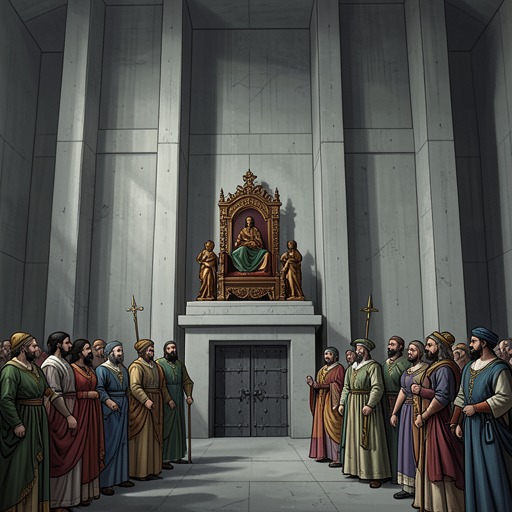
The debate over the sea creature places religious judgment, human status, and royal power in the same frame. Pope Innocent calls the creature grotesque and denies that it has anything of humanity about it. Yves de la Croix instead understands the sea monsters as a possible miracle raised toward humanity. Lucien de Barenton, Count de Chrétien, challenges the assumption that appearance can settle the question: he compares Sherzad with himself, insisting that Sherzad is less grotesque, while pointing out that he himself is human—and very rich. The exchange makes rank and wealth part of the argument. Lucien’s pointed comparison does not itself decide Sherzad’s status, but it reveals how easily judgments of humanity can be entangled with judgments of bodies and social standing.
The debate matters to royal authority because classification shapes what may be done. If Sherzad is treated as a creature without humanity, his life can be discussed as a resource; if he is acknowledged as a person, that treatment becomes harder to justify. The scene does not make Louis XIV the sole speaker in this dispute, but it places competing claims before the court’s powerful figures. Royal glory therefore appears alongside uncertainty: ceremony may make authority look settled, while the status of the being under its control remains contested.
Petition, Silence, and Access
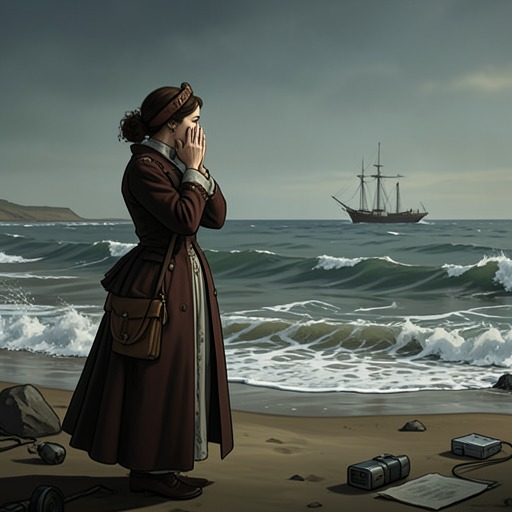
Marie-Josèphe’s approach to Louis XIV on Sunday morning gives power a more intimate and precarious form. As he walks to Mass with his family, she pushes through the crowd of petitioners and throws herself at his feet. She says nothing. Instead, she holds out a letter in both hands, afraid that he will refuse to take it. Louis XIV remains impassive, revealing neither annoyance at her presence nor satisfaction at her submission; then he accepts the letter.
The small action concentrates the imbalance between ruler and petitioner. Marie-Josèphe can bring her appeal into the King’s presence, but she cannot compel him to receive it or know from his expression how he will respond. Her silence is not simply an absence of speech: the letter carries what she has come to say, while her posture makes her dependence on access visible. Louis XIV’s decision to take it opens a channel of communication, but the scene records no immediate answer. His authority is shown in the power to receive—or potentially withhold—the appeal, not in a response the evidence does not supply.
Treasure, Death, and the Limits of Royal Desire
The argument over Sherzad’s possible treasure makes royal power material and transactional. Lucien presents the sea woman’s life as a route to treasure and her death as worth only a morsel of meat. Louis XIV answers that the morsel represents a feast comparable to Charlemagne’s and, beyond wealth, the chance of immortality. Marie-Josèphe directly contests that hope: she urges him to believe that it is a myth and that Sherzad cannot give him immortality.
The exchange distinguishes the King’s ability to command from his ability to secure what he wants. Treasure can be imagined as an investment, and Sherzad’s survival or death can be weighed against its possible return; immortality, however, remains an expectation rather than a demonstrated result. Marie-Josèphe’s warning places a limit on the royal fantasy without showing that Louis XIV accepts it. The scene’s tension comes from the stakes of the calculation: a life is set against a projected fortune and the King’s desire to outlast mortality. Power can determine what is attempted, but cannot by itself turn a myth into truth.
The Carrousel and Public Recognition
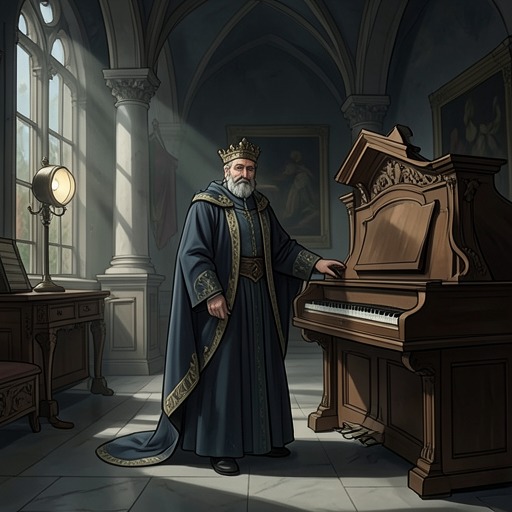
At the Versailles Carrousel, royal glory becomes overwhelming spectacle. Louis XIV leads the procession as Augustus Caesar, Emperor of Ancient Rome, on the tallest spotted Chinese horse. Rubies and diamonds cover the red harness; gold glints from the tack, and feathers and ribbons enlarge the display. His own diamond-paved tunic, ruby-covered armor, jeweled sandals, and high headdress extend the same visual argument. Even his shield bears the sun in beaten gold dispersing clouds of burnished silver. The costume makes kingship legible as abundance: the King is not merely present at the event but placed at its head, embodying imperial grandeur.
That spectacle takes on a more personal meaning when Louis XIV strides toward Yves de la Croix after Pope Innocent tells Yves to go to the chapel and meditate on sin. With the Carrousel teams and court watching, Louis XIV embraces Yves by the shoulders and calls him his son, inviting him to stand at his right hand. The public setting turns recognition into an act of rule: the King does not simply acknowledge Yves privately but declares their relationship before courtiers, visiting monarchs, and Princes of the Church. The gesture binds personal recognition to political display, making the court an audience to both. In these scenes, royal power is at its most visible when it stages magnificence or gives a person a place beside the sovereign; its limits emerge when the living being before the court cannot be reduced to a spectacle, a source of treasure, or a promise of immortality.