Saint-Cyr
The Moon and the SunSaint-Cyr is presented as a convent school and a place of instruction for impoverished high-born girls. For Marie-Josèphe de la Croix, it was less a school she attended as a pupil than the setting of her first work in France: the Marquise de Maintenon gave her a position teaching arithmetic to younger girls. The institution thus connects religious education and charitable patronage with the intellectual work through which Marie-Josèphe begins to establish an independent role.
Setting and Patronage
Marie-Josèphe arrived in France from Martinique after attending a convent school there. At twenty, she was considered too old to enroll as a student at the Marquise de Maintenon’s school at Saint-Cyr. Instead, the Marquise made room for her as an arithmetic instructor. This distinction matters: Marie-Josèphe’s place at Saint-Cyr was a working one, even though her own education had also taken place in a convent setting.
The Marquise’s kindness had a personal context. Like Marie-Josèphe, she had come to France from Martinique with nothing. She spoke to the girls in her care about the hardships she had faced in the New World, and held out a future in which piety and obedience might be rewarded. She told the impoverished high-born students that the King would provide dowries, enabling them to escape their circumstances. Saint-Cyr therefore appears not only as a site of religious instruction but as a household of protégées whose prospects depended, in the Marquise’s account, on devotion and royal assistance.
Teaching and Life at the School
Arithmetic gave Marie-Josèphe a defined intellectual responsibility among the younger girls. The job also placed her within an environment where the students’ conversation ranged beyond religion. Marie-Josèphe recalled that they spoke about court life, the King, and changing fashions whenever they were not discussing religious matters. Madame took this as evidence that the Marquise had not fully subdued the girls’ interests; the school’s pupils remained attentive to the world beyond its religious routines.
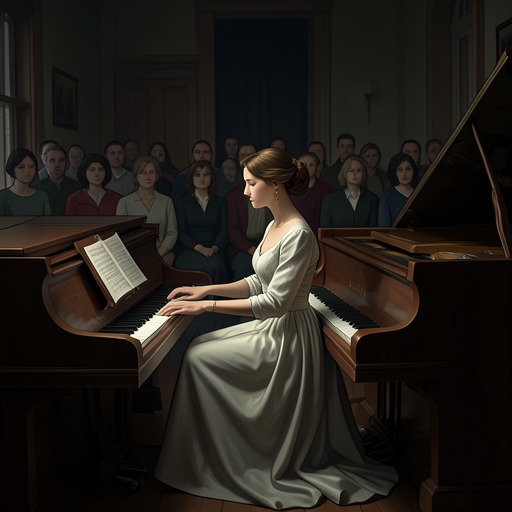
Saint-Cyr also forms part of Marie-Josèphe’s musical background. At a later performance before the King, she had practiced a little there, although she had been forbidden to touch an instrument during the five years before that. The evidence does not establish the extent of the school’s musical instruction, but it marks a contrast between limited practice at Saint-Cyr and a longer period of enforced separation from instruments. When her fingers falter in performance, that history helps explain why her musical confidence is still developing.
The Requirement to Leave
Marie-Josèphe eventually explains that she could not remain at Saint-Cyr because all the instructresses had to take the veil. The condition made the teaching position inseparable from a religious commitment she did not choose. Her departure is therefore not simply a change of employment: it marks the boundary between a life shaped by the convent and the wider possibilities she wants to pursue.
After leaving, Marie-Josèphe thinks of herself as free to study without being forbidden. On a morning walk, she considers how calculation might describe the motion of a stone and predict the paths of stars and planets, and wonders whether she should write again to M. Newton. Her interest in natural philosophy is not described as something she learned at Saint-Cyr. Rather, the contrast makes clear what leaving the convent means to her: she can now pursue questions that extend beyond the duties and restrictions of her former setting.
Significance
Saint-Cyr’s importance in Marie-Josèphe’s story lies in the mixed character of her experience there. It gave her an opportunity to teach, placed her among girls whose interests reached toward court life, and formed part of the limited musical practice she could undertake. At the same time, the veil required of instructresses meant that the position could not become a lasting home for her without a commitment she rejected.
The school thus stands at a threshold in her life. Its religious structure both provides an opening, through the Marquise’s patronage, and sets a limit on the future Marie-Josèphe imagines. She leaves with teaching experience and some musical practice behind her, while her later ambitions turn toward composition and natural philosophy. Saint-Cyr is not presented as the source of all those ambitions; it is the place from which the choice to pursue them elsewhere becomes possible.