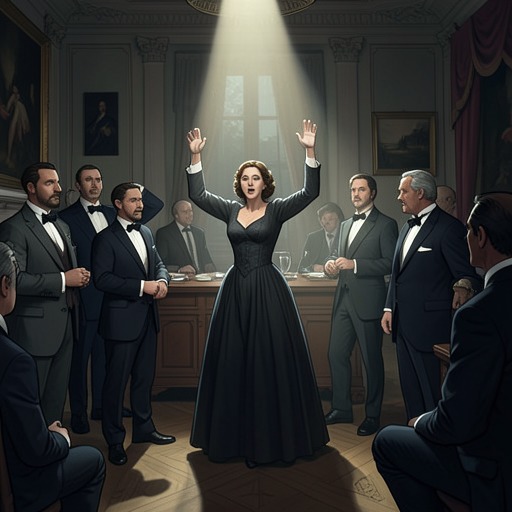
Sherzad’s Grand Canal Escape Attempt
The Moon and the SunSherzad’s Grand Canal escape attempt is a brief but consequential struggle for freedom: she leaves the foul water of her confinement and searches underwater for a route to the sea, only to learn that the canal leads nowhere she can escape. The sequence gives her hope a physical shape in the water, then breaks that hope with a correction from Marie-Josèphe. Sherzad’s eventual appearance at the bank confirms that the journey has not freed her, while her injured body makes the cost of the attempt visible.
Background and Setting
After days in filthy water, Sherzad enters the Grand Canal and luxuriates in its clean coldness and the space around her. Fresh water tastes bland to her, but even that is preferable to the filth she has endured. The change in conditions is immediate and tangible: this is not yet the sea, but it offers room to move and water that does not carry the same degradation as the fountain.
Sherzad perceives the canal as a world of shapes and obstacles. Humming and whistling, she listens to its “long sharp edges and regular curves.” There is little life below the surface: bits of algae and broken water plants struggle upward, only to be slashed away or uprooted. The keels of small boats jut through the surface into the realm she is exploring. The canal is therefore both an apparent opening and a constructed boundary, its orderly banks and boat traffic unlike the living sea she seeks.
The Search for a Way Out
Sherzad swims into a faint, confused current, looking for the underwater river. Her movement is purposeful: she is not merely exploring a better stretch of water but trying to locate a passage onward. In her song, the sea woman describes fighting past iron gratings, swimming along an underwater stream, and reaching freedom in the sea. The song gives the escape a complete imagined destination, from the barriers she must pass to the liberation beyond them.
That account, however, is not the same as a successful escape. Sherzad’s song presents the route as a passage to freedom, but the sequence returns to her at the Grand Canal, not in the sea. Its contrast between the song’s fulfilled journey and the physical circumstances of Sherzad’s return leaves the hope intact as an expression of what she wants, while making clear that she has not reached it. The current she follows is faint and confused; it offers no reliable guide to the destination she imagines.
Marie-Josèphe’s Recognition
When Sherzad surfaces before her, Marie-Josèphe kneels at the bank and adopts a cheerful manner. She bends to kiss Sherzad’s forehead and asks, “Dear Sherzad, what happened, what’s wrong?” The greeting is intimate, but her attention quickly turns to the injuries Sherzad has brought back with her. Sherzad’s skin feels cooler and rougher than usual; a claw is broken, an ugly ulcer marks her shoulder, and her hair is tangled and dull. Her eyes, by contrast, gleam wild. The injuries establish that the attempted journey has not been a harmless swim, although the evidence does not identify how each wound occurred.
Marie-Josèphe interprets Sherzad’s song as a story of escape and corrects the geographical assumption behind it: “Oh, my sweet, did you believe the Grand Canal is a river? It isn’t, it only connects to the aqueduct.” The revelation is practical and devastating. The canal may look like a route outward, but it does not connect directly to the sea. Marie-Josèphe urges Sherzad not to despair, adding that the ship will find the treasure and that His Majesty will keep his promise. Her reassurance points toward a separate hope, dependent on the ship and the promised treasure, rather than confirming that Sherzad’s own attempt has succeeded.
Failure and Significance
When Marie-Josèphe touches the inflamed skin around the ulcer and asks how it happened, Sherzad flinches and snarls. Her response complains of the filth in the fountain. She has experienced the Grand Canal’s clean water and open space, yet the attempt has brought her back to the conditions of confinement. The movement from foul water to apparent possibility and back again gives the escape its painful reversal: freedom is pictured in Sherzad’s song, but denied by the actual geography and by her return.
The episode also makes communication itself part of the struggle. Sherzad sings the journey she understands or desires; Marie-Josèphe listens, recognizes its meaning, and answers with information Sherzad needs. Yet understanding does not remove the bars or make the canal a river. The route is exposed as a false exit, and Marie-Josèphe’s promise offers only a future possibility. Sherzad’s broken claw, ulcer, and angry reaction leave the scene grounded in the bodily consequences of captivity rather than in the song’s imagined arrival at the sea.