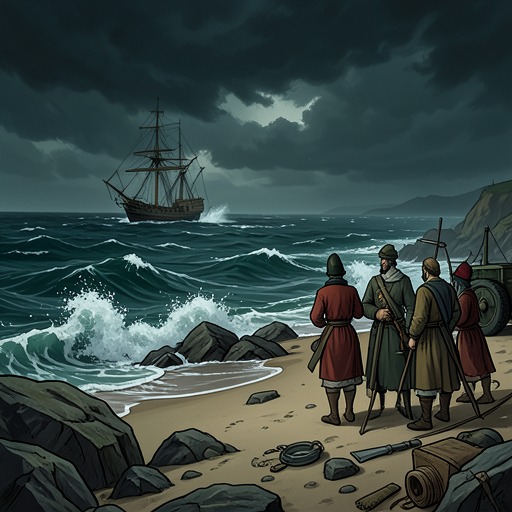
Sinking of the privateer by the sea people
The Moon and the SunSherzad’s attack on the pursuing galleon turns the sea people’s response to ships of land from wary observation into deliberate destruction. She leads her siblings in a coordinated assault: they approach beneath the hull, anchor themselves with narwhal-tusk spears, and use focused voices to break the ship apart. The men who enter the water are not allowed to escape, and a summoned octopus pulls the wreck down. The episode makes the sea people’s collective power unmistakable, while showing Sherzad choosing to use it where she once would have swum away.
Background and decision
The attack follows an account of two ships that had fought each other across the sea people’s domain. Sherzad’s younger sister sings of witnessing their encounter: for half a day, the ships battered the air and water with noise, and iron balls drove the sea people to dive for safety. In the end, the ships sank each other and their crews drowned. The sister laughs at the outcome and hopes that other ships will likewise destroy one another—or that the sea people will destroy them first. Her account establishes the danger posed by ships of land and the hostility they have already brought into the sea people’s waters.
The later pursuit presents a different situation. Two ships are again moving through those waters, but now one flees while the other pursues and gains on it. Sherzad and the others stalk the ships from below. She swims under the pursuer’s barnacled bottom and sings at it, testing it with her voice, searching and questioning. She finds nothing worth saving. Previously, she would have swum away; this time, she stays. That contrast marks a choice to intervene rather than merely avoid the human ships passing through the sea people’s domain.
The assault beneath the hull
Before approaching more closely, Sherzad entrusts her baby to her young brother to guard. The gesture makes the attack a shared undertaking with responsibilities carried across generations: Sherzad can lead the danger-facing action because another family member watches over her child. She then joins her companions beneath the galleon. They thrust spears made from narwhal tusks into its bottom; the ivory bites into the wood, and the sea people hold the tusks as they ride along with the ship.
The assault proceeds by degrees. Sherzad shouts at the planks, directing her focused voice against the hull. She shouts again, and her spear quivers in the wood as it shakes. The detail connects the voice’s force to a physical surface: the ship does not simply hear the sea people, but trembles under their attack. Sherzad’s brothers and sisters then shout together. With their voices joined, the wood cracks and splits, and the ship’s bottom disintegrates. The scene presents their power as both individual and collective: Sherzad initiates the attack, while the siblings’ united voices bring down the structure.
The sinking and its aftermath
As the hull gives way, men shriek and dive into the water. Sherzad and the others make sure none of them surfaces again. The attack therefore does not end when the ship loses its seaworthiness; the sea people also prevent its crew from escaping into the water. Waves wash across the deck as the vessel goes under, and the sea people sing their triumph while calling to their allies.
A shadow rises, flickering with tiny sparks. The giant octopus stretches its tentacles into the moonlight, entwines them around the mainmast, and inexorably pulls the ship into the depths. The ending enlarges the assault beyond Sherzad and her siblings: the sea people can summon an ally whose strength completes the destruction. The mainmast, a remaining upright part of the ship, becomes the point by which the octopus draws the whole vessel down.
Significance
The episode reverses the earlier encounter between ships. In the sister’s account, ships destroy one another while the sea people escape their weapons by diving; in Sherzad’s attack, the sea people themselves act, and the pursuing ship is broken from beneath. The change is also personal: Sherzad moves from her former habit of swimming away to a direct, planned attack, taking the risk after first ensuring that her baby is guarded.
The sequence makes the sea people’s voices an instrument of physical force without explaining their operation beyond what the scene shows. Spears lodge in the hull, focused shouting makes the wood quake, and the siblings’ combined voices split it apart. Their song of triumph then accompanies, rather than replaces, action: the call brings an ally, and the octopus finishes the sinking. Together, these details define the event as a coordinated defense of the sea people’s domain, with Sherzad at its center and the pursuing ship’s destruction as its decisive result.