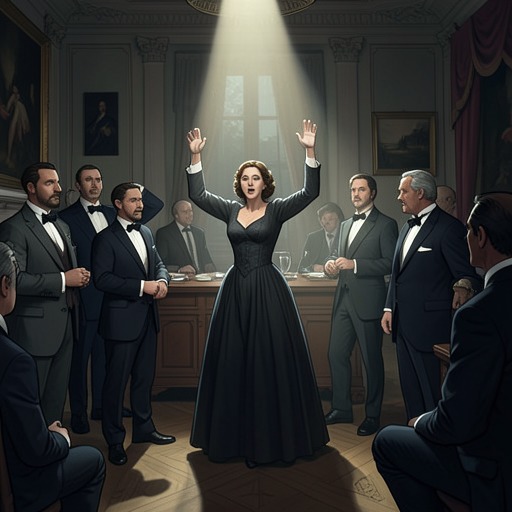
The Sea Monster’s Public Exhibition at Versailles
The Moon and the SunThe Sea Monster’s Public Exhibition at Versailles is a public display ordered by Louis XIV and an improvised demonstration of trust between Marie-Josèphe de la Croix and the captive sea monster. Visitors are admitted to see the creature, but Marie-Josèphe’s feeding lesson reveals the limits of treating her as a tame exhibit: she can be enticed into view, yet she approaches, withdraws, and returns on her own terms.
The King’s Order Opens the Tent
Marie-Josèphe arrives among the visitors in velvet and lace, her courtly clothing marking her as a member of Louis XIV’s court. The crowd’s excitement is not abstract: one family leaves after the father apologizes, pulling his wife and four young children away while the eldest continues begging to see the sea monster. Marie-Josèphe calls for a guard, and a Musketeer makes a path for her through the crowd and into the tent. The access she receives distinguishes her from the spectators, but it does not mean she has been told what is happening.
She asks why the visitors have been allowed inside. The Musketeer answers that Louis XIV has ordered it: “His Majesty’s subjects are to be allowed to see the monster.” The tent has been opened for a stream of visitors. They look at sketches made the previous day—not the drawings from the secret dissection, which Marie-Josèphe has left safe in the chateau—then peer through the cage bars and leave by another raised section of the tent wall. The distinction between public sketches and concealed dissection drawings places an unseen history of examination just behind the current display. For the visitors, access means looking; for Marie-Josèphe, the order creates the immediate problem of how to show them a creature hidden beneath still water.
Fish, Silence, and the First Approach
At the Fountain of Apollo, the water lies still as glass. Marie-Josèphe has fish to offer; their value is made tangible by her awareness that a servant wishes he had more than a person could eat for dinner, even if dinner were the only meal. She nets one and turns the feeding into a call: “Sea monster! Fish, nice fish!” Beneath the hooves of the dawn horses, the sea monster flicks her tails. A few visitors see the movement, gasp, point, and call for Marie-Josèphe to show them more. Marie-Josèphe asks them to be quiet, hoping the creature will emerge if the crowd does not frighten her away.
A ripple breaks the stillness. The sea monster’s long dark hair streams behind her, covering her back from the sun and disguising her glowing copper skin. She hesitates as Marie-Josèphe holds out the fish, then responds to the invitation, “Good sea monster. Come a little closer, come have your fish.” The creature says, “Fishhh!” and surfaces. She snatches the offering and eats it in several messy bites, leaving fish guts and bits of fin in the water. The visitors’ response—astonishment, murmuring, and disgust—turns the feeding into a spectacle. Startled by their reaction, the sea monster slips below the surface again. The brief reveal meets the audience’s appetite for a sight, but their noise also shows the cost of being displayed.
A Lesson That Depends on Choice
The Musketeer moves to face the crowd, prepared to bully or cajole the visitors if the King’s gardens become disorderly. Instead, the spectators press closer, fascinated and entertained; those nearest the cage look through its bars, while others try to see over them. Marie-Josèphe continues the demonstration by feeding the sea monster and luring her toward the platform. The creature slithers half out of the water and rests her elbows there as the visitors whisper in awe. Marie-Josèphe lets her swim away, calls her back, and offers another fish. After three repetitions, the sea monster floats just beyond Marie-Josèphe’s reach and sings without coming closer.
Marie-Josèphe imagines she ought to understand the song, then checks that expectation against her own uncertainty. She calls again, but the sea monster has already learned the simple lesson and is bored with repeating it. Rather than insist, Marie-Josèphe lets a fish swim free as living prey. This choice changes the terms of the exercise: the fish is no longer merely a reward held out to command a return. Marie-Josèphe wonders whether she can claim to have trained the creature if she obeys only when she chooses. The question remains unresolved, because the sea monster surfaces, whistles, splashes her tails, and surges closer without being compelled to do so.
Spectacle and Autonomy
Marie-Josèphe rises and tells the sea monster she may have more fish later if she comes when called. On a whim, she adds that she will receive an extra portion if she shows herself again to the visitors. The offer acknowledges the public purpose of the performance, yet the creature’s earlier refusal to approach on cue has already exposed its limit: the reward may invite cooperation, but it does not secure obedience. Marie-Josèphe smiles at the thought that creatures might be easy to train, while the scene has demonstrated precisely how uncertain that claim is.
The exhibition therefore holds two kinds of looking in tension. Louis XIV’s subjects have been admitted to see the quarry, and their crowd gathers around every sign of movement; Marie-Josèphe, meanwhile, attends to the conditions under which the sea monster will come near. The creature’s copper skin, hair, voice, and feeding are displayed before the audience, but her hesitation, retreat, boredom, and voluntary return prevent the performance from becoming a simple triumph of control. The scene ends not with a guaranteed display but with an invitation and a conditional promise of fish: the King may order the public admitted, while the sea monster’s appearance remains dependent on a relationship that cannot be commanded into existence.