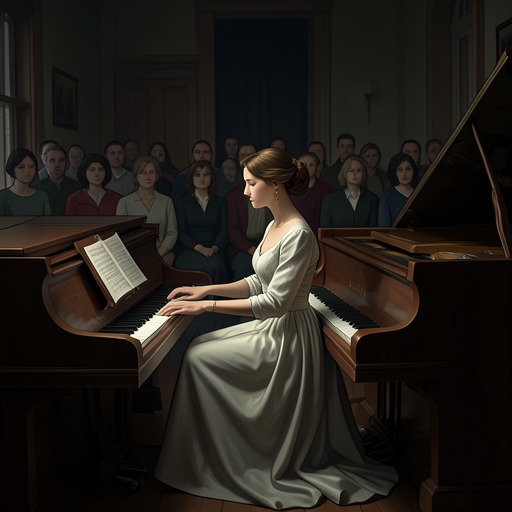
The Sea Woman’s Cantata
The Moon and the SunThe Sea Woman’s Cantata is Marie-Josèphe’s attempt to make the sea woman’s song and the sea people’s tragedy legible at the French court. As she revises it, a piece that began as a heroic account of a hunt becomes increasingly tragic. She completes the score and plays its story, hoping music will move Louis XIV to recognize the sea woman’s humanity; when she tries to place the work before a court musician, however, its author’s status as an amateur woman becomes grounds for rejection.
Composition and Revision
Marie-Josèphe works on the score while sitting beside Odelette, who holds her hand even after falling asleep. Marie-Josèphe continues revising with her free hand, keeping the pages with her as she dozes. The scene connects the labor of composition to care and companionship: the music does not emerge in isolation, but is revised while Marie-Josèphe remains physically present with someone close to her.
Her own assessment of the early work is that the score is perfect, but that it fails to reflect how sad and frightened the sea monster is in captivity. The contrast identifies the problem she is trying to solve. Technical completion is not enough if the music’s emotional account does not correspond to the creature’s condition. The cantata’s later development answers that concern not by preserving the first version unchanged, but through repeated revision.
From the Hunt to the Sea People’s Tragedy
When Marie-Josèphe begins the cantata, she regards its subject as altogether heroic. With each revision, the story becomes more tragic. That change in musical perspective is also a change in what the work represents: the hunt no longer stands only as a heroic episode, but leads toward an account of the suffering of the sea people.
A new scene enters the cantata through the sea woman’s song. Marie-Josèphe hears her reply, takes up her pen, and writes the music as it comes to her. The passage links composition to listening: the song is not merely a subject for Marie-Josèphe to invent from a distance, but a source from which she develops the work. She finishes the final notes and waves the page so that the ink will dry. At that point, the cantata is complete.
In the shadow of dawn, with tears running down her face, Marie-Josèphe plays the story of the sea people’s tragedy. This performance gives the completed work a form beyond the written score, but the evidence does not establish that it is a public performance or that Louis XIV hears it then. Its immediate significance lies in the act of rendering the tragedy musically, after the composition has moved away from the heroic account with which it began.
Intended Audience and Purpose
Marie-Josèphe wants the music to affect Louis XIV because he loves music. She believes that if he listens to the sea woman, he may see what Marie-Josèphe sees and understand her. The cantata is therefore both a composition and part of an effort to change the King’s judgment. Its intended force depends on joining an artistic experience to an argument: Marie-Josèphe hopes to tell him who the music belongs to and, through that explanation, persuade him to believe her account of the sea woman.
After returning to her room, she turns to the harpsichord and gathers the score, treating the cantata as the one part of her plans that has gone right. She believes she has done justice to the sea woman’s music and expects that hearing the work will support her claim. That confidence is not the same as a successful presentation. Marie-Josèphe still has to find a way to bring the score into the court’s musical life and to reach the King with it.
Rejection at Court
Marie-Josèphe carries the score through the château to the musicians’ room, where the King’s musicians have gathered at Versailles for his celebration. She finds Domenico Scarlatti alone at the harpsichord and waits while he plays. She then relinquishes the pages to M. Coupillet, who weighs and leafs through them before condemning the work.
M. Coupillet treats the score as an inappropriate undertaking by an amateur woman and rejects it as worthless and hopeless. He attempts to tear the sheaf in half, but it is too thick to divide in one motion. He rips only the first half-dozen pages, then tears at the rest with both hands and throws the sheets onto the polished floor. Marie-Josèphe stoops to collect the torn, rumpled pages. The episode ends not with acceptance or a successful hearing, but with an attack on the physical score and the composer’s effort to submit it.
Significance and Limits
The cantata brings together two kinds of listening that the novel keeps distinct: Marie-Josèphe listens to the sea woman’s song as material for composition, while she hopes that Louis XIV will listen to the resulting music as evidence of the sea woman’s humanity. In this sense, the work is meant to carry an experience across a divide between species and into a court whose judgment has practical consequences for the captive. Its movement from the hunt’s apparent heroism to the sea people’s tragedy gives that attempted communication its moral direction.
Yet the score’s treatment at the musicians’ room exposes the limits of Marie-Josèphe’s access to an audience. The work’s intended appeal to the King must pass through a courtly musical establishment, and M. Coupillet’s response shows that her gender and amateur standing can disqualify her before the music receives the hearing she seeks. The cantata is complete, and Marie-Josèphe has played its story, but the surviving episode leaves its hoped-for effect on Louis XIV unresolved.