The papal order to erase the sea folk’s history
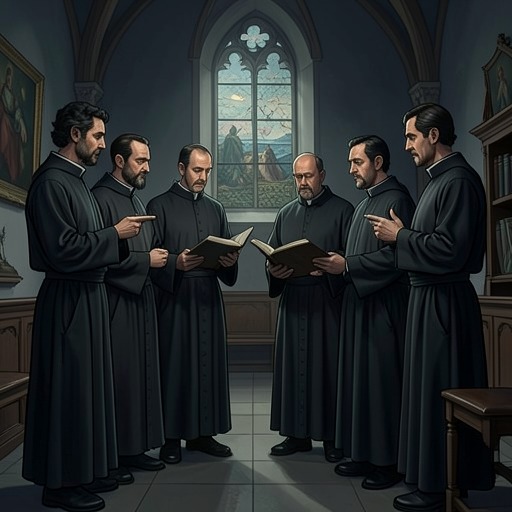
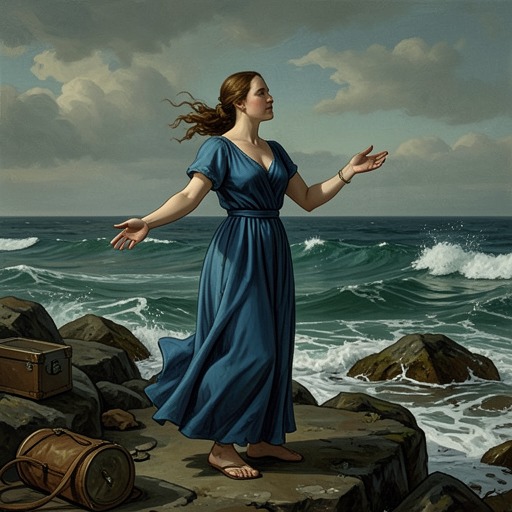
The Moon and the SunThe papal order to erase the sea folk’s history is Pope Innocent’s sweeping command that Yves de la Croix eliminate every record, image, and memory of the sea people. Issued as penance, it seeks not merely to conceal their existence but to remove them from the conscience and inheritance of those who come after. Yves begins the commanded destruction, yet the epilogue shows that the past survives in objects he keeps hidden. The order therefore makes historical memory a contested responsibility: an institution can destroy its public record, but not necessarily every trace or the knowledge held by those charged with erasing it.
Authority and the Demand for Correction
The command takes shape in a reckoning over how the sea people have been treated and represented. Pope Innocent and Yves speak of the past as something requiring correction: the sea people had been tormented as demons and preyed upon as cattle. The Church had also issued a decree raising them from the category of demons to that of beasts. This change in classification did not undo the violence; in the scene, it appears among the records Pope Innocent now orders destroyed. The directive thus reaches beyond suppression of an embarrassing episode. It targets the successive language through which the Church and human authorities have defined the sea people, including an official ruling that had altered their status without securing their history from further abuse.
Pope Innocent assigns the work directly to Yves as penance. The instruction is comprehensive rather than limited to one archive or one account: Yves must search out every mention of the sea monsters. The scale of the task makes the order an exercise of institutional power over what can be transmitted. It addresses not only books and official documents but also the varied materials through which an account can endure, from private correspondence to stories and images. The order’s stated horizon is posterity: its goal is for the sea people’s existence to disappear from public and inherited memory, not simply to silence a present dispute.
The Records Marked for Destruction
Pope Innocent turns the abstract demand into a visible inventory. He takes M. Boursin’s book from the table and throws it down, then scatters letters awaiting reading in the King’s Black Cabinet, including some written in Madame’s distinctive hand. He tears pages from M. de Dangeau’s journal, naming the chronicle of the Carrousel celebrations as another record to be removed. These acts reach across different kinds of testimony: a book, correspondence, and a court journal. Their juxtaposition shows that the history at stake is distributed among official, personal, and narrative forms rather than contained in a single authoritative account.
The order also extends to the broadsheets called Stories of Sherzad, as well as paintings, myths, and memories of the creatures. Pope Innocent includes the Church’s own decree reclassifying the sea people among the materials to erase. The demand therefore encompasses both representation and the history of official representation: it would remove records of the sea people and the record of how the Church had categorized them. Its reach into memory itself distinguishes this command from ordinary destruction of a particular text. The intended result is not a revised public account that acknowledges earlier errors, but the disappearance of the subject from the record and from the capacity to recall it.
Yves Carries Out the Order
Marie-Josèphe de la Croix’s dissection sketches are among the first materials put at risk. Pope Innocent takes pages from the drawing box, crumples one, and sets its edge to a candle. He then gives Yves a roll of vellum bearing an illuminated text. The order thus moves from a spoken assignment to a material document and a visible act of destruction. Yves unrolls the vellum and holds it to the flame, dropping the ashes into an Aztec dish. The careful sequence makes compliance legible: the written command itself is consumed as Yves accepts the task it records.
The work remains unfinished in the narrative, however. Yves is ordered to search for every mention, but the scene shows the destruction of selected materials, not proof that every trace has been found or eliminated. That distinction becomes decisive in the epilogue. Yves’s actions in the chamber demonstrate obedience to Pope Innocent’s command; what he later keeps demonstrates that obedience has not made him an untroubled agent of total erasure. The order assigns him the means of suppressing the history and, at the same time, places him in a position to know what survives beyond the purge.
Secrecy, Preservation, and the Unfinished Record
On Midwinter Night in Paris, Yves returns to his small house, opens a secret door, and enters a library. There he unwraps an illuminated manuscript showing sea people at play in blue waves and golden sunlight, and places it beside Marie-Josèphe de la Croix’s bound opera score, M. Boursin’s cookbook, and Madame’s letters. The library’s contents give the order a concrete aftermath: items resembling the books, letters, and accounts marked for destruction have not all vanished. Instead, they are gathered in a private space, withheld from the public record and retained by the very man charged with erasing them.
Other surviving objects make this hidden archive more than a store of written testimony. A sea monster medal stands with two of Marie-Josèphe de la Croix’s drawings, one of Sherzad and one of the male sea monster; the male creature’s skeleton rests in an ebony reliquary inlaid with mother-of-pearl. These different forms preserve different kinds of evidence—images, commemorative objects, and physical remains—without undoing the public order. The epilogue does not show Yves openly repudiating Pope Innocent or restoring the sea people’s history to circulation. It shows him guarding what remains in secrecy for the present, while leaving open the possibility that this concealment will not last forever.
The order’s central irony lies in its attempt to make historical correction synonymous with forgetting. Pope Innocent calls for the past to be corrected, yet the procedure he commands would destroy the evidence needed to remember the sea people’s treatment and the changing judgments made about them. Yves’s hidden collection preserves that contradiction in material form. The mandate can control which histories are publicly visible, but its final success remains uncertain because the records survive—and because the person assigned to destroy them also becomes their keeper.