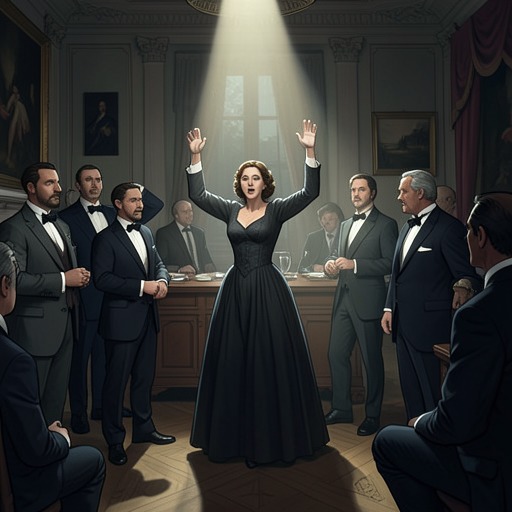
The sea monster’s captivity at Versailles
The Moon and the SunThe sea monster’s captivity at Versailles is a guarded state of confinement in which the creature’s access to the water, privacy, and visibility is controlled by the court. In the Fountain of Apollo, a locked cage and the surrounding guards make her available for royal purposes, while Marie-Josèphe de la Croix’s efforts to approach and protect her expose the difference between keeping a creature alive and respecting her as a being with her own experience.
Confinement in the Fountain of Apollo
At night, Marie-Josèphe enters the tent around the Fountain of Apollo and unlocks the sea monster’s cage. She has shut her lantern so as not to frighten the creature, and she carries small fish in a jug of seawater as supper. The scene establishes the practical terms of captivity: the sea monster is confined behind a lock, while her food and access to the pool depend on human visitors who can enter and leave. Marie-Josèphe can open the cage, but the setting remains a guarded royal enclosure rather than a place the sea monster can choose to leave.
Screens of heavy white silk, decorated with gold sunbursts and fleurs de lys, have been placed between the dissection table and the living sea monster. The screens shield her from the table, yet they do not undo the broader arrangement that brings her into the same tent as the work of dissection. Their royal imagery also locates the scene within the King’s domain: even the attempt to screen the creature from view takes place amid the symbols of Versailles. When Marie-Josèphe calls softly to her and offers supper, ripples cross the pool. The small response does not explain the sea monster’s thoughts, but it gives the encounter a sign of life that the locked cage and the surrounding apparatus might otherwise obscure.
From guarded privacy to public exhibit
The arrangement changes when Louis XIV orders that his subjects be allowed to see the sea monster. Visitors enter the tent through one open side, look at sketches made the previous day, peer through the cage bars, and leave by another opening. The secret-dissection sketches are not among those shown: Marie-Josèphe had left them safely in the chateau. The exhibit therefore has boundaries, but those boundaries serve royal management of what may be seen rather than the sea monster’s privacy. The public receives a controlled view of the captive, while the more sensitive records of the dissection remain protected elsewhere.
The crowd does not make the sea monster appear. The pool lies still, and one visitor proposes shooting at her to bring her out. No shot is described, but the suggestion reveals how easily public curiosity turns into a demand that the captive perform. Marie-Josèphe answers by comparing the crowd around the creature’s bed to a thousand people gathered around a person while she is frightened. Her comparison refuses the visitor’s assumption that the sea monster’s silence is a failure of display. She presents it instead as a response to exposure and intrusion.
Marie-Josèphe’s challenge to the keepers
Marie-Josèphe tells the musketeer that the sea monster is frightened. The musketeer answers that the creature is wild, a classification that supports the guards’ authority to treat her as an animal under royal control. In the same exchange, the musketeer invokes Louis XIV’s youth, when he too had been regarded as wild. The comparison unsettles the category without removing the power behind it: the King’s subjects are permitted to look because Louis XIV has ordered it, and the guards enforce that order even when Marie-Josèphe asks why the visitors have been admitted.
Her resistance is specific rather than absolute. She does not free the sea monster or end the exhibition; she names the fear that the crowd disregards and asks others to imagine the creature’s position. That appeal makes the cage’s meaning harder to reduce to custody of a wild specimen. The sea monster is also someone exposed to the gaze of strangers, unable to choose whether to appear. The text gives no account here of a lasting change in the guards’ policy, so Marie-Josèphe’s intervention should be understood as a challenge within captivity, not its resolution.
The laboratory and the limits of protection
After the visitors have passed through, Marie-Josèphe closes the cage and crosses the plank floor to Yves de la Croix’s laboratory. The guards have moved the screens around it, concealing the shroud and protecting the equipment and samples. Inside, everything remains as Yves left it. Louis XIV had not told Yves that the sea monster would be displayed; he apparently expected the guards to prevent casual curiosity or accidental damage to the laboratory.
This contrast shows how protection is distributed within Versailles. The laboratory receives a barrier against unsupervised access, and its instruments and samples remain in place; the sea monster herself is made available to the public under the King’s order. Marie-Josèphe’s relief at finding Yves’s work intact does not mean the captive has been restored to privacy. Rather, the close of the episode leaves the two forms of treatment side by side: human-made knowledge is carefully secured, while the living subject at the center of that knowledge remains locked in a cage and exposed to visitors. Her captivity is thus maintained not only by bars and guards, but by a court that controls what can be studied, what can be shown, and who is allowed to decide.