The sea woman’s Atlantis story
The Moon and the SunThe sea woman’s Atlantis story is a history sung to visitors who expect a spectacle, and its telling changes the terms of the encounter. Rather than make the sea woman leap or perform on demand, Marie-Josèphe de la Croix offers the crowd a story; the song recalls friendship between the sea people and the people of the land, then the destruction of Atlantis and the loss of those first friends. But the performance is also a test of translation. Marie-Josèphe must turn song and images into words, and the sea woman makes her promise not to leave the story unfinished.
A story offered in place of a spectacle
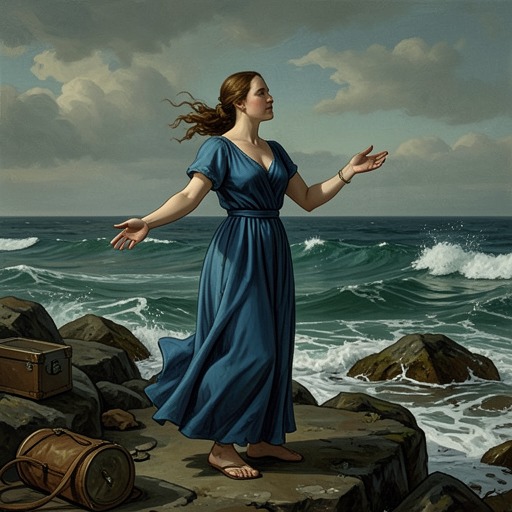
The visitors grow impatient and call for the sea woman to leap, scream, and laugh. Marie-Josèphe instead asks her to sing the story again so the visitors can hear it, then tells them that the sea woman will tell a story. The change is small but consequential: the sea woman is no longer being presented only as a creature expected to obey commands. Her song gives her a history to share, while Marie-Josèphe takes on the role of interpreter before the crowd.
The telling is not a simple recital. The sea woman sings, and Marie-Josèphe describes the images in words she recognizes as inadequate. Her position is therefore divided between witness and mediator: she can make the song accessible to the visitors, but she cannot reproduce its full form or meaning. The visitors hear an account through her voice, while the sea woman retains authority over the song itself. That tension becomes explicit when Marie-Josèphe stops before the story has reached its proper end.
The first meeting with the people of the land
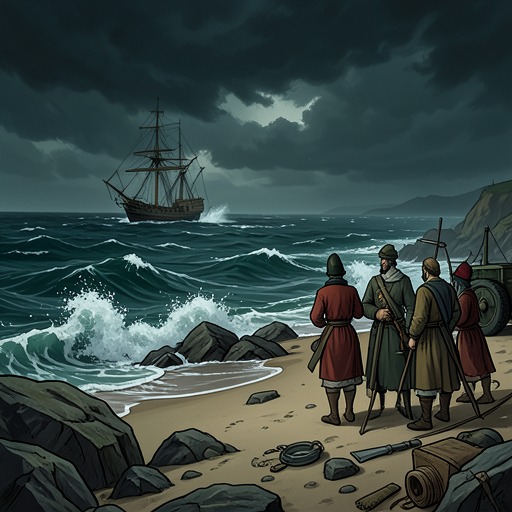
The song begins with the sea people’s first meeting with the people of the land, set four thousand and three hundred years in the past. A ship approaches, and its passengers enter the water to meet the sea people. The newcomers are described as young people, both boys and girls; the two peoples play and sing together. The meeting is presented not as a conquest or a bargain but as a reciprocal encounter between curious strangers.
The sea woman gives that reciprocity its clearest formulation: “We gave them songs, they gave us stories, that cannot be taken, only given. We met as friends.” The exchange makes song and story forms of giving rather than possessions to be seized. The visitors’ present demand for the sea woman to perform stands in contrast to that remembered friendship: in the ancient encounter, the peoples meet and share; in the present, the audience expects an imposed display. The story does not erase that difference, but makes it part of what the visitors are being asked to hear.
The sea people accompany the ship to an island in the Mediterranean, where the newcomers’ city is identified as Atlantis. The account includes a harbor, a palace, and a welcome from the people who live there. In Marie-Josèphe’s translation, the sea people enter the chief city and share pools with the people of the land; shells and flowers pass between them. These details extend the story beyond a single first contact. The sea people are welcomed into a human settlement and take part in an exchange that joins places, customs, and communities.
Atlantis destroyed, and the story interrupted
The song changes as the account reaches the island’s destruction. An immense eruption shakes the ground; ash and falling material overwhelm the city and the sea people’s chariots. The catastrophe ends the meeting and destroys Atlantis. The sea woman’s words turn from the shared life of the two peoples to the search for their friends, whom the sea people never see again. She identifies those friends as the first of her people to perish after meeting the people of the land.
Marie-Josèphe stops there. She tells the visitors that this is all and leaves them at the image of the sea people accepting flowers in the lost city. The audience applauds, treating the account as a completed performance, but the sea woman splashes at Marie-Josèphe and demands an explanation. Their disagreement exposes a difference between an audience’s sense of closure and the teller’s. The visitors have heard a story with an ending they can accept; the sea woman knows that Marie-Josèphe has cut off its last part. Her anger is not over the translation alone, but over the loss of the ending from the account.
The promise to finish
The sea woman makes the condition for any further telling unmistakable: “You must always finish the story.” She repeats the demand and says she will tell no more unless Marie-Josèphe promises. Marie-Josèphe agrees that from then on she will finish the story, no matter what. The promise establishes a responsibility between teller and interpreter. Marie-Josèphe is not merely asked to convey separate images for the visitors; she must carry the account through to its conclusion, even when the material is difficult to present.
The visitors immediately call for another story, but the episode has already altered the meaning of the first one. Its subject is a lost friendship between peoples, while its present form depends on a fragile act of listening across species and language. The sea woman’s insistence gives her control over whether the history continues, and Marie-Josèphe’s promise recognizes that control. The Atlantis account thus does more than supply a past: it establishes that the sea woman possesses a history and sets a rule for how that history must be told.