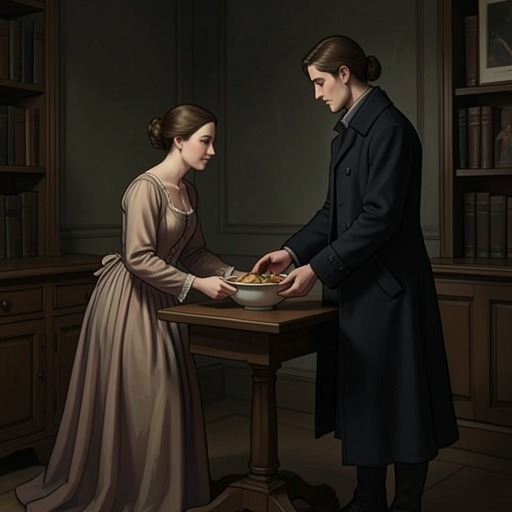
Without boundaries, without limits
The Moon and the Sun“Without boundaries, without limits” is a recurring expression of love between Marie-Josèphe de la Croix and Lucien de Chrétien. It appears in three connected circumstances: Marie-Josèphe’s spontaneous confession after Lucien rejects the idea of saving souls, her written reply to a message from him, and his later explanation of why he loves her. The wording shifts each time, but its central claim remains expansive and reciprocal: their attachment is voiced not as a measured bargain or a duty, but as love that refuses stated limits.
First Confession and Its Immediate Context
The expression first enters the exchange when Marie-Josèphe and Lucien are discussing the effort to save Sherzad’s life and His Majesty’s soul. Lucien identifies himself as an atheist and says that he has no business saving anyone’s soul. Marie-Josèphe laughs, then answers with an avowal that joins repetition to reach: “Lucien, I love you, I love you without limit or boundaries.” The phrase’s first form places “limit” before “boundaries,” and pairs it with an emphatic repetition of “I love you.” The confession follows an exchange about religious belief, but it does not answer Lucien’s atheism with a theological argument. Instead, it turns the moment toward their personal bond.
The context gives the expression a particular contrast. The immediate concern is consequential and outward-facing: Sherzad’s life and the king’s soul. Lucien declines the spiritual responsibility, while Marie-Josèphe’s response is laughter and a declaration of love. The scene therefore does not establish that love resolves either problem. It does show that the discussion of rescue, belief, and obligation opens into an intimate statement that asks for no qualification. The expression marks a change in the conversation, from what they might do for others to what Marie-Josèphe feels for Lucien.
The Message and Written Reply
The language returns in writing when Marie-Josèphe is alone with Haleed. Haleed presses a scrap of paper into her hand; recognizing Lucien’s handwriting, Marie-Josèphe catches her breath. The message reads, “We will see each other soon. I love you. L.” Its brevity makes the words of affection direct, while the promise of seeing each other soon gives the note a forward-looking purpose. The message does not repeat the full expression, but its arrival prompts Marie-Josèphe to formulate her own reply in the language that will recur between them.
Marie-Josèphe asks whether she can send an answer. Haleed says it might be managed and notes that Count Lucien has many agents. Marie-Josèphe then writes, “I love you without boundaries, without limits.” Here the terms exchange order: “boundaries” precedes “limits,” unlike her first spoken declaration. The alteration retains the same paired idea while giving the reply its own phrasing. The words are not merely a recollection of what she said before; they are an answer sent back through an intermediary, after Lucien’s message has reached her.
The note also makes the expression part of an exchange across distance. Lucien’s paper reaches Marie-Josèphe through Haleed, and Haleed arranges for Marie-Josèphe’s reply to be sent onward. The passage specifies the physical objects and actions that carry the affection: handwriting on a scrap, its recognition, a written response, and a page boy sent away with the note. The expression thus recurs not only as speech but as language capable of being preserved and delivered when the lovers are not together.
Lucien’s Reciprocation
In a later encounter, Lucien explains his feelings directly to Marie-Josèphe. He says that it has been too long since his last adventure; when she asks whether that is the only reason, he answers, “The reason is, you let me see your spirit, and I love you. Without boundaries. Without limits.” His statement gives the expression a changed emphasis. The earlier declarations say how far love extends; Lucien’s wording also identifies what draws him to her: she has let him see her spirit. The feeling is linked to her character as he perceives it, rather than offered as an unexplained compliment.
The paired fragments “Without boundaries. Without limits.” echo Marie-Josèphe’s words while breaking the thought into two short assertions. This is a close verbal reply to the expression she has already used, but it is not simply a repetition: Lucien speaks after naming the reason for his love. Across the three appearances, the phrase moves from her impulsive confession, to a written message of devotion, to his explicit reciprocation. Its changing order and punctuation make the recurrence recognizable without making each use identical.
Meaning and Narrative Function
The expression’s significance lies in this pattern of return. Marie-Josèphe first says she loves Lucien without limit or boundaries; she later writes that she loves him without boundaries, without limits; he finally tells her that he loves her “Without boundaries. Without limits.” The shared vocabulary gives their declarations a form of mutual recognition. Marie-Josèphe’s written reply anticipates the terms Lucien will use in person, and his final statement confirms that the language belongs to both of them rather than to her confession alone.
The wording is absolute, but the scenes ground that absoluteness in particular acts of communication. A spontaneous declaration follows laughter; a scrap of paper carries Lucien’s brief message; Haleed helps arrange a reply; and Lucien gives his answer face to face. The expression therefore gathers together speech, writing, and response. Its reach is conveyed by the repeated negation of limits, while its emotional force depends on the specific circumstances in which one person speaks and the other answers. It is not a general doctrine about love in the novel: in the supplied appearances, it is the language through which Marie-Josèphe and Lucien articulate and recognize their attachment.