Women’s silence and intellectual agency
The Moon and the SunWomen’s silence and intellectual agency concerns who is permitted to create knowledge, make art, and speak with authority. Through Marie-Josèphe de la Croix, the novel sets explicit religious and social restrictions against a woman’s demonstrated competence as a musician, observer, and interpreter. Her resistance is neither abstract nor limited to defiance: she claims the right to describe what she sees, to distinguish natural philosophy from alchemy, and to relay another being’s testimony without replacing it with a more acceptable version.
Rules of Silence and Their Effects
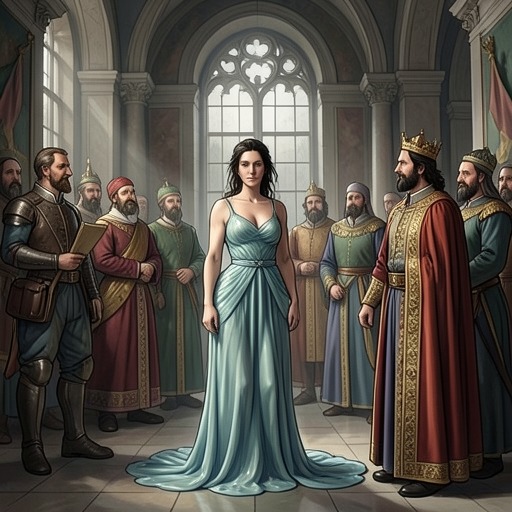
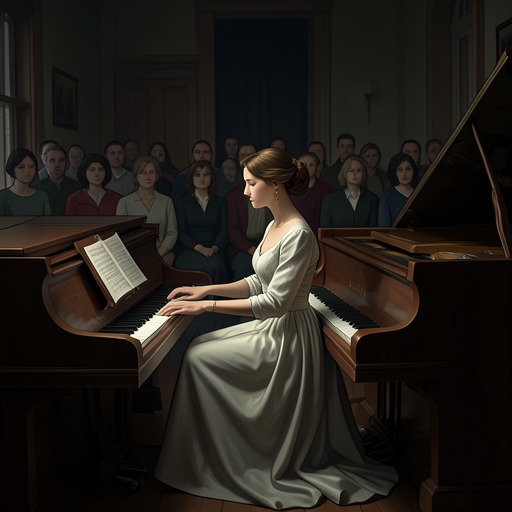
At the court, Pope Innocent treats women’s silence as a rule extending beyond religious practice. When he condemns Marie-Josèphe’s composition as improper, she answers that the rule applies in church. He insists that it applies at all times and calls on the King to censor what he regards as pagan excess. The dispute turns artistic expression into a test of religious authority: for Marie-Josèphe, music is something she can compose and perform; for Pope Innocent, a woman’s music itself violates the expected limits of modesty.
His rebuke reaches beyond the immediate disagreement. Marie-Josèphe recalls the convent, where asking questions brought punishment instead of an explanation. She had believed the sisters’ silence reflected a mistaken understanding of God, rather than the guidance of the Church. Under the Pope’s judgment, she begins to doubt that distinction and wonders whether the convent’s practices were closer to religious truth than she had thought. The passage shows how a prohibition works not only by preventing speech, but also by making a woman question her own right to interpret what she has experienced.
The restriction also appears in the practical allocation of scholarly work. When Yves prepares to continue dissecting a sea monster, he tells his sister that he does not want her help with the parts considered improper for public view and says he will ask the ladies not to attend. He assigns the drawing to Chartres rather than to Marie-Josèphe. She objects that she has drawn animal anatomy for Yves repeatedly and challenges the implication that a woman’s presence or record of the work is unacceptable. Her protest exposes the selectivity of the standard: she has already contributed to the brothers’ investigations, but the public presentation of knowledge is now being organized to exclude her.
Work, Evidence, and Recognition
Marie-Josèphe’s intellectual agency is established through specific work, not merely through her objections. When a speaker mistakes her and Yves’s studies for alchemy, she corrects him: Yves studies natural philosophy, while she studies mathematics. The distinction matters to her because it identifies what she actually does rather than allowing a gendered assumption to define her pursuits. She also sketches the male sea monster during the investigation, attending to its torso and physical structure.
After examining preserved organs in the laboratory, she prepares samples of the kidney, liver, pancreas, and lung, mounts them, and draws them through Yves’s microscope. Her careful work on the anomalous lung lobe lets her compare its texture with ordinary lung tissue; under magnification, she observes that it has overlapping leaves rather than the air sacs she expects. She begins a drawing of the unusual structure. This sequence places her within the practices by which evidence is produced—preparation, observation, comparison, and visual record—even when institutional recognition and access remain unequal.
A public demonstration by the French Academy of Sciences makes the exclusion sharper. Yves presents the dead sea person as a natural creature and dissects an arm before the assembled scholars. Marie-Josèphe documents the work, but Yves discusses the lungs and the creature’s capacity to remain underwater without mentioning the anomalous lobe she has investigated. Her knowledge is therefore not simply a private accomplishment: it bears on the same evidence being presented publicly, while the account of the research leaves out the feature she has carefully examined.
Art, Authority, and Patronage
The dispute over her musical work repeats the same pattern in a different field. M. Coupillet approaches the King’s cantata commission by emphasizing that Marie-Josèphe is both a woman and an amateur, and offers to supervise her so that her work will not offend the King. His intervention casts her learning and artistic labor as presumptuous, even as she has been entrusted with the commission. Marie-Josèphe refuses the insult rather than accepting his supposed assistance as a necessary correction.
Lucien de Barenton, Count de Chrétien, initially acknowledges that many people in France would doubt women’s ability to excel as artists or scholars. He then turns the argument back on the assumption itself, comparing it to the belief that a dwarf could not ride to war. His response gives Marie-Josèphe support without pretending that the prejudice is absent: the obstacle is the judgment imposed on a person, not proof of incapacity. Around the commission, her artistic authorship is contested, but she continues to be treated as its creator rather than simply as an instrument of someone else’s work.
Speaking for Another Without Taking Her Voice
Marie-Josèphe’s role as an interpreter of the sea woman brings the question of agency into contact with the limits of translation. Before presenting the sea woman’s account to Louis XIV and Pope Innocent, she considers whether she could make it sound more diplomatic, then rejects that alteration because it would entangle her in lies and the sea woman could correct her. The moment defines her responsibility as more than simply speaking on another’s behalf: she must resist the pressure to make testimony convenient for its powerful audience.
When the sea woman’s story raises a question about immortality and resurrection, Marie-Josèphe responds in song, expressing the sea woman’s understanding of life, new life, and death. Pope Innocent treats the exchange as a challenge to religious orthodoxy and warns Marie-Josèphe that she approaches heresy. She insists that the account came from the sea woman, who does not understand heresy, and argues that the sea woman could understand God. Her intervention does not remove the conflict over who may define legitimate belief. It does, however, make the sea woman’s account audible within a courtly and religious setting where the speaker herself is otherwise treated as a monster rather than as a person with knowledge.
Across these episodes, the novel connects women’s silence to control over access, authorship, and credibility. Marie-Josèphe is told not to compose freely, is excluded from a dissection, and sees an observation she has pursued omitted from a public account. Yet she keeps drawing, examining, composing, correcting false descriptions of her studies, and conveying the sea woman’s testimony on its own terms. Her agency consists not in escaping every limit, but in continuing to produce and communicate knowledge where the surrounding authorities would prefer her silence.