
Poor Woodcutter’s Wife’s Transformation
The Most Precious of CargoesThis flow traces Poor Woodcutter’s Wife from lonely longing through active motherhood and bereavement to a life rebuilt around her daughter.
increasing Bearing strength in each event
 decreasing
Bearing strength in each eventdecreasingLoneliness in the Forest
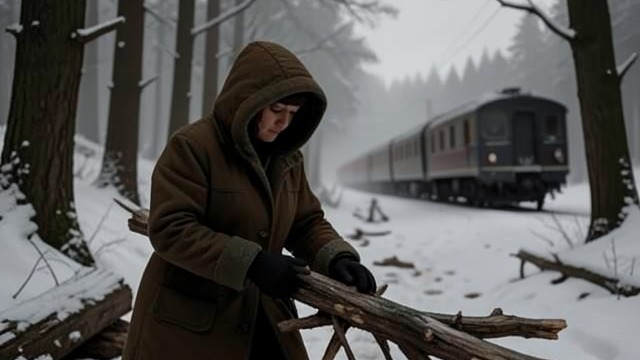
Loneliness in the Forest
Work without fulfillment
Poor Woodcutter’s Wife gathers wood and checks traps while hunger and cold shape each day. She longs for a child, a desire she keeps largely to herself.
Imagination as shelter
She watches the train and invents a hopeful meaning for the cargo it carries. This private expectation gives her something to anticipate in a life defined by labor and deprivation.
The Child She Claims

The Child She Claims
A prayer answered unexpectedly
Poor Woodcutter’s Wife finds a crying baby wrapped in a richly worked shawl. She holds the child close and calls her the beloved child she never had.
Love with an immediate burden
The infant’s hunger turns the miracle into responsibility. The woman has no milk and no secure permission to keep her, yet she begins acting as the child’s mother at once.
A Bargain for Nourishment
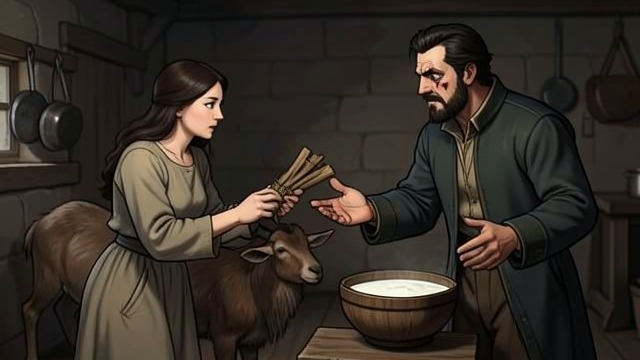
A Bargain for Nourishment
Asking a feared stranger
Poor Woodcutter’s Wife enters the Man with the Goat and Shattered Face’s secluded territory to ask for milk. She admits she has nothing of value but offers to bring firewood.
Maternal persistence
The man agrees to supply goat’s milk and gives instructions for feeding the infant. The woman’s willingness to bargain and labor shows that her new identity as a mother is active, not merely emotional.
Flight and Bereavement

Flight and Bereavement
Loss during escape
Poor Woodcutter’s Wife flees with the girl after Poor Woodcutter fights the informer and armed men. She hears his final words but cannot stay with him.
Continuing as protector
She reaches the forest man and accepts his sanctuary. Grief accompanies her, but her immediate task is to keep the child safe and fed.
A Life Rebuilt in Public
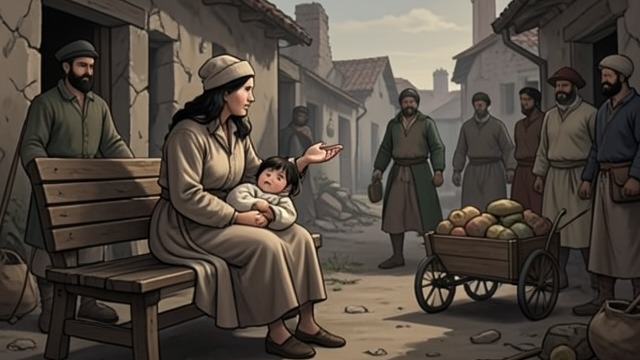
A Life Rebuilt in Public
A household on the move
After the forest man is killed, Poor Woodcutter’s Wife gathers clothes, tools, cheese, and the girl, then walks east. She settles among the ruins and begins selling what she can make.
Motherhood as lasting identity
The girl sits on her lap while customers approach. The woman’s life no longer depends on the forest cabin, but it remains organized around the daughter she chose and protected.
Before the deportation train brings the baby
The day the infant is found
The child’s first day in the grove
After the attack on the cabin
After the war, in the village square
