Father throws the baby from the train
The Most Precious of CargoesThe father’s decision to pass one of his twins through a barred train window is a desperate act of separation undertaken in the hope that one child might survive. As the train moves through a snowbound forest, he chooses neither boy nor girl: he takes the infant nearest him, wraps the child in a Prayer shawl, and sends the baby toward the woman running after the train. The scene makes survival depend on a choice made under pressure, and on the narrow opening between the crowded carriage and the winter landscape beyond.
A crisis on the train
The decision follows mounting fear. Whenever the train stops in a siding, the father worries that it might reverse course, or halt at a station where the dying, children, and old men would be thrown onto the platform. He turns that fear against himself, asking what he can do, but the crowded carriage offers no clear answer. His anxiety is not abstract: the train’s stops make the feared reversal seem possible, while the vulnerable passengers around him give the danger a human scale.
He apologizes as he elbows his way to the barred window. There, an old man struggling to breathe says that he has asthma. The man smiles at the father and looks at him with an expression described as if he had foreseen everything from birth. He does not appear surprised; he needs air. The encounter places the father beside another person whose body is under strain, but it offers no rescue or instruction. The old man’s gaze becomes a silent counterweight to the father’s growing urgency.
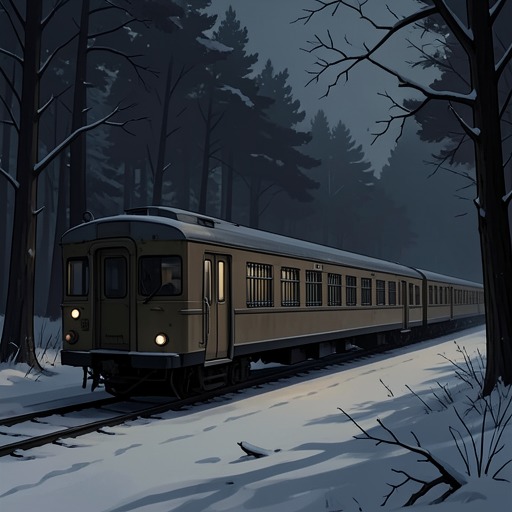
Outside, snowdrifts slow the train. It stops briefly, then judders forward again, its motion likened to the old man’s asthmatic breathing. In that pause, the father understands that an opportunity has opened. The train is still moving, but the forest and the figure outside have come close enough to make a transfer conceivable. The moment is brief: hesitation must give way to action before the train carries the family beyond reach.
Choosing without choosing
The father pushes back through the crowd toward the twins, who are wrapped in a woolen Pyrenean shawl. He recognizes the moral trap in selecting one child over the other. Rather than decide between the boy and the girl, he resolves not to choose and takes the infant nearest him. The gesture does not remove the choice’s consequence; it gives the father only a way to act without ranking the twins by sex or preference.
Dinah looks at him for a moment. Then she closes her eyes and hugs the other twin to herself. The passage does not explain what she understands or what she feels, and her response is conveyed through these small physical actions rather than an account of her thoughts. The two infants are now held separately: the child selected by the father, and the twin Dinah keeps close. That division makes the cost of his decision visible even before the baby reaches the window.
He has already taken out his Prayer shawl. Returning to the window, he unfolds it and sees that the bars are spaced widely enough for an arm to pass through. Beyond them are trees bent beneath the weight of snow and a figure apparently running after the train, calling out. The shawl, first carried in his pocket, becomes the means of protecting and lowering the infant; the bars become both the obstacle he must overcome and the narrow passage through which the child may escape.
The passage through the bars
The father cradles the baby and wraps the infant in the tallith. The old asthmatic watches him with an expression that seems to warn him not to proceed. The father nevertheless acts, thinking that there is not enough milk for two, but perhaps enough for one. The thought frames the act as an attempt to give one child a chance, not as a guarantee of rescue. What he can offer is a transfer out of the carriage; what happens afterward remains beyond his control.
He lifts the shawl-wrapped infant toward the opening and tests whether the head will fit between the bars. The old man tells him in Yiddish not to do it. The father looks at him and pretends not to understand a word of Yiddish, refusing the warning without answering it. The baby’s head passes through, then the shoulders. The physical sequence is exact and perilous: the child must fit through the bars while the train is still carrying the family away through the snow.
Once the infant is through, the father waves to the old woman outside. She stops and falls to her knees in the snow as if giving thanks to heaven. The scene thus shows the woman’s response, but does not narrate the child’s subsequent fate at this moment. The train then roars out of the forest, carrying the father, Dinah, and the twin who remains with her onward.
Separation and significance
The act’s outcome is both decisive and unresolved. One twin has left the train; the other remains in Dinah’s arms. The father has acted on the hope that one child may receive enough milk, but the narrative does not treat that hope as certainty. The woman’s kneeling gesture suggests gratitude at receiving the infant, while the train’s departure immediately widens the distance between the two children and the people who have been caring for them.
The scene’s force comes from the collision of movement and choice. The father cannot stop the train or make the circumstances safe; he can only seize a brief opening created when snow slows it. A shawl, a gap between bars, and an outstretched arm become the instruments of an irreversible decision. The action is neither presented as a simple rescue nor reduced to abandonment: it is an attempt to preserve life under conditions that leave no intact option. The train’s roar closes the moment without resolving what the separation will mean for the family, allowing the child’s passage into the snow to stand as both an act of desperate hope and a lasting rupture.