Foxes
The Most Precious of CargoesFoxes occupy two sharply contrasting forms in the Poor Woodcutter’s Wife’s story: their pelts have been made into boots for her, while living fox cubs later run beside her and help carry her and the infant toward safety. The narration gives the cubs an active role in the escape, presenting them not merely as part of the forest but as its guides.
Pelts and the Winter Journey
In the wintry half-light, the Poor Woodcutter’s Wife hurries through snow to reach the train, stopping to gather branches that the weight of snow and night has broken from trees. Her boots are made from fox cub pelts, turned inside out and fashioned by the Poor Woodcutter. The detail places foxes in her ordinary struggle for survival: their pelts protect her feet as she crosses the snow, while her husband’s handiwork makes the difficult journey possible.
The scene emphasizes physical effort rather than ease. She runs, lifting the fox-cub boots from the snow, and reaches the railway clearing breathless. The train, slowed by the same thick snow that hinders her, pants and inches forward. Here, foxes are present through the material object she wears; the narrative does not establish a connection between those pelts and the living cubs who appear later.
Companions in the Escape
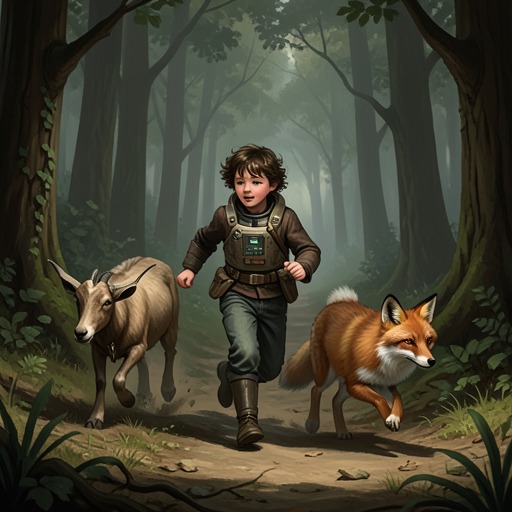
During her flight with the infant, whom she holds close in a shawl, the Poor Woodcutter’s Wife longs to stop and disappear into the ferns and high grasses. The fox cubs stand guard at her feet. The narration stresses their familiarity with running, pursuing, and being pursued, making their movement a form of practiced endurance rather than a sudden, isolated dash.
Their repeated running carries the escape forward. The cubs tear up the ground without fear or reproach, and the narration presents them as knowing the way to safety. When the Poor Woodcutter’s Wife and the infant reach the edge of a part of the wood regarded as impenetrable, the cubs do not slow down. They plunge into the thicket, bounding from root to root and stumbling over dead branches. Their actions bring the fleeing pair across a boundary into dense woodland, where the pursuit’s danger meets a route the cubs appear to know.
Narrative Role
The contrast between the boots and the cubs gives the foxes’ presence a material and an active dimension: first, their pelts are fashioned into protection for a human traveler; later, living cubs accompany and guide a mother and child in flight. The text leaves the relation between these appearances unstated, but both are bound to movement through a hostile winter landscape.
The cubs’ repeated running also shapes the passage’s rhythm. It echoes the Poor Woodcutter’s Wife’s earlier rush toward the train, then becomes part of a collective escape in which she is exhausted and wishes to stop while the animals keep going. Their knowledge of the path turns the forest from an apparent barrier into a possible refuge, making the Foxes crucial to the passage’s movement toward safety.