France
The Most Precious of CargoesFrance is the novel’s landscape of occupation, roundup, and deportation: the country where a family can be seized, interned, and sent away, and where the story’s invented forest lies beside a history made concrete in transport records. The narrative moves between the intimate survival of a persecuted family and the machinery that carries people out of France, while its appendix names actual convoys and deportees. France is therefore not merely a setting but the threshold between a precarious life at home and an imposed, often fatal displacement.
Occupation and Everyday Life
During the war, the conquering army occupies towns, villages, fields, and forests across France. The Poor Woodcutter has been conscripted for public works that benefit the occupying army; from morning until night, his wife searches the woodland, often without finding enough to support their household. The forest’s hunger and cold are part of this larger condition: hardship is not separate from the war but reaches into ordinary life, shaping what the couple can provide and what they fear losing.
The novel places its fairy-tale forest within that occupied country without turning it into a named map location. The woodcutter’s labor and his wife’s daily search establish how occupation presses on people who are not presented as combatants. Their immediate concerns—food, shelter, and family—unfold under the presence of an army that has commandeered labor and control of the land. This contrast between a small household and a power occupying the country gives the setting its political force.
Roundups, Camps, and Deportation
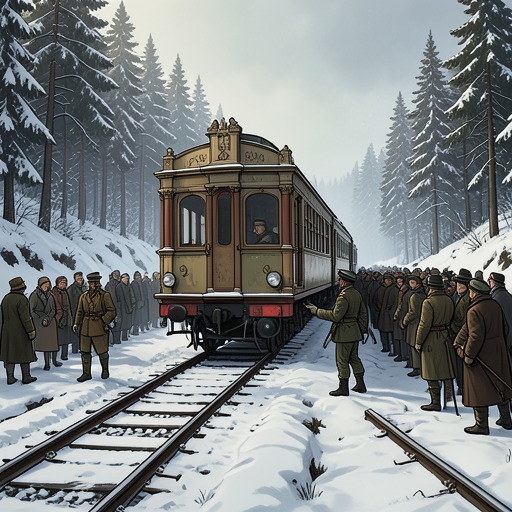
France is also the point of departure for the story’s deportation history. In the narrative, a Jewish family is transported from Pithiviers to Drancy internment camp, where the father and mother have so far avoided separation from their twins, Henri and Rose. That fragile interval ends when they are put aboard a cattle wagon. The father’s fellow travelers describe themselves as stateless former Romanians, picked up in Paris or elsewhere in France; their conversation connects different histories of belonging and dispossession inside the same transport.
The camp offers the father a temporary role and a way to care for his children: after almost completing medical studies, he finds work as a barber because Drancy already has many doctors and patients. He presses the camp administration to protect the twins, who have become, in his words, everyone’s children to save. But the journey out of France strips away the limited security of camp life. The cramped wagon, its unbearable smell, and the children nursing at their mother’s dry breasts make the cost of deportation bodily and immediate, rather than an abstraction of policy or geography.
The story later follows the father’s struggle to return toward the forest and search for his daughter. After reaching a reunification camp, where former victims and former tormentors mingle, he leaves with the small sum provided by the camp authorities. His route takes him toward railway lines and forests, but the text does not identify those places as France. That distinction matters: France is central to the roundup and departure, while the search and the family’s later encounters belong to a wider landscape of displacement. The father’s movement between places cannot restore the home or family that deportation has broken.
The Historical Record
The appendix anchors the imagined narrative in records of deportations from France. Convoy 45 left Drancy on November 11, 1942, carrying 778 men, women, and children, many elderly or infirm. Among them was a blind man, Naphtali Grumberg, the author’s grandfather. The appendix gives the convoy’s aftermath in starkly compressed form: two survivors in 1945. The figure turns the transport from a departure date and passenger count into a measure of near-total loss.
Convoy 49 left Drancy on March 2, 1943, with 1,000 Jews aboard, including Zacharie Grumberg, the author’s father, and Sylvia Menkès. Sylvia had been born on March 4, 1942, and was gassed on March 4, 1943, the anniversary of her birth. The exact dates make the calendar itself register the violence: a first birthday coincides with death. These particulars do not simply illustrate the fictional story; they locate its emotional premise within identifiable people and transports leaving France.
A further entry records Abraham and Chaja Wiesenfeld and their twin girls, Fernande and Jeannine, born in Paris on November 9, 1943. They were deported from Drancy on Convoy 64 on December 7, only twenty-eight days after their birth. The children’s brief time in France is measured through birthplace, departure date, and age, making the country both the site of their arrival into the world and the place from which they were taken.
Narrative Significance
The novel places France at the junction of fairy tale and documentary history. In the story, the forest shelters a child and offers the Poor Woodcutter’s Wife the chance to love and raise her; in the historical frame, France is crossed by roundups and transport systems that deny families the power to choose where they go or remain together. The contrast does not make the fictional refuge a substitute for the historical record. Instead, the appendix’s names, dates, and numbers preserve the difference between an invented child and actual deportees while showing why the story’s imagined act of rescue carries such weight.
France’s significance also lies in the way its boundaries fail to guarantee safety or belonging. The family’s movement from Pithiviers to Drancy, and the travelers’ accounts of being seized in Paris or elsewhere in the country, reveal a national landscape reorganized by internment and forced departure. The father’s later search cannot undo that rupture. France remains the place from which the journey began, while the story’s intertwining of a forest fable with records of convoys insists that the consequences of leaving it were not shared evenly and were often irreversible.