German occupation of France during World War II
The Most Precious of CargoesGerman occupation of France during World War II is rendered through the pressures it places on ordinary lives and the administrative machinery that carries people away. The occupation brings forced labor into the forest, lays a railway through it, and connects a poor household’s daily routine to the deportation of Jewish families. Later, the father of Henri and Rose survives by shaving prisoners’ heads, while the trains and the labor organized around them continue until the transports stop.
Occupation and the Forest
The war changes the forest from a secluded setting into occupied territory and a route of transport. The Poor Woodcutter has been conscripted for public works that benefit the conquering army occupying towns, villages, fields, and forests. From morning until evening, the Poor Woodcutter’s Wife searches the woodland for fuel and checks the traps her husband sets before leaving for work. Her effort is shaped by constant hunger and cold, conditions that the narrative places alongside the war’s broader violence.
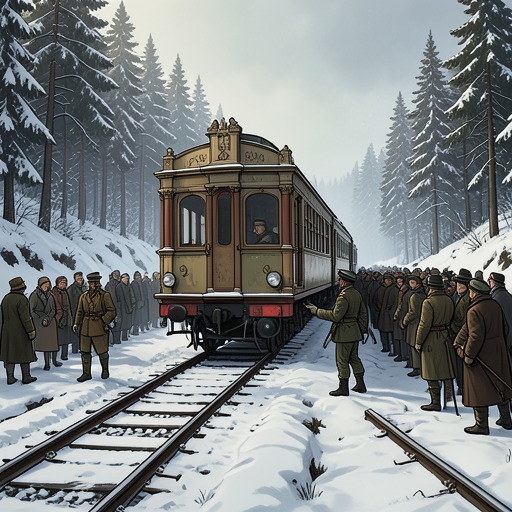
At the war’s outbreak, forced laborers and powerful machines cut through the forest and laid railway tracks in the resulting opening. A single train then travels along the line in winter and summer. The Poor Woodcutter’s Wife watches it pass and gradually arranges her daily routine around its appearances. To her, the train suggests the possibility of escape from isolation and want; her husband dismisses it as a cargo train. That description proves accurate in a devastating sense: the railway brings the household into the orbit of a system transporting people as cargo.
The occupation also frames the Poor Woodcutter’s Wife’s longing for a child. With her husband away at forced labor, she gathers wood and lives with hunger, while secretly grieving that she has no child to love. She prays to heaven, the gods, the wind, rain, trees, and sun for a child, then recognizes that her hopes are being denied. The war’s material deprivation and her private yearning are not separate strands: they meet when the passing train delivers the child she adopts.
Deportation and Separation
The railway’s other passengers are revealed through the account of Henri and Rose’s family. Transported from Pithiviers to Drancy internment camp, the family has so far avoided separation, and the father believes the twins helped them remain together. Henri and Rose were born in spring 1942, during a period when their Jewish identity made their existence dangerous. Their family spends Christmas 1942 together in Drancy, but that brief interval does not protect them from the deportation system.
The father has nearly completed medical studies in ear, nose, and throat surgery. Because Drancy already has many doctors and patients, the camp’s Jewish administration gives him work as a barber after two camp hairdressers leave. He draws on his observation of his father’s work with scissors and becomes skilled enough to be mistaken for a trained barber. For as long as the French National Gendarmerie guards the prisoners, he cuts hair. The transformation of a nearly trained physician into a camp barber shows how the occupation’s institutions redirect skill and labor to serve the needs of imprisonment.
Convoy 49 left Bobigny-Gare, near Drancy, on March 2, 1943, and arrived at its destination on March 6. Its passengers included people of different ages and conditions, their relatives, and people connected through their work and religious communities. After arrival, qualified doctors conducted a selection in which only 10 percent of the group—about one hundred people out of a thousand—were retained. The rest were killed. The account’s official-sounding language of cargo, delivery, selection, and rejection exposes how administrative classification and professional roles are made part of mass violence.
Labor, Survival, and the End of the Trains
The father’s work as a barber continues within a larger system of forced processing. Using shears because he has no scissors, he shaves thousands of heads arriving on trains from occupied countries. The labor does not make him secure: the account describes him as surviving against his will, held temporarily by the work and by the possibility that he might yet endure. Over time, he gathers the blond, dark, and red hair into bales. The hair is shipped to the land of the conquering generals to be made into wigs, finery, upholstery, or floor cloths. Human beings are reduced first to a transport load, then to a labor requirement, and finally to materials sorted and sent away.
As the trains continue, prisoners’ cries and the sounds of families being separated go unheard. Then the trains cease running, and the supply of shaven heads ends with them. The father, now no longer a shaver, collapses from starvation, sickness, and despair. The Death’s Heads force surviving prisoners to dig trenches in the snow and burn the bodies accumulated around the crematoria, while also destroying facilities and evidence of the crime. Hair already packed for shipment is left behind beside spectacles and piles of clothing. The interruption of transport does not immediately end the violence; instead, the system turns to concealing what it has done.
The prisoners hear that the Reds are advancing and that distant cannon fire signals the approaching end of the war. The narrative thus links the trains’ cessation to a military reversal, but it does not present liberation as an uncomplicated or immediate release. The father remains gravely ill, haunted by the memory of separating one of his children from his wife and throwing the child from the train. Two fellow prisoners drag him into a nearby shack so that he will not be burned while still alive. His survival depends, at this moment, on the actions of others, just as the novel’s other acts of survival depend on human choices amid a system organized to deny them.
Narrative Significance
The occupation is depicted not as distant political background but as a structure that reaches into domestic routines, work, family bonds, and the use of human remains. The railway first appears to the Poor Woodcutter’s Wife as a possible route out of loneliness; its actual role is to carry deportees and to connect her forest to the machinery of persecution. The contrast makes the train both a recurring object of hope and an instrument of organized violence.
The narrative’s attention to labor and procedure gives the occupation a particular shape. Forced workers build the track; camp authorities assign the father barbering work; selectors sort arrivals; prisoners are made to dispose of bodies and evidence. These tasks are distinct, but together they reveal a chain in which transportation, classification, labor, and disposal reinforce one another. Against that chain, the novel sets acts of care: the Poor Woodcutter’s Wife feeds and shelters a child, and fellow prisoners keep the father from being thrown into the flames. The occupation’s power is immense, but the story locates the remaining possibility of life in human actions rather than in the institutions that claim to manage it.