Goats
The Most Precious of CargoesGoats make survival tangible in the story: their milk keeps the abandoned child alive, while their companionship helps transform an exchange of necessities into a chosen family. The adult nanny goat first appears as the answer to the Poor Woodcutter’s Wife’s urgent need for milk; later, a young goat becomes the child’s wet nurse and playmate. After the death of the Man with the Goat and Shattered Face, a goat travels with the mother and daughter, and its milk supplies the cheese that leads the father to recognize his child.
Milk and the Child’s Survival
When the Poor Woodcutter’s Wife ventures into the dangerous part of the forest, the child is failing to thrive. Kasha porridge has been rejected, and the woman fears the baby cannot survive without milk. Her first concern is whether the nanny goat is still alive and still producing milk. The animal’s presence is uncertain, but the possibility of its milk gives her a reason to enter the grove and seek help.
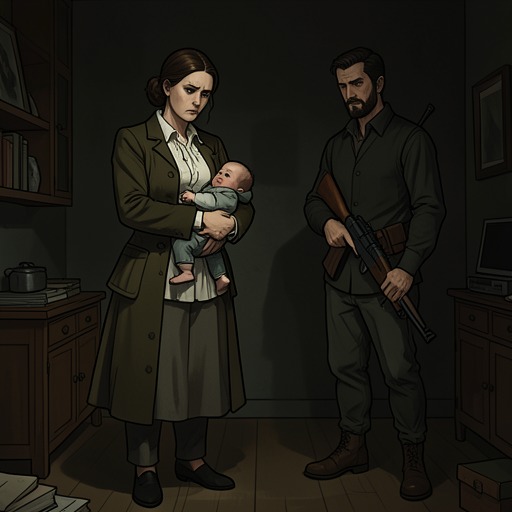
The Man with the Goat and Shattered Face appears carrying a rifle and wearing a czapka. When he asks where she expects him to find milk, the Poor Woodcutter’s Wife answers that it must come from his nanny goat. She offers firewood in exchange: first a bundle for two mouthfuls, then two bundles each day for a small cup of warm milk. The proposed bargain is not simply a trade between strangers. She is offering work for food that the child needs immediately, while the man points out that the wood she means to bring is not his to sell.
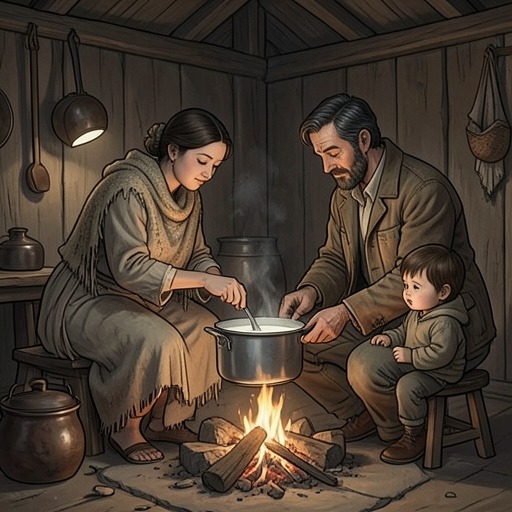
He agrees to provide milk and explains the conditions of feeding the infant. Milk from a jenny would be preferable, but he has none; for the next three months, the goat’s milk must be diluted with boiled water at a ratio of two measures of water to one of milk. He advises supplementing it with porridge, then fruits and vegetables when spring comes. His instructions set out care as practical, sustained labor rather than a single rescue. The child’s survival depends on what the animal can provide and on the feeding routine the humans maintain around it.
From Payment to Companionship
Every morning, the Poor Woodcutter’s Wife brings a bundle of firewood and receives a warm cupful of milk. The regularity matters: the arrangement continues through the seasons, and the child endures, though hunger never fully releases her. She sucks whatever she can put in her mouth and, once restored to health, cries without restraint. The milk saves her, but it does not erase the privation that has shaped her earliest life.
Later, the Man with the Goat and Shattered Face leads the mother and child beyond the place where the daily milk and firewood had been exchanged. They reach a clearing and a garden, then a grotto beside his cabin. There he sets the child before a diminutive goat with swollen udders. The two are the same height. He presents the animal as her wet nurse and third mother, giving the practical bond of feeding a place within the child’s family story.
The child hugs the goat, which settles into her arms; then goat and girl press their foreheads together and gaze into one another’s eyes. The scene gives the animal more than a place in a supply chain. Its closeness to the child is shown through shared bodily gestures, while the Man with the Goat and Shattered Face explains the arrangement as a gain for both: the girl will have all the milk she needs, and his lonesome goat will gain a playmate. The new abundance comes with a small loss for him, who gives up the firewood he had received, making care a relationship of mutual benefit rather than a one-way gift.
A Living Bond After Loss
When the Man with the Goat and Shattered Face is found dead, the Poor Woodcutter’s Wife mourns him, the child weeps, and even the tender-eyed goat weeps. The response places the animal within the household’s grief, not at its edge. The woman covers the man’s body with blossoming branches and prepares to leave; she no longer trusts the gods of the train, and credits the child’s survival to the hand that dropped her from the train and to the man who provided the goat’s milk.
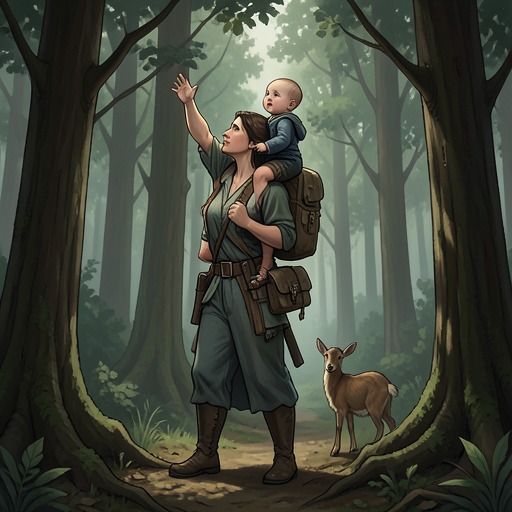
The Poor Woodcutter’s Wife wraps a few old clothes, freshly made cheese, and the cheese-making tools in the Prayer shawl. She takes her daughter by the hand and leads the goat like a pack animal as they set off east, without knowing their destination. The goat is at once a companion and a source of practical support. When the woman settles among the ruins of a village, she lays out the cheeses for customers while her daughter sits on her lap and the little goat grazes nearby. Their life after the forest is precarious, but the animal remains part of the unit that allows them to continue.
Milk, Cheese, and Recognition
The goat’s milk carries the story’s chain of care beyond the forest. Years later, the child’s father encounters the cheeses displayed on the Prayer shawl and recognizes the unusual cloth. The child gestures toward the goat beside her, indicating that the cheeses were made from its milk. He does not understand the language being spoken, but he understands what the milk and the animal mean: the daughter he believed lost survived and has been raised within another family.
The goat does not know or announce the history that the father reconstructs. Its presence nevertheless makes recognition possible: the milk that once sustained the infant has become cheese for sale, and the animal beside the child links that public transaction to the private act of rescue. The father sees his daughter alive and happy with the Poor Woodcutter’s Wife, but chooses not to reveal himself. The goat thus remains part of the child’s ongoing life, while also standing at the point where the father’s past and her present meet.
Narrative Significance
The story gives Goats a material role in human survival without reducing their meaning to utility. Milk, firewood, and cheese are concrete necessities, and each appears in a specific exchange or stage of the family’s life. At the same time, the young goat’s closeness with the child and its grief at the man’s death place it within a network of attachment. The animal is not merely a symbol of kindness: its milk has consequences, its companionship is described as a benefit to the goat itself, and its continued presence accompanies the mother and daughter through displacement.
This double role sharpens the story’s account of chosen kinship. Care moves across species and takes practical form—feeding, carrying, grazing, and sharing a home—before it becomes visible as family. The goat’s milk first answers an emergency; later, the goat and the cheese made from its milk preserve the continuity of a life that war had nearly erased. Through that continuity, an animal’s ordinary presence helps connect rescue, survival, mourning, and recognition.