Gods of the Train and Providence
The Most Precious of CargoesGods of the Train and Providence names a changing explanation for need, chance, and survival in the story of Poor Woodcutter’s Wife and the baby delivered from a passing train. At first, she imagines the train as a power that might answer her prayers and relieve her hunger; when it sends her a child, she understands the gift as divine, even though it cannot meet the child’s most urgent need. The story tests that belief against material facts: a hungry baby needs milk, and it is the sustained care of people and animals, not the train’s supposed gods, that keeps her alive. In the end, Poor Woodcutter’s Wife revises her account of providence, blessing the human hand that released the baby and the wounded man who helped raise her.
Prayer and the Promise of Cargo
Poor Woodcutter’s Wife’s belief in providence begins in deprivation. While Poor Woodcutter gives thanks for their childless life, she grieves privately that she has no child to love. She prays not only to heaven but to the gods, wind, rain, trees, and sun, asking for a child; as years pass without an answer, she comes to feel that the powers of heaven and earth are conspiring with her husband to deny her one. Her prayers then turn toward relief from the hunger and cold that occupy every day. The story establishes her religious longing alongside bodily need: what she asks for is hope, but also food, warmth, and an end to suffering.
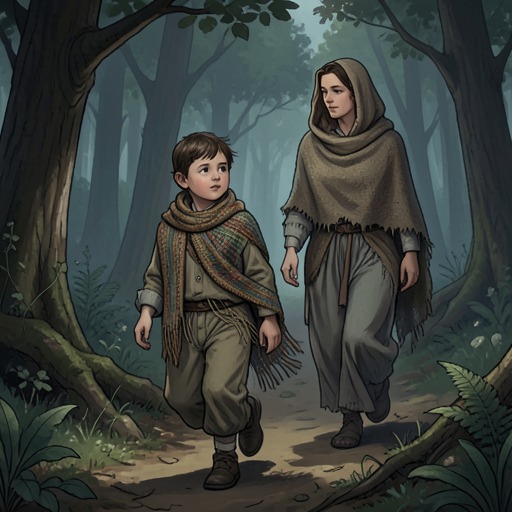
The train becomes the object onto which these wishes gather. Poor Woodcutter’s Wife arranges her daily routine around its passage and, having never seen another train, accepts Poor Woodcutter’s contemptuous description of it as a cargo train. The word cargo warms and animates her imagination. She pictures food, clothes, and marvelous objects inside its timber wagons, and imagines taking what she needs. Her fantasy grows into hope that the train might pity her hunger and drop some of its precious contents. She calls out and waves; sometimes hands answer from the barred windows, and sometimes one throws her something. Those scraps encourage her to read the train not merely as a passing vehicle but as a presence capable of response.
The Gift and Its Unanswered Need
That expectation changes when Convoy 49 passes. Poor Woodcutter’s Wife calls for it to wait, and a hand at a narrow window lowers a flag and drops a package into the snow, then emphatically signals that the parcel is for her. The gesture seems to fulfill the hopes she has attached to the train: she falls to her knees, clasps her hands to her breast, and receives the package as an answer to prayers that had seemed ignored. Inside is not food or clothing but a baby. The child does not behave like an idealized sacred image; hungry and desperate, it struggles, screams, and flails. The miraculous-seeming gift arrives already demanding care.
Poor Woodcutter’s Wife wraps the baby in her scarves and presses her to her breast, discovering at once that she is a mother and that she has no milk. The contrast is central to the story’s treatment of providence: the delivery gives her the child she longed for, but does not give her the means to keep the child alive. At home she lights a fire, boils water, and searches for food. She tries kasha, first as porridge and then on her finger, but the baby spits out the bitter food. Cooking water eases the child’s thirst, while the kasha partly staves off hunger. As the baby calms, Poor Woodcutter’s Wife sings a lullaby calling her little cargo and her own child. The prayer shawl that wrapped the parcel, with its gold and silver embroidery, looks to her like rich divine packaging; its beauty sustains the sense of a sacred gift, but does not solve the need for milk.
Human Care as Providence
The distinction between receiving a child and sustaining one becomes explicit when Poor Woodcutter’s Wife seeks help from the Man with the Goat and Shattered Face. She knows her daughter cannot survive without milk and carries her into the dangerous grove where the solitary man lives. When he asks why she believes the child was entrusted to her, she answers that the god of the cargo train gave her the baby. His response exposes the gap in that explanation: the train’s supposed god has given her no milk. She insists that the child will die without it and offers to come every day with firewood in exchange for two mouthfuls of milk. Her proposal turns a divine claim into a practical obligation and a concrete exchange.
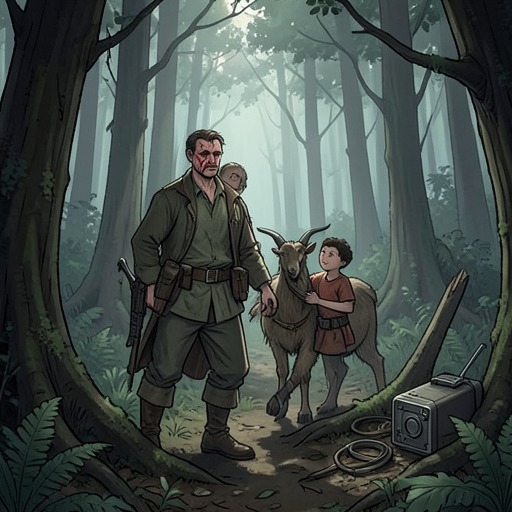
The Man with the Goat and Shattered Face eventually agrees to help. He explains that goat’s milk must be diluted with boiled water for the next three months, advises supplementing it with porridge and later fruits and vegetables, and points out that milk from a jenny would be preferable, though he has none. His answer is not a miracle but specific, continuing care. When Poor Woodcutter’s Wife tries to kiss his hand in gratitude, he recoils and orders her to stand. He also insists that she must not praise him as a good man or reveal that he gives away milk. Yet each morning she brings a bundle of firewood and receives a warm cup of milk. The repeated exchange makes the baby’s survival dependent on labor and resources: the child remains hungry, but the milk and food allow her to endure.
Poor Woodcutter’s Wife continues to describe the child as entrusted by the train’s god, and uses that belief to urge the man to help, arguing that the gods will be grateful and protect him. The man’s damaged body offers no reassurance that protection has been granted: he reveals a battered forehead, crushed temple, and missing ear. His refusal to trust divine reward does not prevent him from feeding the child. The story thus separates belief from action. Poor Woodcutter’s Wife’s faith helps her insist on the child’s worth, while the man’s contribution arises as a daily, material commitment, not confidence that supernatural powers will repay him.
Loss and the Revision of Belief
The scene of the hidden garden briefly gives Poor Woodcutter’s Wife a way to reconcile the world’s beauty with its suffering. The Man with the Goat and Shattered Face carries her precious cargo with a gentleness suited to a sacred object, and leads mother and child into a garden she has never seen. In late spring and early summer, fruit seems to reach toward the child and flowers offer themselves to be picked. Poor Woodcutter’s Wife imagines that the gods are just beyond the forest and capable of doing good when they choose. The garden does not undo the struggle that preceded it; rather, its apparent abundance offers a moment in which divine goodness seems imaginable alongside the man’s practical protection.
That interpretation is shattered when the Reds kill the Man with the Goat and Shattered Face. They enter the forest, shoot him, and leave after one dismisses him as an ugly old man. The following morning, Poor Woodcutter’s Wife discovers his body. She weeps, and the child and the goat weep too. She covers him with blossoming branches instead of burying him, and makes a prayer asking that he find among the gods the peace and happiness denied him on earth. But she does not mention the gods of the train: she no longer trusts them. Her prayer still reaches toward divine welcome, yet it cannot restore the person whose care had made her daughter’s survival possible.
Poor Woodcutter’s Wife then identifies what, in her judgment, actually saved the child. The baby survived not thanks to the train’s gods but thanks to the hand that dropped her into the snow and the righteousness of the man with the rifle and the goat. That distinction does not erase the original gift or prove what the unknown hand intended; it relocates providence from the train’s imagined supernatural agency to particular acts and their consequences. The train delivered the baby, but the milk, labor, food, and protection that sustained her came from elsewhere. After the man’s death, Poor Woodcutter’s Wife gathers old clothes, cheese, and cheese-making tools, wraps them in the prayer shawl, takes her daughter by the hand, and leads the goat east. Her changed faith is carried forward in the objects and living responsibilities she can take with her: she gives thanks for human help, while no longer entrusting her hope to the train.