Hunger
The Most Precious of CargoesHunger is both a bodily condition and a force that organizes the novel’s world. In the forest it wears down the Poor Woodcutter’s Wife through poverty and exhausting work; in the rescued infant it becomes an immediate demand for milk; in the deportation system it belongs to a broader landscape of starvation and mass death. Against hunger’s relentless recurrence, the story sets acts of care that do not end deprivation everywhere but make survival possible for particular lives.
Hunger in the Forest
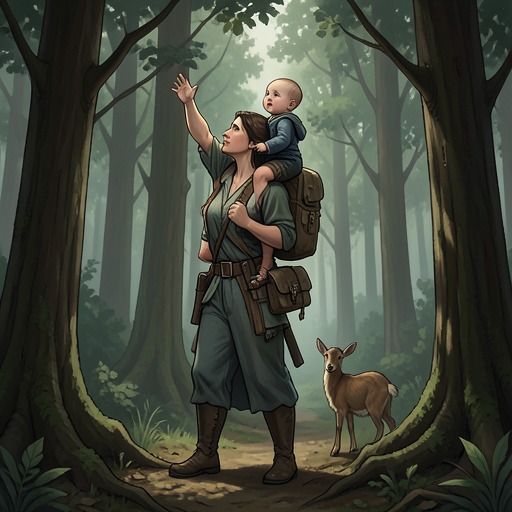
The forest is introduced as a place ruled by “a great hunger and a great cold.” Cold ebbs when summer heat arrives, but hunger remains constant, sharpened by the war raging around the woods. The Poor Woodcutter has been conscripted for public works serving the conquering army, while the Poor Woodcutter’s Wife spends her days roaming the forest in the uncertain hope of finding enough to sustain the family. Their different circumstances do not free either of them from scarcity: he rises before dawn for military construction, and she gathers twigs and deadwood, collects the traps he has set, and tries to make their meager resources last.
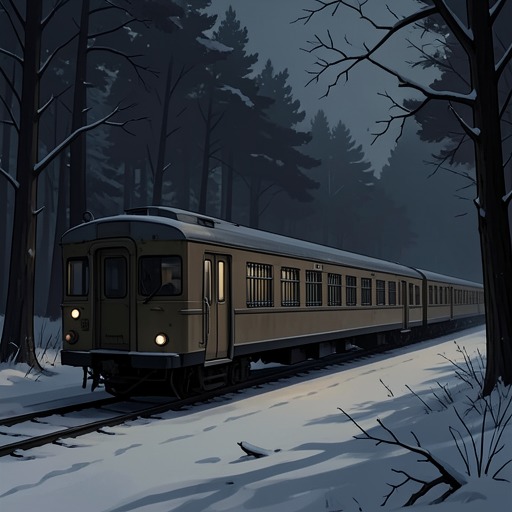
Her hunger is not described as a brief crisis but as the ordinary measure of her days. It gnaws at her while she gathers wood, and she longs for even one day when she might eat her fill. The contrast between the lush forest and her deprivation is pointed: the woods stretch away, leafy and apparently abundant, yet provide no reliable escape from want. Meanwhile, the landscape itself has been cut through by railway construction. Forced laborers and powerful machines have opened a wound in the forest and laid tracks across it, bringing a train that the Poor Woodcutter’s Wife watches as if it might carry her away from hunger, cold, and loneliness. The train is at once a possible route out of deprivation and the means by which another, more lethal deprivation enters her life.
A Longing Beyond Food
For the Poor Woodcutter’s Wife, hunger exists beside another absence. She has no child to feed, but she also has no child to love, and she prays for a child as well as for relief from hunger and cold. Her appeals go to heaven, the gods, the wind, the rain, the trees, and the sun. As the years pass, she comes to feel that every power she has entreated is conspiring with her husband to deny her a child. Her prayers for food and warmth are therefore part of a wider plea for a life that might contain more than endurance.
The narration keeps the material need concrete: she hoards each twig and sliver of deadwood as though it were recovered treasure, even as her belly aches and her thoughts are overtaken by yearnings she can no longer put into words. The repeated labor does not promise plenty. It is a cycle of searching, gathering, and hoping that the next effort will bring enough. This slow pressure gives hunger its force in the story: it is not confined to a single dramatic shortage, but accumulates through seasons, work, and repeated disappointment.
The Infant’s Need for Milk
When the Poor Woodcutter’s Wife finds the baby in the snow, the fulfillment of her longing immediately brings a new emergency. She presses the hungry child to her breast, but she has no milk. The infant’s mouth searches, then the child cries and struggles again; the wife is at once overjoyed to be a mother and terrified that she cannot keep her daughter alive. The child’s hunger turns the gift she has received into a responsibility that cannot be answered by wonder or prayer alone.
Back in the cabin, she tries what she has. She heats water, finds kasha, presses a finger to the baby’s mouth, and attempts to feed the child buckwheat porridge. The infant sucks at her finger, rejects the bitter kasha, and continues to cry. The Poor Woodcutter’s Wife then offers cooking water and tries again. Little by little, the water eases the child’s thirst and the kasha staves off some of her hunger; the immediate crisis lessens, though the baby’s need for milk remains. The lullaby she sings calls the infant her little cargo and her own child, binding the train’s anonymous delivery to a new relation of care.
The next day, the insufficiency of porridge becomes urgent again. The baby spits it up, and her head nods weakly beneath the shawl in which she has been wrapped. The Poor Woodcutter’s Wife understands that without milk the child cannot survive. She carries her into the dark grove, where she hopes the goat still lives and still gives milk, and appeals to the powers of the forest for help. Her plea to the Man with the Goat and Shattered Face makes the stakes explicit: if the child does not get milk that day, she will die. In the story’s movement from prayer to practical dependence, a hungry child’s survival rests not on supernatural assurance but on another person’s willingness to help feed her.
Deprivation in the Deportation System
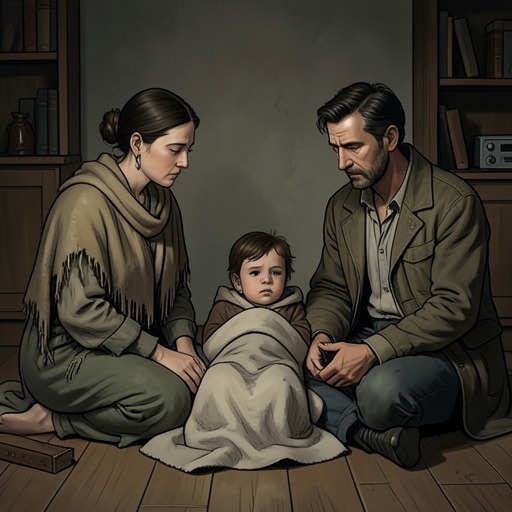
The forest’s hunger unfolds alongside a distinct, organized violence beyond it. The father of the twins Henri and Rose is deported from Pithiviers to the Drancy internment camp with his family. There, although he had nearly completed medical studies in eye, ear, nose, and throat surgery, he finds work as a barber because the camp already has many doctors and needs hairdressers. His skill keeps him occupied while French gendarmes guard the camp, but the work takes place inside a system that reduces people to cargo and processes them for deportation.
Convoy 49 leaves Bobigny-Gare near Drancy on March 2, 1943, and reaches its destination on March 6. At arrival, the deportees are subjected to selection by doctors; only ten percent are retained, while the others, including children, the elderly, the sick, and the infirm, are sent to their deaths. The novel’s account of hunger sits within this machinery of classification and disposal: people are transported, examined, and divided according to a procedure that determines who may continue living and who will disappear. Meanwhile, the father’s barbering produces bales of blond, dark, and red hair, shipped away to be made into wigs, finery, upholstery, or floor cloths. Human beings are made to labor even as the system strips them of protection and treats the remains of their bodies as material.
As the trains cease to run, the father, by then a former barber and the father of separated twins, collapses from starvation, sickness, and despair. The sequence makes hunger one part of a compounded assault: the surviving prisoners are weakened by deprivation while the Death’s Heads force them to dig trenches and burn the piled corpses, destroying evidence of the crime. Hair already packed for shipment lies abandoned beside spectacles and heaps of clothing. The cessation of transport does not immediately bring relief; the people left behind remain hungry, ill, and compelled to work among the dead.
Care, Survival, and the Limits of Relief
The novel does not suggest that hunger is overcome by prayer or by a single act of kindness. The Poor Woodcutter’s Wife’s appeals to the gods accompany the effort to find food, but the child survives through material care: the cooking water and kasha that quiet her at first, and the milk sought from the goat. After the Man with the Goat and Shattered Face is killed, the Poor Woodcutter’s Wife recognizes that her daughter’s survival was not secured by the gods of the train. She credits the hand that dropped the baby into the snow and the man who helped protect and feed her. Her gratitude is directed toward human action, even as the loss of the man who aided them shows how precarious such protection is.
The closing movement preserves that precariousness rather than offering a general cure. The Poor Woodcutter’s Wife leaves the forest with her daughter and the goat, carrying clothes, cheese, and the tools for making it wrapped in the prayer shawl. She walks east through ruined villages and settles among the remnants of a village square, laying out the surviving cheese for customers while her daughter sits on her lap and the goat grazes nearby. Hunger has not vanished from the world, but the family now has a means of subsistence and the child is no longer alone in her need. Across the novel, hunger exposes the distance between abundance and access, between a prayer for life and the practical acts that sustain it.