Hunters of the Heartless
The Most Precious of CargoesThe Hunters of the Heartless are the feared agents of a system that marks certain people as enemies and makes their persecution seem righteous. The book gives them no individual biographies or formal organization chart; instead, their power appears in the threats people fear, the songs workers repeat, and the informer who brings armed men to the Poor Woodcutter’s cabin. Their name belongs to the story’s allegorical language, but their consequences are concrete: the Poor Woodcutter’s Wife and her adopted daughter live under the danger of betrayal, and the Poor Woodcutter dies defending them.
Identity and Reach
The Hunters of the Heartless are presented as part of the occupying power’s network of masters, invaders, and collaborators. The Poor Woodcutter’s Wife fears that other woodcutters will betray her to them if they discover the child in her home. Her fear gives the hunters an influence beyond any scene in which they appear directly: people anticipate their response and consider concealment a matter of life and death.
The forest itself is an uneasy refuge. Its secluded grove is difficult to enter, feared by local people, and associated with a solitary man who is also dreaded by the Boches and their conscripts. Yet remoteness cannot guarantee safety. The hunters’ reach is evident not because the book describes them conducting a search through the woods, but because the possibility of their pursuit shapes the family’s choices and the threat facing anyone who shelters the child.
Propaganda and the Making of an Enemy
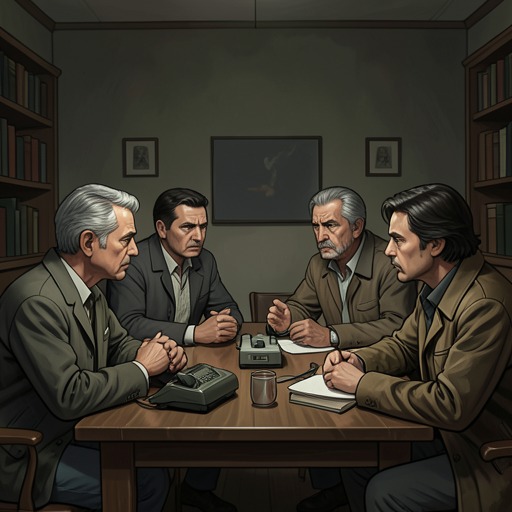
The hunters’ influence also operates through language. After work, the Poor Woodcutter’s companions drink together and complain about hardship. Some blame the people carried on the trains, alleging that they caused the war, killed God, and deserve extermination. Their claims turn deprivation into an accusation against the persecuted and make murder sound like a collective remedy. The men describe trains carrying the Heartless as privileged transport, contrasting them with their own low-paid labor.
The Poor Woodcutter’s outburst breaks that chorus. He asserts that the Heartless have hearts, then leaves for home, at once frightened by his defiance and relieved to have spoken. His companions dismiss him as drunk. They continue singing songs taught by their masters, the hunters, and the invaders: in those songs, violence against the Heartless is cast as deserved and necessary. The contrast matters. The Poor Woodcutter’s speech recognizes the humanity that the propaganda denies; the group’s response shows how thoroughly the hunters’ teaching has entered ordinary social life.
The woodcutters’ labor elsewhere in the story sharpens this context. The Poor Woodcutter shaves the heads of people arriving on cargo trains, using shears because he has no scissors. The work, and the possibility that it may briefly help him survive, place him close to the machinery of persecution without making him one of its willing advocates. The book distinguishes forced proximity to that machinery from the choice to repeat its hatred.
Informing and the Attack on the Cabin
The threat becomes immediate through the Wood-Alcohol Distiller, a fellow worker who has heard the Poor Woodcutter’s dissent. He encounters the Poor Woodcutter’s Wife and child in the forest and asks where the child came from. She says the girl is hers. He studies them, then leaves with a courteous greeting. The encounter appears harmless, but its later consequence recasts the politeness as part of an act of betrayal.
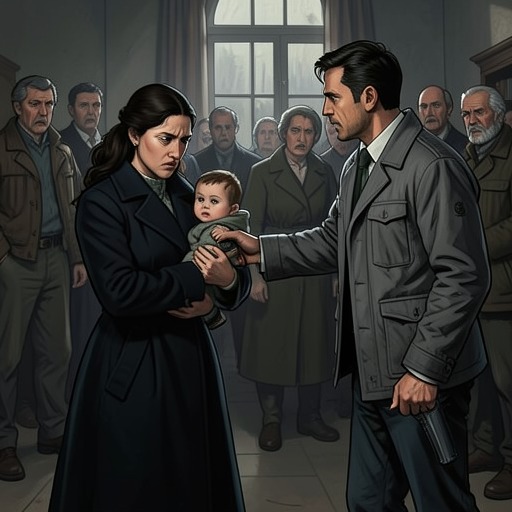
Before dawn, the distiller returns with two militiamen carrying rifles. The Poor Woodcutter initially denies the charge that the child is undocumented, claiming she is his daughter and explaining the missing registration as a consequence of his dislike of paperwork. Under threat of death, he admits the truth, but asks to hand the child to his comrade himself so that the transfer can be handled gently and the rifles will not alarm his wife. His request does not save the family; it shows the care he tries to preserve even when facing a coercive demand.
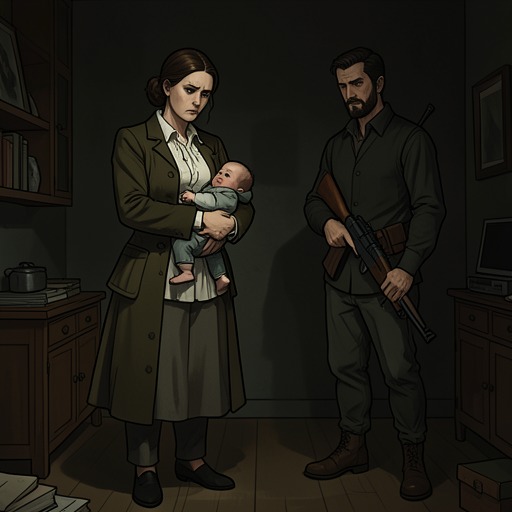
When the Poor Woodcutter’s Wife appears with the child, the girl reaches toward him. He takes up his ax and attacks the distiller, then strikes one of the militiamen and drives the other back. The Poor Woodcutter’s Wife flees with the child as he falls. His final concern is that their little cargo survive. The hunters do not need to be shown at the cabin for their system to be present there: the informer, armed escort, threat of death, and attempt to take the child carry that danger into the household.
Retreat and Narrative Significance
As the Reds advance, the hunters go to ground or flee west with the Death’s Heads and their collaborators. The change ends their visible control of the forest, though it cannot undo the losses already inflicted. The Man with the Goat and Shattered Face, who has protected the Poor Woodcutter’s Wife and child, is killed by Red soldiers; after finding his body, she leaves the forest with her daughter and goat. The hunters’ retreat is therefore not a restoration of safety or a resolution of the story’s violence.
The Hunters of the Heartless matter both as agents of danger and as a recurring explanation for how persecution is sustained. Fear of betrayal reaches the family before the armed men arrive; propaganda gives co-workers a shared vocabulary for hatred; and the informer converts that vocabulary into action. Against this progression, the Poor Woodcutter’s refusal to join the chorus and his defense of the child mark a moral division within the working community. The hunters’ disappearance when the front shifts shows the political fragility of their power, while the family’s flight records its lasting human cost.