Internment and Deportation at Drancy
The Most Precious of CargoesInternment and Deportation at Drancy is the passage from precarious survival to forced removal in the family’s wartime story. At the camp, the father’s medical training gives way to work as a barber, while Dinah struggles to keep their twins alive and the family together. Their confinement offers a brief interval of shared life, but registration, changing guards, and the departure of other internees make clear that this reprieve has no secure future. Deportation on Convoy 49 separates the family’s fates: the narrative records Dinah and Henri’s deaths, while the father survives and carries the loss into the postwar search for his daughter.
Confinement and a precarious reprieve
Transported from Pithiviers to Drancy, the father and his family have so far avoided the separations they watch other internees endure. He attributes this period of grace to their beloved twins, Henri and Rose. Born in the spring of 1942 beneath the yellow star, the children are both a source of joy and a reminder of the danger surrounding their family. Their presence allows the family to spend Christmas together in Drancy, but the father’s belief that the twins have protected them cannot make the protection permanent.
He has nearly completed medical studies specializing in eye, ear, nose, and throat surgery. At Drancy, however, he is told there are already many doctors and patients; the camp’s Jewish administration instead finds him work as a barber after two camp hairdressers leave. He draws on memories of his father’s practiced use of scissors, and even professionally trained barbers take him for one of their own. The work is a practical means of getting by, not a continuation of the profession for which he trained.
The camp’s conditions change with its guards. While the French National Gendarmerie guard the internees, the father cuts hair. After the gray-green Death’s Heads replace them, his customers contract to members of the administration and a few internees. He repeatedly reassures this desperate clientele that everything will be all right, though the reassurance is a lie. His barbering thus becomes an intimate service performed within a system whose direction he cannot control.
Dinah and the twins
The twins’ birth follows a decision Dinah makes under the pressure of persecution. In the spring of 1942, before knowing that she carried two children, the father considers abortion. Dinah thinks it over and chooses to keep the pregnancy. At a discreet maternity clinic on rue de Chabrol, near Cité d’Hauteville, staff suggest placing the babies with a trustworthy family. Dinah rejects the proposal: she insists that their own parents are the family to trust. Though deprived, she produces enough milk for the twins and is described as full of love and confidence.
That confidence does not survive unchanged in Drancy. On the deportation train, Dinah lies on straw with the twins and has little or no milk to feed them. The narrative links the camp’s pressures and the family’s losses to this physical depletion: the departure of her parents, and later the father’s, has left them without news, while fear and deprivation have worn down her hope. She tries to comfort one child as the other cries, swaddling them in the woolen Pyrenean shawl she has been allowed to keep. The contrast with the clinic is stark: the mother who once had milk enough for four now cannot feed her babies.
Convoy 49 and the family’s fate
Convoy 49 leaves Bobigny-Gare, near Drancy, on March 2, 1943, and reaches its destination in Poland on the morning of March 6. The account describes the train’s human cargo through the bureaucratic language of transport, then exposes the violence concealed by that language: after arrival, qualified doctors select ten percent of the deportees, while the rest—the elderly, men, women, children, and infirm—are killed. The image of selection as administrative procedure makes the reduction of people to a fraction of a shipment especially stark.
The narrative identifies Dinah on her provisional papers and new official family record book as Diane, and names Henri as Rose’s twin brother. It then describes Dinah and Henri as leaving earthly life for a heavenly limbo promised to the innocent. In the context of the selection just described, this fairy-tale phrasing marks their deaths without presenting them as a separate, recoverable fate. The family’s brief unity at Drancy gives way to a divided outcome: the mother and one child die, while the father survives and the other twin’s story continues elsewhere.
Displacement after the deportation
The father’s survival does not restore a place to which he can return. In the cattle wagon, a fellow traveler asks whether he is Romanian. The father says that he is; the other man explains that he, too, used to be Romanian but is now stateless. The wagon contains many stateless former Romanians, picked up in Paris or elsewhere in France, and someone mentions Iaşi. The exchange places national identity alongside the family’s camp registration: labels remain consequential, but they do not secure anyone’s safety or belonging.
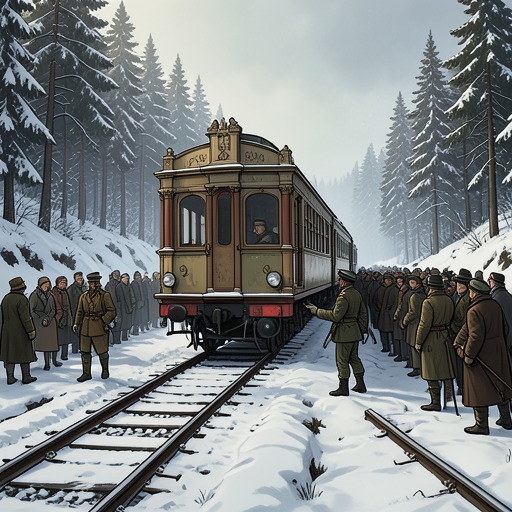
After the war, the father reaches a reunification camp, where former victims live alongside former tormentors. His gaunt appearance and the number tattooed on his forearm serve as his passport. Although he has room and board, settling there brings the deportation back in recurring images: the train, snow, forest, prayer shawl, and the old woman. He also remembers his wife’s eyes as she turned away from him, and is tormented by the thought that he failed to let fate take the whole family together. The narrative presents survival not as release from the past but as an ongoing encounter with it.
He cannot settle into a new life while his daughter may still be alive. The camp’s authorities give him a small sum when he leaves, freeing the straw mattress he occupied; he sets out toward the railway and forest, following an abandoned, weed-grown line. By then he can no longer remember his daughter’s name. That loss of memory does not stop the search, but it shows how displacement has damaged even the language through which he might reclaim his family.
Significance
Drancy functions in this account as both refuge and mechanism of removal. The family remains together there for a time, the father finds work, and the twins become a shared focus of protection. Yet the camp’s administration, the succession of guards, and the deportation train expose the limits of that temporary shelter. The transition from the clinic’s offer of a trustworthy family to the father’s inability to protect his children makes the question of family trust painfully concrete: Dinah chooses her own household, but the machinery of persecution reaches it all the same.
The passage also traces how official classification follows people beyond the camp. The family is registered and marked; Dinah appears under the name Diane on provisional papers; the father’s tattoo becomes his means of identification after the war; and stateless former Romanians recount the loss of national belonging inside the deportation wagon. These records and labels do not provide protection. Instead, the narrative sets their administrative certainty against the instability of human lives: the twins’ brief Christmas together, the mother’s dwindling milk, the four-day journey of Convoy 49, and a father who survives but cannot remember the name of the child he is seeking.