Man with the Goat and Shattered Face
The Most Precious of CargoesMan with the Goat and Shattered Face is a feared hermit who becomes an essential protector and caregiver to Poor Woodcutter’s Wife and the child she has taken from the snow. His goat’s milk keeps the girl alive, and his later shelter gives the mother and child refuge; his own death, inflicted by advancing Reds, exposes the difference between the care he provides and the violence of the armies crossing his forest.
The Hermit and His Forest
The forest-dwelling man lives alone in a dense, secluded grove where the trees have been spared the Poor Woodcutter’s ax and no path leads in. Poor Woodcutter’s Wife knows the place as a preserve of faeries, sprites, witches, and werewolves. She has glimpsed its solitary master while gathering wood at the grove’s edge, but has not approached him. The surrounding villagers regard him with fear: some say he is malevolent; others say he befriends animals and is an enemy to people. Even the Boches and their conscripts dread meeting him.
His appearance intensifies the impression of danger. When he emerges, his boots creak on rotten wood; he wears a czapka and carries a rifle. His face is shattered, and his isolation has made him a figure of rumor before Poor Woodcutter’s Wife meets him directly. The narrative does not explain the origin of his damaged face. Instead, it sets the fearful image around him against the decisions he makes: he is suspicious of human motives, but his conduct toward the child is patient and practical.
Milk, Work, and Care
Poor Woodcutter’s Wife seeks him out because the child cannot survive without milk, while she has none to give. The man asks where she expects him to find milk, and she answers that it must come from his nanny goat. He is surprised that she knows he has one. Rather than ask for charity, she offers a bundle of firewood every day in exchange for two mouthfuls of milk, insisting that the wood she gathers is not his to claim as payment.
The child is already too hungry to wail strongly. The man recognizes the immediate need and agrees to give milk from his goat. He explains that milk from a jenny would be preferable, but he has none; for the next three months, the goat’s milk must be diluted with boiled water at a ratio of two measures of water to one of milk. Porridge should supplement it, followed, when spring comes, by fruits and vegetables. His care is not a vague gesture of pity: he identifies what the infant needs and sets out how to feed her with the resources available.
When he hands the baby back, Poor Woodcutter’s Wife takes her lovingly and falls to her knees, trying to kiss his hand. He recoils and orders her to get up. He refuses the position of moral superior that her gratitude would give him. He also tells her never to kneel before him or anyone else again, never to call him a good man, and never to reveal that he owns a goat and gives milk away. Asked what makes him hide the gift, he answers that it is the war; whether this war or another, he says, hardly matters. The help must remain discreet because giving it openly could expose him and the goat to danger.
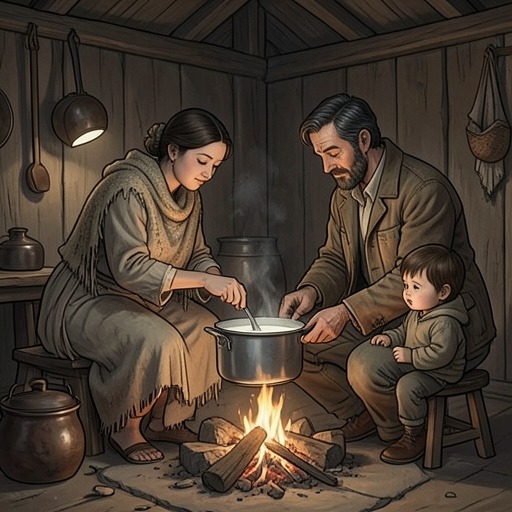
The exchange becomes a daily practice: every morning, Poor Woodcutter’s Wife brings firewood and receives a warm cupful of milk. The child survives, though hunger continues to gnaw at her, and even after she regains her strength she sucks whatever she can put in her mouth. The man’s contribution thus sustains more than a single moment of rescue. It gives the family a routine of food and work through which the girl can grow.
Shelter and a Wider Kinship
Later, when Poor Woodcutter’s Wife arrives in distress and cannot explain what has happened, the man understands that her husband and his ax have made a desperate stand against their tormentors. He tells her that she need say no more, offers to do his own best if her pursuers warrant it, and asks her to hand over her “precious cargo” and follow him. His response extends the earlier exchange: he acts before requiring a full account of the danger.
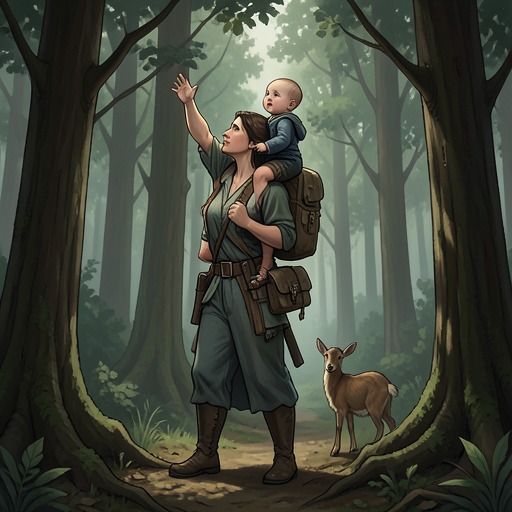
He leads Poor Woodcutter’s Wife and the child through the dense forest into a clearing and a garden she has never seen. Fruit hangs from the trees, flowers rise around them, and the man carries the child toward a grotto beside his cabin. There, he sets her in front of a small goat with swollen udders, introducing the animal as her wet nurse and “third mother.” The girl embraces the goat; they press their foreheads together and gaze at one another. Poor Woodcutter’s Wife weeps as the man explains that she will now have all the milk the child needs and will no longer have to gather kindling. He gives up the daily bundles of firewood, but the goat gains a playmate. In his account, the arrangement brings a gain and a loss together, as they do throughout mortal life.
The child thrives under his watch. Poor Woodcutter’s Wife is absorbed by the girl’s laughter, singing, babbling, and dancing with the goat, which becomes more than a sister to her. The man remains watchful, listening toward the east as the Reds advance. His care for the household does not make him unaware of the wider danger: he fears the Reds as he had feared the Gray-Green of the Death’s Heads, their minions, and their collaborators. Once a week he visits nearby villages to barter goat cheese for basic necessities, while people there speak of the war’s approaching end with either hope or regret.
Death and Narrative Significance
As the war shifts, planes with red stars bomb the Gray-Green positions, cannon fire follows, and the Hunters of the Heartless go to ground or flee west. The man patrols the eastern edge of his forest with his rifle, determined that the new invaders respect his right to his land. Two Red soldiers enter stealthily and kill him with a burst of machine-gun fire. One turns his body over with a boot; seeing his face, the soldier calls him “An old man, ugly.” Finding no one else there, the soldiers leave to rejoin the larger force, which has chosen to skirt the forest rather than pass through it.
The following morning, Poor Woodcutter’s Wife finds the body. She weeps, and the child weeps with her; even the goat appears to weep. She covers the man with blossoming branches rather than burying him, and makes a prayer for the peace and happiness denied him on earth. She no longer trusts the gods of the train. The child’s survival, she recognizes, came not from them but from the hand that dropped her from the train and from the righteousness of the man with the rifle and the goat. His ending gives force to the care he practiced in secret: the person whom others feared and the soldiers dismissed as ugly had sustained a child, sheltered a mother, and defended his small refuge, while the armies passing through the forest brought death.