Prayer shawl
The Most Precious of CargoesThe Prayer shawl is the central recurring object linking the child thrown from the train to the life she later makes with the Poor Woodcutter’s Wife. First used by her father to wrap and lower one of the twins through the train’s barred window, it becomes the infant’s covering and a treasured possession. As the plot advances, the shawl changes function: it helps preserve the child, is offered in exchange for goat’s milk, carries the family’s belongings, and finally serves as the material sign through which the father recognizes his daughter. Its importance is practical as well as symbolic, though the ending unsettles its apparent history by saying that the shawl did not exist.
A covering at the moment of separation
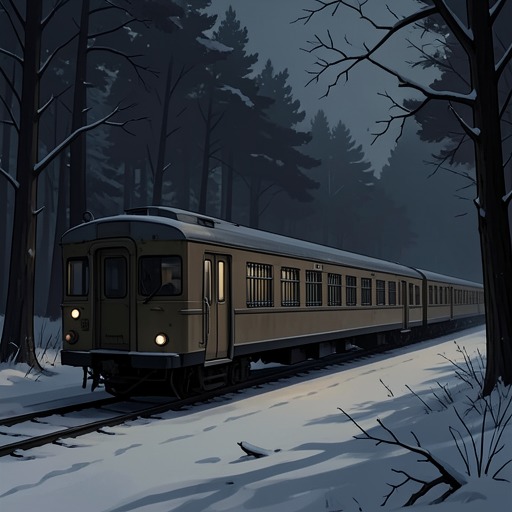
On the crowded train, the father takes the child nearest to him rather than choosing between the boy and the girl. He has already taken out his Prayer shawl, and, as he returns to the barred window, he unfolds it. The bars are wide enough for an arm to pass through; outside, a figure runs after the train through the snow. The shawl becomes the wrapping around the infant as the father attempts to pass her through the opening. An elderly passenger tries to warn him, but the father pretends not to understand Yiddish and continues. The infant’s head and shoulders pass through the bars, and the old woman outside falls to her knees in the snow.
The action makes the shawl part of a deliberate separation: the father cannot keep both children with him, and he sends one away wrapped in the object he carries. It is not presented merely as protection from the cold. Its folds make the infant portable at the instant when the train’s movement is taking her family away, while its distinctive threads will later make it recognizable. The shawl therefore accompanies both the immediate danger of the passage through the window and the possibility of a life beyond the train.
The child’s covering and the adoptive mother’s treasure
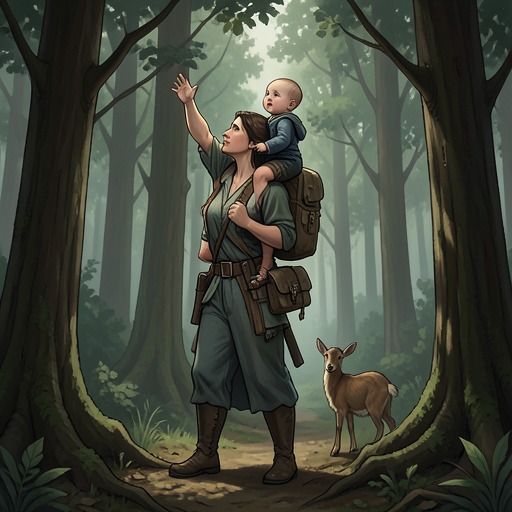
After the Poor Woodcutter’s Wife has taken the infant in, she feeds her cooking water and kasha, then holds out a finger for the child to suck. When she lays the baby in the bed, her attention turns to the unfolded shawl, which she has hung up to dry. She notices its fine, interlaced threads, fringed ends, and embroidery in gold and silver. Having never seen or touched anything so precious, she thinks of it as a rich wrapping for the gift the gods have sent her. She soon falls asleep holding the child, with the baby wrapped in the shawl.
This early scene establishes the object’s double value in the Poor Woodcutter’s Wife’s eyes. It is an unusually fine possession, and it is also inseparable from the little girl she has begun to treasure. The narrator’s image of mother and child resting together above the ordinary world of woodcutters gives their shared covering an almost sacred importance. Yet the shawl’s value is not only devotional or decorative: the child still needs milk, and the Poor Woodcutter’s Wife must find a practical way to keep her alive.
Exchange, travel, and changing uses
Knowing that the child cannot thrive without milk, the Poor Woodcutter’s Wife goes into the part of the forest where the Man with the Goat and Shattered Face lives. She carries the baby enfolded in the shawl, whose gold and silver edging still marks it as a remarkable object. When porridge fails to feed the child, she proposes bringing two bundles of firewood each day in return for a small cupful of warm milk. Asked whether the gods gave her anything valuable with the girl, she frees the little one from the Prayer shawl and offers the cloth to the man. She points out its intricate workmanship; he wraps it around his neck.
The offer puts the shawl’s material worth into direct relation with the child’s need. A possession once regarded as a divine gift becomes something the Poor Woodcutter’s Wife is willing to surrender in order to obtain milk. Its role shifts again after the Man with the Goat and Shattered Face dies. The Poor Woodcutter’s Wife gathers her old clothes, the newly made cheese, and the tools for making it, wrapping them in the Prayer shawl before setting off east with her daughter and the goat. In the ruined village where she settles, she spreads it over a surviving section of wall and lays the cheeses on it to sell. The object that first sheltered the infant now serves as a bundle and a makeshift display cloth, accompanying the family’s attempt to establish a livelihood.
Recognition and the story’s final qualification
After the war, the father wanders through towns and villages, hungry and uncertain about what he is seeking. At a small table he sees cheeses displayed on a cloth that seems to be woven with gold and silver threads. He touches it, puts down coins, and suddenly remembers. Behind the table sits a woman with a girl on her lap; the girl gestures toward the goat whose milk made the cheeses. The father understands that the child is his daughter, the one he sent from the train. The unusual cloth has helped bring the memory back: the Prayer shawl has outlasted its earlier uses as a wrapping, a proposed payment, and a carrier of possessions, becoming the sign that connects the man at the table to the infant he once sent away.
The recognition does not lead to reunion. The father reaches toward the girl, who takes his hand and presses it to her lips before laughing; he quickly withdraws his hand. The shawl makes recognition possible, but it does not erase the distance between the father who saved her and the life she has grown up living. In the final account, the narrator then qualifies the whole imagined chain: the little girl, the Poor Woodcutter’s Wife, and the fringed Prayer shawl embroidered with gold and silver thread are declared not to have existed. The story nonetheless identifies the act of a father throwing a little girl from a train as its grain of truth. The shawl’s elaborate recurrence thus belongs to the invented form of the tale, while its narrative work remains precise: it carries the child through separation, care, exchange, survival, and recognition.