Prohibition on sheltering the heartless
The Most Precious of CargoesThe Prohibition on sheltering the heartless is a death-threatened rule that makes protecting a Jewish infant a perilous act. In the forest, it is presented as an unquestionable command, reinforced by the threat of informers and armed enforcement. The Poor Woodcutter’s Wife and the Poor Woodcutter nevertheless choose the child’s safety over the rule, exposing the gap between its asserted moral authority and the human consequences of obeying it.
Nature and Justification
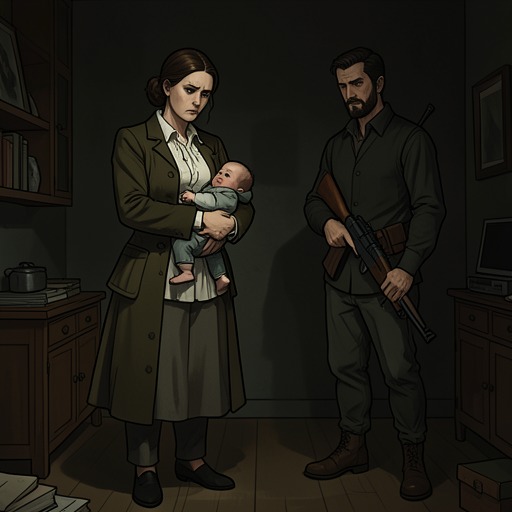
The rule is introduced when the Poor Woodcutter challenges his wife about the infant she has brought home. He warns that sheltering the heartless is forbidden on pain of death, and repeats the persecution’s religious rationale: the heartless are blamed for killing God. The accusation is paired with another, that they are thieves. These claims make an act of care appear, within the rule’s distorted logic, both impious and criminal. The prohibition is therefore more than a warning about the danger of being discovered; it supplies an ideological justification for excluding and punishing the child.
The rule’s force also depends on fear spreading beyond the household. The Poor Woodcutter tells his wife that other woodcutters could betray them to the Hunters of the Heartless. That prospect turns neighbors into potential informers and makes ordinary concealment seem inadequate: the couple must fear not only an official search but disclosure by people who know them. The threat of death gives this social pressure its ultimate consequence, even before anyone arrives to enforce it.
The Couple’s Response
The Poor Woodcutter’s Wife counters the prohibition with the circumstances before her. The child is too small to have stolen anything, she argues, and she imagines that, as the infant grows, the child might help gather wood. She also proposes a cover story: she will claim the baby is her own, born late after a pregnancy attributed to her husband. The Poor Woodcutter answers with incredulity about the implausibility of that explanation, but the exchange shows that his wife is already trying to turn a forbidden act into an ordinary family fact.
Her defense is not limited to the invented birth story. She regards the child as entrusted to her by the god of the cargo train, and later tells the Man with the Goat and Shattered Face that helping to feed the girl will allow her to live and may bring divine protection. These appeals reveal that she understands the child’s survival as a responsibility, even when the powers she invokes offer no practical guarantee. Against the rule’s abstract accusations, she places the infant’s immediate need and the possibility of a life within the household.
The Poor Woodcutter’s initial warning cannot be mistaken for a lack of awareness of the danger. He says discovery would expose them to lethal punishment. Yet when the threat becomes immediate, he acts to protect his wife and child. His eventual resistance makes the prohibition a decisive test: the couple’s choice is not between a safe and a risky form of shelter, but between compliance with the threat and an attempt to save the infant.
Enforcement and Resistance
The danger becomes concrete when the Wood-Alcohol Distiller, a comrade of the Poor Woodcutter, comes to the cabin before dawn with two militiamen. Earlier, he had encountered the Poor Woodcutter’s Wife and the child in the forest, asked where the girl came from, and watched her answer that the child was hers. He left after the exchange, but later returned with armed companions to take delivery of the child. His first encounter and subsequent arrival show how a seemingly casual question can become part of the surveillance through which the prohibition is enforced.
At the cabin, the Poor Woodcutter first denies the accusation and claims the child as his daughter. Asked why the birth was not registered at the town hall, he says that he dislikes filling out documents and that the girl has grown up undocumented. Under threat, he eventually confesses, but asks to hand the child to his comrade so that the removal can be carried out gently and without frightening his wife. The request is a brief effort to preserve the child from the immediate terror of the armed men; it does not mean that he accepts the prohibition as just.
Instead, he uses the apparent handover to give his wife the chance to escape. When the child reaches toward him, he attacks the Wood-Alcohol Distiller and urges the Poor Woodcutter’s Wife to flee with the girl. He then confronts the militiamen. The escape and the Poor Woodcutter’s resistance are the direct consequence of the rule’s enforcement: once the authorities arrive to seize the child, secrecy and argument no longer suffice. The prohibition converts domestic shelter into a confrontation with armed power.
Wider Context and Significance
The forest episode belongs to a story in which the threat to Jewish children is not confined to one household. The father of Henri and Rose, a Romanian Jew, is deported with his family from Pithiviers to Drancy. In the cattle wagon, passengers include stateless former Romanians, and the journey evokes Iaşi. Elsewhere, the narrative describes a selection process in which only a fraction of those delivered are retained, while the rest are sent to their deaths. This wider context grounds the prohibition in a system of persecution: the forest couple’s fear of discovery echoes the institutional power that has already separated families and endangered children.
The rule also clarifies the difference between a label imposed on the child and the child’s actual presence. The infant is treated by the prohibition as a member of a hated category, while the Poor Woodcutter’s Wife responds to a dependent child who needs care. The contrast does not erase the danger or make the couple’s resistance easy; it shows how the rule attempts to make persecution seem lawful and morally warranted by replacing the person in need with an accusation.
The narrative later places this act of shelter within a broader reckoning about who enabled survival. After the Man with the Goat and Shattered Face is killed, the Poor Woodcutter’s Wife covers his body with branches and gives thanks for the goodness he showed her and her daughter. She recognizes that the girl survived through the action of the person who dropped her from the train and through the man who protected them, not through the gods of the train. In that contrast, the prohibition’s claim to moral authority is answered by the concrete conduct of those who risk themselves to preserve another life. The rule defines shelter as a crime; the story makes shelter an act of responsibility.