Second World War
The Most Precious of CargoesThe Second World War is the historical force that turns the great forest into a place of persistent hunger and danger. It reaches beyond the distant battlefield: occupation and forced labor govern the lives of the Poor Woodcutter and the Poor Woodcutter’s Wife, while the war’s changing front eventually brings the Reds toward the forest.
Wartime Setting and Occupation
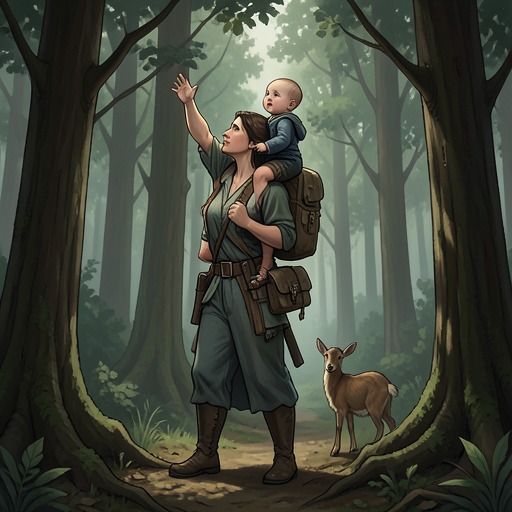
The forest endures both severe cold in winter and oppressive heat in summer, but hunger persists through every season. As war rages around it, a conquering army occupies towns, villages, fields, and forests. The Poor Woodcutter is conscripted to carry out public works for the occupying army, laboring from sunup to sundown. His wife walks through the woodland each day, often without success, trying to provide for their household. Their childlessness is a complicated reprieve: the Poor Woodcutter regards having no children to feed as a blessing, while his wife privately mourns it.
The War’s Reversal at the Forest’s Edge
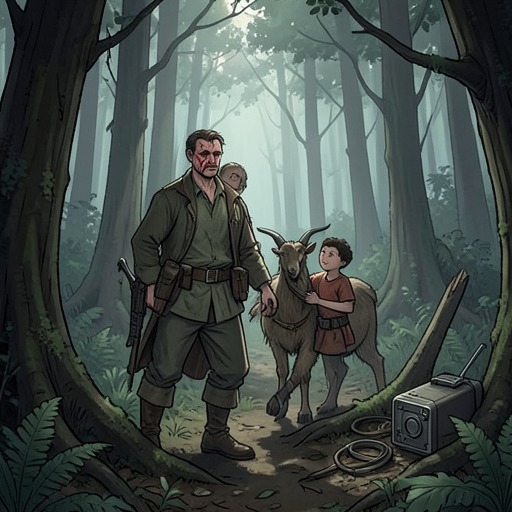
As the war approached its end, its changing front reached the forest through rumor, trade, and the sound of battle. The Man with the Goat and Shattered Face listened eastward, rejoicing at the Reds’ advance even as he feared them. That fear recalled the Gray-Green Death’s Heads, their minions, and the collaborators who had made the earlier occupation dangerous; the arrival of a new army did not make armed power feel safe.
Once a week, the Man with the Goat and Shattered Face went to a bordering village to barter goat cheese for necessities. There he heard people speak of the approaching end of the war, some with hope and others with regret. The change became visible when planes marked with red stars bombed the Gray-Green’s positions, and the roar of cannon fire followed. The Hunters of the Heartless then went to ground or fled west, marking a retreat in the forces that had terrorized the forest.
The War’s Final Violence in the Forest
With the Hunters of the Heartless gone to ground or fleeing west, the advance of the Reds brought a new danger to the forest. The Man with the Goat and Shattered Face patrolled its eastern edge with his rifle, determined to defend what he regarded as his property against the arriving forces. Two Red soldiers slipped into the woods and shot him with a burst of machine-gun fire. One approached the body, turned it over with his boot, and, seeing no appeal in the man’s face, dismissed him to his comrade as “An old man, ugly.” Finding no one else there, the soldiers left to rejoin the main force, which had skirted the forest.
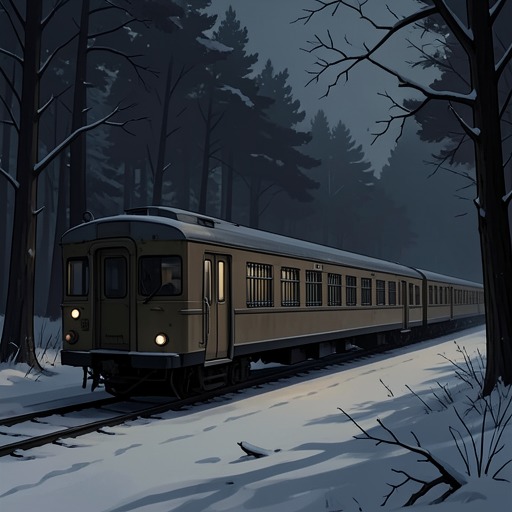
The next morning, after a night of anxiety, the Poor Woodcutter’s Wife found the dead man. She wept, and her little cargo wept with her; even the goat’s eyes seemed to fill with tears. She chose not to bury him, instead covering his body with blossoming branches. Her improvised prayer gave thanks for his kindness and wished him the peace and happiness denied him on earth. Though she thought of the gods of the train, she did not appeal to them: she no longer trusted them. The wartime arrival of the Reds thus ends not in the forest’s liberation for its inhabitants, but in the death of its protector and a private act of mourning.
Narrative Scale and Historical Meaning
The war is narrated not as a remote campaign but as pressure entering the ordinary rhythms of the forest: hunger persists through the seasons, labor is commandeered, and the changing front eventually reaches people who have experienced it through village talk and the signs of battle. This movement from an encompassing historical condition to violence at the forest’s edge gives the conflict a deliberately uneven scale. The great war may seem distant from the Poor Woodcutter’s household, yet it determines what work is demanded, what food can be found, and whether the forest’s apparent refuge can endure. Set against the tale’s fairy-tale opening, that material history keeps hardship from becoming a merely enchanted misfortune: the forest’s hunger and danger belong to an occupied world shaped by war.