The “Heartless” and Their Hunters
The Most Precious of CargoesThe “Heartless” and Their Hunters is the story’s name for a persecuted group and the people mobilized to hunt them. The term exposes how propaganda turns a human difference into a supposed moral defect, then uses that fiction to justify exclusion and violence. Against this manufactured division, the care of Poor Woodcutter’s Wife and the woodcutter’s changed understanding insist on a simple fact: the child treated as an enemy is alive, vulnerable, and capable of being loved.
The Doctrine of the Heartless
The label begins as a way to classify the baby found by Poor Woodcutter’s Wife after she has been thrown from a train. The woodcutter identifies the child by the group he believes she belongs to and treats that identity as sufficient reason to reject her. When Poor Woodcutter’s Wife calls the baby her own angel and offers the possibility that the child could be his as well, he refuses the relationship before it can begin. In his account, the child’s parents discarded her because they are heartless; the act is made into proof of an entire group’s alleged nature.
The doctrine extends beyond suspicion into a prohibition. The woodcutter warns that sheltering the heartless is forbidden on pain of death, and repeats claims that they killed God and are thieves. These accusations make care appear not merely foolish but transgressive: feeding the baby would mean defying a rule presented as sacred and backed by lethal punishment. The story shows how the prohibition makes persecution an everyday moral test, imposed even on people whose immediate experience is of a hungry infant needing help.
The supposed difference is also described as something that can be detected. The woodcutter says the heartless are marked and claims their nature is unlike that of other people. Yet the account offers no independent evidence for such a mark or difference. The word functions as a device of classification: it turns an inherited accusation into an apparently visible fact, while allowing the accuser to treat the group’s identity as proof of guilt. The baby’s helplessness does not unsettle the doctrine for him at first; instead, he reads her through the category assigned to her.
Care Against the Category
Poor Woodcutter’s Wife’s response begins with the child’s actual needs. The baby is hungry, and the woman has no milk. At the cabin she tries the food available to her, first offering a finger to suck and then preparing kasha with hot water. The child rejects the bitter porridge but takes cooking water and eventually quiets in her arms. This practical sequence contradicts the woodcutter’s abstractions with the particular demands of a child who must be fed and comforted. The woman’s lullaby calls the baby her little cargo and her child; the new relationship takes shape through repeated care rather than shared ancestry.
Poor Woodcutter’s Wife also tries to persuade a man who has reason to distrust divine protection. She says the child was entrusted to her by the god of the cargo train, and later argues that if he helps feed the girl, she will live and the gods may protect him. His response is shaped by his own hardship, not by a willingness to accept that promise. He has suffered and resists the idea that the gods have served him. The scene therefore places the woman’s appeal to providence alongside the limits of that appeal: her confidence matters to her, but it does not erase his experience or immediately change his conduct.
The decisive evidence comes not from an argument about origins but from touch. One night, when the child’s crying provokes the woodcutter, Poor Woodcutter’s Wife catches his raised hand and guides it to the girl’s chest. She asks him to feel the small heartbeat. He pulls away and repeats the slogans that the heartless have no hearts and are to be driven out. Yet the contact has unsettled him: he becomes aware of warmth and of his own heartbeat, while the child reaches toward him. He recoils again, still refusing to look after or feed her, but the embodied encounter has introduced a contradiction that the slogans cannot resolve.
Hunters, Propaganda, and Public Speech
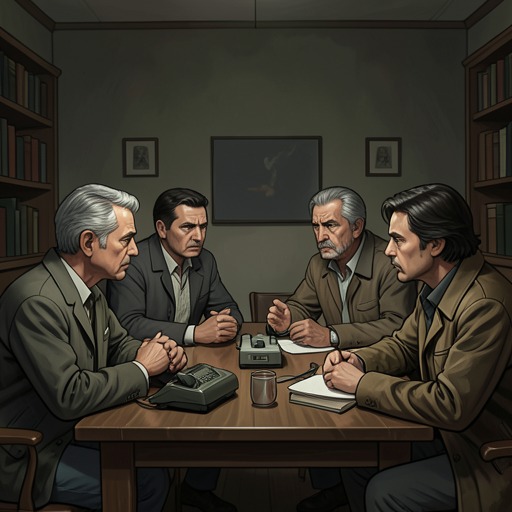
The Hunters of the Heartless are sustained by a wider public culture, not only by one man’s private prejudice. The woodcutter’s companions repeat the hunters’ and invaders’ songs, which call for the group’s destruction and accuse them of taking what belongs to others. Their gathering makes the slogans communal: the men sing together, while the woodcutter initially remains silent. The scene contrasts their rehearsed language with the recognition that has begun at home, where a child’s heartbeat has made the doctrine harder for him to repeat without doubt.
The woodcutter’s change becomes public when, after drinking with the others, he unexpectedly declares that the heartless have hearts. He says it again more loudly, slamming his tin cup onto the rickety table and breaking it. His companions interpret his outburst as drunkenness and expect him to return to normal once sober. But he walks home relieved and proud to have spoken against the teaching that governed his silence. His movement from inward disturbance to public contradiction gives the central claim a social consequence: the doctrine is not only challenged in private through care, but openly refused in the company that reproduces it.
The narration connects the hunters’ campaign to a broader practice of sanctioned killing. It recalls that local authorities had once offered rewards for the heads of animals deemed verminous, a detail that places the hunt for the heartless beside the official treatment of creatures designated for elimination. The parallel does not make the campaigns identical; it shows how the language of vermin and removal can make destruction seem orderly and authorized. The hunters’ songs and the woodcutter’s memory of the bounty both reveal that persecution is supported by systems of permission as well as by individual hatred.
The Human Cost and the Story’s Reversal
The threat surrounding the heartless remains active as the war changes. The Hunters of the Heartless have requisitioned and eaten the wild pigs, and later, as the Reds advance, the armed man who shelters Poor Woodcutter’s Wife and her daughter is killed while patrolling the eastern edge of his territory. The violence outlasts the original household conflict. The child’s survival depends not on the hunters’ claims or the gods invoked by the woman, but on people who choose to protect and feed her.
After the armed man’s death, Poor Woodcutter’s Wife revises her understanding of what has saved her daughter. She no longer trusts the gods of the train and gives credit to the hand that dropped the baby from the train and to the righteousness of the man who sheltered them. The distinction matters: the tale began with a gift interpreted as divine, but its aftermath locates survival in human actions, including the risks taken by those who offer protection. Her gratitude does not undo the loss; it names the people to whom the child’s life is owed.
The concept’s central reversal is therefore both intimate and political. The child classified as heartless has a beating heart, and the woodcutter’s own capacity for feeling is stirred when he touches it. That recognition does not erase the danger posed by the Hunters of the Heartless or restore those lost to persecution. It does, however, break the supposed certainty on which the hunt depends. The story sets a repeated public lie against a concrete encounter, showing how a person can begin to resist a violent category by recognizing, and acting upon, another person’s need.