The Precious Cargo Motif
The Most Precious of CargoesThe Precious Cargo Motif gives the story its central reversal: what the Poor Woodcutter’s Wife imagines as goods sent to relieve her poverty arrives as a child whose survival depends on her care. Cargo begins as a promise of food and escape, becomes the child’s intimate nickname, and finally marks the distance between the fairy tale’s invented details and the truth the book claims lies beneath them.
Origins in Hunger and Expectation
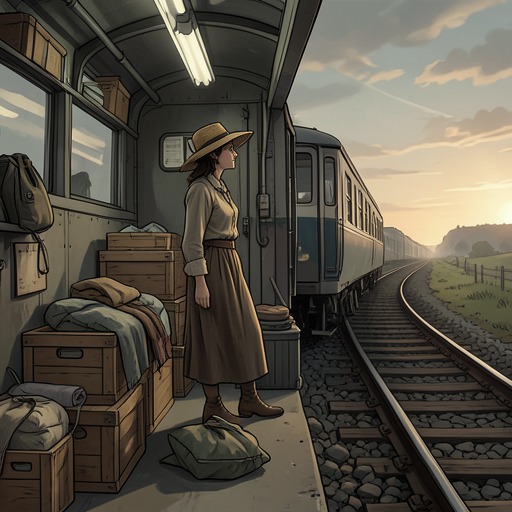
The motif takes shape around the single railway track cut through the Poor Woodcutter’s Wife’s forest at the outbreak of World War II. Forced laborers and powerful machines have opened a passage through the woods; now a train travels back and forth along it. For the wife, watching the train becomes part of her daily routine. She has never seen a train before, and her husband dismisses this one as a cargo train. The word cargo, however, gives her imagination a way beyond the hunger, cold, and isolation of her life.
She pictures the wagons stocked with food, clothes, and fantastical objects, and imagines moving through them to take what she needs. The train is at once a concrete presence and a vessel for hope: perhaps it will take pity on her and leave some of its precious cargo behind. As that hope becomes habitual, she approaches as closely as she dares, calling and waving. The motif thus grows out of a specific deprivation, but it also describes how expectation changes her relation to the train. A passing machine becomes, in her imagination, a possible source of aid.
The Train’s Answer
The expected gift arrives when the train passes as Convoy 49. The reply is not a written sign but a package dropped from a narrow window onto the snow. A hand then signals that the package is meant for the Poor Woodcutter’s Wife. The scene answers her long-standing hope while changing its meaning: what she receives is not food or a useful object but a baby. The cargo train’s human cargo enters the story as a particular child, not as the supplies she had imagined.
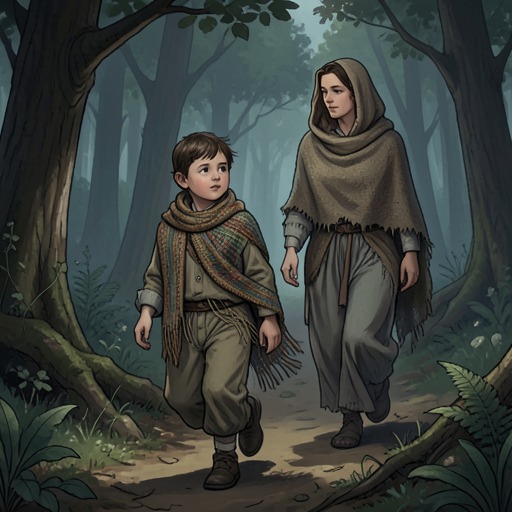
The contrast between fantasy and reality continues when she unwraps the package. Instead of a gift that can simply satisfy her own wants, she finds a hungry infant who needs immediate care. She holds the child against her, wraps it in her scarves, and carries it home. At the cabin, she tries cooking water and buckwheat porridge; the baby accepts some nourishment but remains dependent. The arrival therefore makes her a mother in feeling and responsibility, while confronting her with the limits of what she can provide. The precious cargo is precious not because it is an object to possess, but because the child’s life now calls for care.
A Name Made by Care
The Poor Woodcutter’s Wife’s language of cargo changes as she responds to the child. At first, cargo means an imagined supply of goods that might relieve her hunger. After the baby arrives, the phrase becomes a tender way of addressing the small person she has taken into her arms. Her lullaby calls the child Little cargo, linking the original fantasy to an emerging bond without reducing the child to the package in which it came.
The shawl that wraps the baby extends this transformation through another material object. The Poor Woodcutter’s Wife regards its gold and silver embroidery as part of the miraculous richness of the gift. Yet the child’s need for milk cannot be met by the shawl or by the food she improvises at home. Knowing that the baby cannot thrive without milk, she seeks help from the secluded part of the forest where Man with the Goat and Shattered Face lives. She exchanges firewood each morning for a warm cupful of milk. The exchange gives the child a means to endure and survive, though hunger continues to trouble her. In this sequence, the motif moves from a hoped-for windfall toward practical, repeated acts: carrying the child, feeding her, and bringing firewood in exchange for milk.
Retrospective Truth and the Motif’s Meaning
At the close, the book explicitly unsettles the story’s literal claims. The child and the Poor Woodcutter’s Wife are described as not having existed, as are the embroidered shawl and many other details of the tale. The account nevertheless identifies a little girl thrown from a cargo train, wrapped in a fringed shawl, and gathered up, fed, treasured, and loved by a childless woodcutter’s wife as the one truth, or the truth the story deserves to hold. The ending does not simply confirm every scene as historical fact; it distinguishes the invented narrative from the grain of truth the narrative is trying to preserve.
That distinction gives precious cargo a double force. Within the tale, it names the child through the wife’s first, hopeful understanding of the train and then through the daily relationship formed by care. In the final reflection, the same image joins the fictional child to the book’s qualified assertion of an underlying event. The motif’s progression—from imagined provisions, to the baby in a dropped package, to Little cargo held and fed—makes the story’s central change legible: the hoped-for gift is not an escape from need but a person whose life creates a bond and an obligation. The tale’s language of treasure therefore rests on care rather than possession, even as its ending asks readers to hold invention and historical truth together without confusing them.