The father recognizes his daughter but chooses not to reveal himself
The Most Precious of CargoesThe father recognizes his daughter but chooses not to reveal himself in a brief encounter that turns a long search into a second, deliberate separation. At a table of small cheeses, he sees the child he believed lost and discovers that she is alive, content, and loved by Poor Woodcutter’s Wife. He comes close enough for the girl to take his hand, but he withdraws rather than claim a place in the family she has made. The reunion grants him confirmation of her survival while leaving her future undisturbed by the truth of her birth.
Recognition at the cheese table
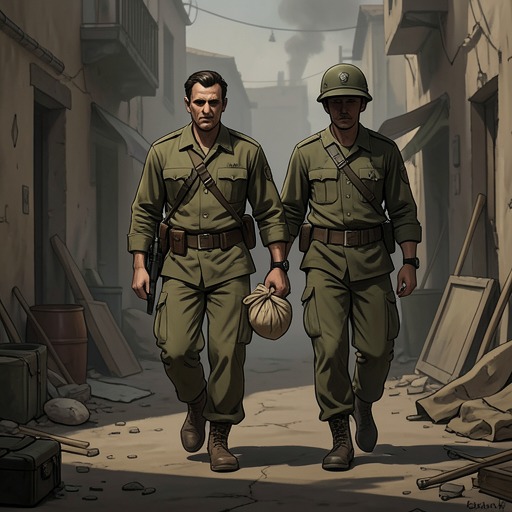
The recognition happens after the father has wandered through forests, towns, and villages in search of something he cannot name precisely. The war has ended for the celebrating crowds around him, but not for him: he remains in mourning for his wife, children, parents, and in-laws. At a small table, hunger draws his attention to the cheeses. The unusual cloth beneath them, which seems woven with gold and silver threads, prompts a sudden memory when he lays a hand on it and sets down coins. The everyday transaction becomes the hinge between his aimless search and the identity he has been trying to recover.
Behind the table sits Poor Woodcutter’s Wife with a child in her lap. She speaks in a language the father does not understand and gestures for him to take a cheese. The girl joins her in the invitation, using her eyes and hands to encourage him, then indicates that the cheese comes from the milk of the Goats beside them. He understands enough to follow the exchange, but his attention has shifted from the sale to the child. He recognizes her as the daughter thrown from the train, the daughter he had saved from the fate he feared awaited her.
A reunion without explanation
The recognition produces no spoken revelation between father and daughter. A cry of joy, grief, and triumph rises within him, but no sound comes from his lips. He takes a cheese while keeping his eyes on the girl, now alive and smiling. His own response is restrained: he manages only the ghost of a smile before reaching with a trembling hand toward her cheek.
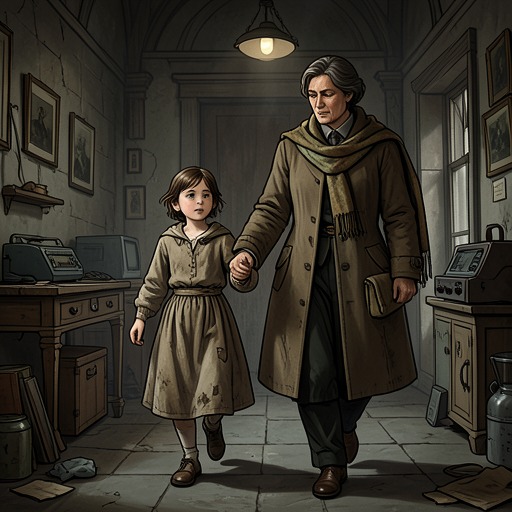
The girl catches his hand and presses it to her lips, then bursts into laughter. Her spontaneous affection makes the encounter intimate without making her aware of its meaning for him. The father quickly pulls his hand away. The gesture is at once a moment of contact and its limit: she can welcome his touch, but he cannot turn that welcome into recognition without changing the terms of her life. The scene gives him unmistakable proof of her happiness while preserving the distance between what he knows and what she knows.
Choosing not to reveal himself
After withdrawing, the father looks from the girl to Poor Woodcutter’s Wife and the goat. He sees the child sitting on the woman’s lap and kissing her, and he fixes this image of their shared happiness in his memory. His hesitation is explicit: he considers whether to reveal himself, then measures what he could offer his daughter against the care she already receives. He concludes that he has nothing to give her, less than nothing, and that disclosing his identity could upset the balance between the child and the woman who has raised her.
He does not leave immediately. He takes a few steps, stops, and seems to reconsider; the possibility of staying or approaching again remains open for a moment. In the end, he tears himself away through what the narration presents as a superhuman effort, mingling joy with sorrow, and walks off quickly. His departure is therefore not simple failure to reach the child. He has found her, but chooses to refuse the claim that biological fatherhood might allow him to make. The choice preserves her present attachment at the cost of his own chance to be known by her.
Aftermath and narrative framing
The narration frames the meeting as both victory and loss. The father has, in one sense, defeated death: his daughter survived, and his earlier act saved her from the extermination machine. Yet finding her does not restore the family that was taken from him. He looks back once at the daughter he has found and lost again, while she turns back to the customer and resumes praising the cheeses. Her small, gesturing hands explain where the cheese comes from, pointing toward the goat and the woman she treats as her beloved mother. The contrast makes the father’s exit concrete: her life continues in the work and affection already surrounding her.
The account then moves beyond the encounter in a deliberately uncertain register. The narrator says that people claim the father returned to the country where he and his family were rounded up, completed his medical studies, became a pediatrician, and devoted his life to caring for other people’s children. These reported outcomes are not presented as certain facts, but they extend the scene’s contrast between the daughter he leaves and the children he may later serve. The reunion remains decisive even without a confirmed later meeting: the father learns that the child lives, sees the family she has formed with Poor Woodcutter’s Wife, and leaves without making his survival or her origins known.