The father searches for his daughter after the war
The Most Precious of CargoesThe father’s search for his daughter after the war begins as an obligation wrested from the ruins of mass death and ends in a choice to remain unknown. Rescued from a shack piled with corpses, he follows the Reds west, passing through refugee camps, abandoned railway lines, and jubilant towns. When he finally finds the girl alive, he recognizes her as the baby thrown from the train. Yet the reunion is not a restoration of the family: he sees her secure and happy with Poor Woodcutter’s Wife, and walks away rather than disturb the life she has made.
From Survival to Responsibility
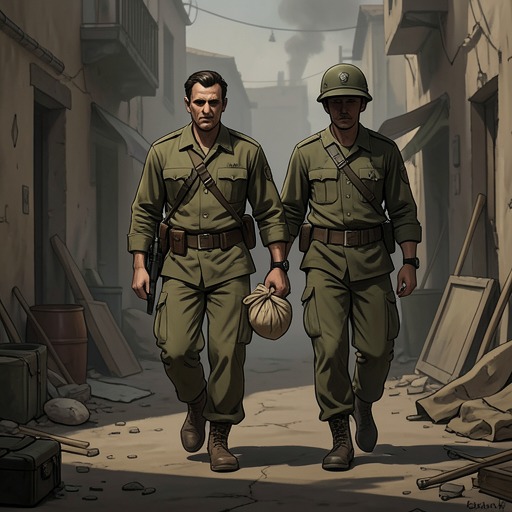
The search becomes possible only after a young soldier wearing a red star finds the father alive among the dead. The soldier gives him water from a canteen and biscuits, lifts him out of the shack, and lays him on clear ground beneath the spring sun. Grass and small white flowers have replaced the snowbound landscape of boots, riding crops, and Death’s Heads. A bird’s song and his own tears return him to the awareness that he is alive; survival, at first, feels less like deliverance than an unexplained fact.
The thought that his daughter might also have survived gives that fact a direction. The father asks himself whether the nightingale’s song has kindled the hope, and concludes that, if the girl lives, he has a duty to do everything he can to find her. He sets off behind the Reds as they march west. The narrative presents the search not as a confident plan but as a responsibility formed amid uncertainty: he does not know whether the child is alive, or even whether he can reach her, but he cannot treat the possibility as irrelevant.
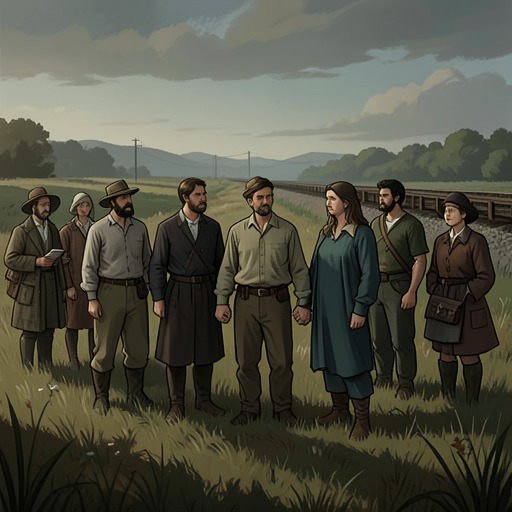
His body repeatedly interrupts that resolve. Starving, he collapses outside a church; a priest helps him stand, gives him food, and prays for him. The father then resumes walking. At a reunification camp, his gaunt appearance and the number tattooed on his forearm identify him amid refugees and displaced people. The camp offers room and board, but shelter does not quiet the past. He relives the train, the snow, the forest, the prayer shawl, and the old woman; most painfully, he returns to the image of his wife turning away from him.
Leaving the Camp and Following the Tracks
The camp brings former victims together with former tormentors. Some seek to begin again, while others try to disappear into the refugee crowds. The father, once a shaver of heads and a medical student, cannot make a future from the roles that remain to him. He wonders where he could go and whether he could resume his studies or open a hairdressing salon, but neither possibility answers the question that holds him in place: whether his daughter survived. He has even forgotten the name he gave her. The loss of her name makes the search more than a matter of tracing a known identity; he must seek a child whose life he remembers but whose name he can no longer summon.
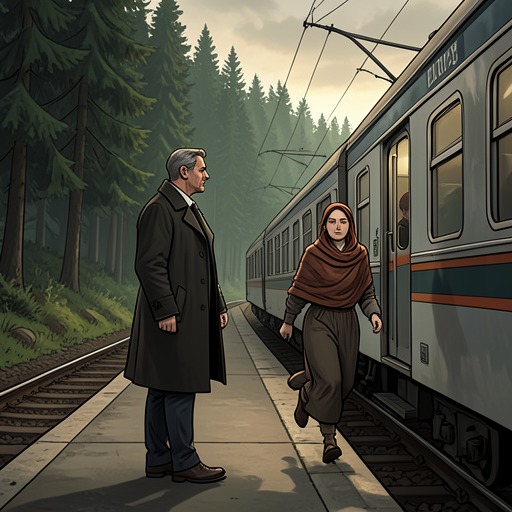
That same day, he leaves with the small amount of money supplied by the camp authorities to people willing to vacate their straw mattresses. He turns toward the railway, the forest, and the bend in the line where the earlier catastrophe took place. The tracks he finds are abandoned and overgrown. He follows them through successive forests, although the snow has vanished and the landscape offers little to confirm that he is on the right way. Old women he encounters do not answer his greetings. When the railway leads nowhere, he wanders through towns and villages instead.
The world around him treats the war as finished. There are songs, flags, speeches, and firecrackers; the crowds celebrate and make vows that such violence must never happen again. To the father, these scenes sharpen rather than soften his isolation. Everyone else seems to have entered the aftermath, while he remains bound to the dead and to the possibility that his daughter is alive. He moves through the celebrations like an apparition, carrying a private mourning that the public signs of victory cannot resolve.
Recognition at the Cheese Stall
Hunger persists even as the father walks. In a village square, he sees small cheeses on a table covered with an unusual cloth that seems woven with gold and silver threads. He touches the cloth and puts down a few coins; the contact brings back recognition. Behind the table sits Poor Woodcutter’s Wife, with a child on her lap. She speaks in a language he does not understand and gestures for him to take a cheese. The child also gestures, then indicates that the cheeses were made from the milk of the nearby Goats. He cannot follow every word, but he understands what the scene means.
The child is his daughter: the baby thrown from the train, whom he had saved. The recognition arrives through the ordinary particulars of the stall rather than through a spoken account of what happened. The cloth, the cheeses, the girl, Poor Woodcutter’s Wife, and the Goats connect the living scene before him to the remembered chain of loss and rescue. His daughter is not merely alive; she is present in a daily life that appears to contain affection and security. She smiles and gestures for him to take the food, unaware of his identity.
The father reaches toward the girl’s cheek. She catches his hand and presses it to her lips before laughing. He quickly withdraws it. Her spontaneous gesture gives him a moment of closeness, but it does not disclose who he is to her or change the relationship she has with Poor Woodcutter’s Wife. He looks at the woman, the Goats, and the child, fixing their shared happiness in his memory. Recognition fulfills the search in one sense, yet makes a reunion more difficult: what he has found is not an empty place waiting for him, but a child already held within another bond.
The Choice Not to Reveal Himself
The father considers whether to reveal himself, then judges that he has nothing to offer his daughter and might upset the balance of her life. The decision is neither a failure to recognize her nor a retreat from the effort to find her. He has reached the person he set out to seek, and the final obstacle is the consequence of that discovery: claiming his place would alter a happiness that exists without him. The narrative leaves his proposed alternatives unfinished, emphasizing the effort required to turn away rather than presenting the choice as easy.
He steps back, takes a few more steps, pauses, and finally tears himself away. The search therefore ends with knowledge but not reunion. He can carry the image of his daughter alive, smiling, and kissing Poor Woodcutter’s Wife, but he does not enter that scene as her father. His return to walking echoes the journey that brought him there, while its meaning has changed: he is no longer walking toward an unknown child. He leaves after recognizing her, accepting separation as the price of preserving the life he has found.