The heartless have a heart
The Most Precious of CargoesThe heartless have a heart is the Poor Woodcutter’s Wife’s insistence that the child her husband calls heartless is not without feeling or life. In a tense domestic scene, she turns that claim into something he can physically recognize: she stops him from striking the child, places his hand against the child’s chest, and asks him to feel the heartbeat. The phrase then recurs, first as her whispered appeal and finally as the Poor Woodcutter’s own thunderous declaration. Its significance lies in that change of speaker and force: what begins as an argument for the child’s humanity becomes a truth he voices himself.
The Phrase in Its Scene
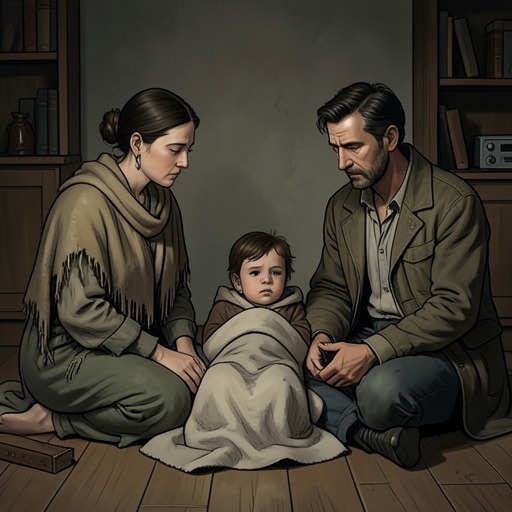
The words emerge during a night when the child’s crying wakes the Poor Woodcutter. Angry and overwhelmed, he raises his hand toward her. The Poor Woodcutter’s Wife catches it before he can strike and holds it suspended. She then places his hand against the child’s chest, keeping it there despite his effort to pull away. The scene makes the phrase a response to an immediate threat and disagreement, not a detached maxim.
The child is the Poor Woodcutter’s Wife’s beloved little cargo, while her husband calls the child a demon and a cursed heartless creature. Their opposed descriptions establish the conflict around the expression: he treats the label as a reason to reject the child, whereas she challenges the label by directing his attention to the child’s living body. Her action supplies the basis for her words. Rather than asking him to accept an abstract claim, she asks him to feel the small heartbeat for himself.
Repetition as Persuasion
The expression is built around insistence. The Poor Woodcutter’s Wife repeats her request that the Poor Woodcutter feel the heartbeat, then repeats that the heartless have a heart. The recurrence links a physical sensation to a moral conclusion: the child’s heartbeat contradicts the idea that being called heartless means being less than human. Her comparison of the child’s heart with the hearts of herself and her husband extends that recognition beyond the immediate fact of life and places the child within a shared human likeness.
The phrase also appears in a broader formulation that applies to a man or a child: the heartless have a heart beating inside the chest. That wording makes the claim general rather than exclusive to this one child, while the scene keeps its proof intimate and specific. The expression’s force comes from the combination: a universal assertion is made through one person’s hand resting against one child’s chest. Its repeated form sustains the appeal through the Poor Woodcutter’s anger, allowing the same claim to be heard more than once without changing its central meaning.
From Whisper to Declaration
At first, the Poor Woodcutter’s Wife speaks quietly, holding her husband’s hand in place as he roars in rejection. The contrast between her whisper and his anger gives the phrase a practical purpose: she is trying to interrupt his response and redirect his attention. The words accompany a gesture of care, and the hand he raised toward the child is made to register the heartbeat instead.
Later, the Poor Woodcutter surprises himself by saying the same phrase in a thunderous voice. Before speaking, he slams his tin cup onto the rickety table, which collapses. The action marks a shift in the scene’s sound and energy: the declaration is no longer only the wife’s quiet counter to his anger. He repeats her central words aloud, with a force of his own. The text presents this as a moment of change in his response, but does not by itself establish what he will do in every later circumstance.
Narrative Significance
The expression connects bodily evidence, speech, and recognition. The Poor Woodcutter’s Wife does not answer the label with another label; she makes the child’s heartbeat the center of the exchange. The repetition gives the scene its progression: first a request to feel, then an assertion about the heartless, and finally the Poor Woodcutter’s echo of that assertion. In that sequence, the phrase moves from persuasion between spouses to a statement the initially rejecting husband also voices.
The wording does not erase the disagreement that gives it urgency. The Poor Woodcutter has resisted the child, and his wife has had to intervene directly. What changes within the scene is that the claim she makes for the child becomes audible in his own voice. The phrase therefore functions both as a defense of the child’s humanity and as the scene’s measure of a turning point: the child is not made acceptable through a new name, but recognized through the beating heart the Poor Woodcutter is asked to feel.