Wood-Alcohol Distiller
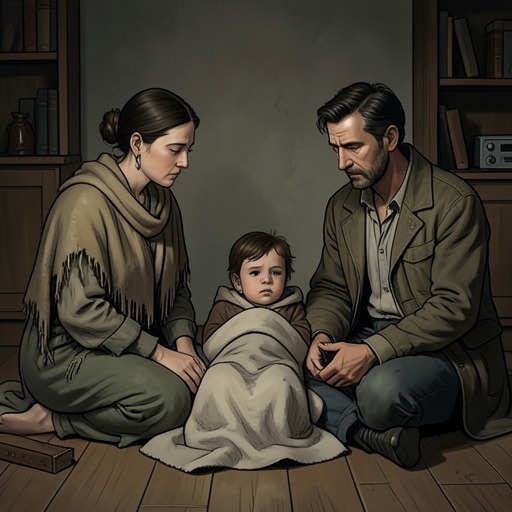
The Most Precious of CargoesThe Wood-Alcohol Distiller is a co-worker of the Poor Woodcutter and the maker of the homemade drink around which the woodcutters gather. His role shifts from provider of conviviality to participant in the attempt to seize the Poor Woodcutter’s adopted daughter: after questioning the Poor Woodcutter’s Wife about the child, he returns with militiamen. The Poor Woodcutter attacks him with an ax, turning an apparently ordinary comrade into the immediate focus of the household’s desperate resistance.
Work and Place in the Community
The Wood-Alcohol Distiller is introduced through his small-scale enterprise. Among the Poor Woodcutter’s co-workers, he is the one enterprising enough to establish a home still and provide the drink at their post-work gatherings. The narrator pointedly refuses to give its recipe, adding that wood alcohol is inadvisable to drink and, in large quantities, causes blindness. That warning makes the drink more than a casual emblem of fellowship: the men’s chosen refuge from their labor is itself dangerous.
The Poor Woodcutter, newly buoyed by happiness in his family life, sometimes joins these evenings reluctantly, giving up time he would rather spend at home. His co-workers drink together after work, talking and raising successive glasses. The Wood-Alcohol Distiller’s still thus brings him into the setting where their shared complaints acquire a more threatening political language. He is not shown as the author of the men’s hostility, but his drink helps furnish the occasion in which it is voiced and echoed.
The Drinking Circle and the Bounty
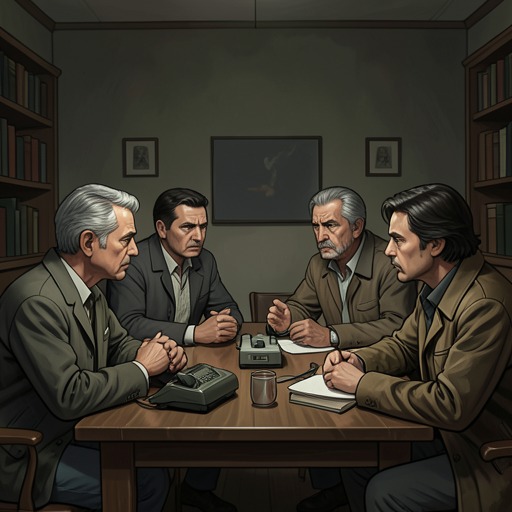
At the gatherings, the men first toast the end of the war and then the destruction of the heartless. One claims that a crowded train returning empty had carried heartless people from across the world; another objects that they are paid starvation wages while those passengers travel free. The accusation escalates: the heartless are blamed for killing God and causing the war, and the men cheer their death. The Woodcutter remains silent at first, even as the group turns toward him for a response.
In this scene, the Wood-Alcohol Distiller is identified as the man making the drink. The account does not give him a speech endorsing the group’s slogans. Instead, it records his recollection of a prewar practice: local authorities had offered a reward for the head of every verminous animal brought by hunters to the town hall. The detail sets official reward and sanctioned hunting beside the men’s talk of extermination. It also shows that the violence of their language has a precedent in a public order that classified living creatures as vermin and made their killing remunerative.
The Poor Woodcutter finally breaks his silence with the words, “The heartless have a heart.” His answer contradicts the group’s premise by insisting on the humanity of those they have reduced to a category. His companions dismiss him as drunk and resume singing songs taught by their masters and by the Hunters of the Heartless. The Wood-Alcohol Distiller’s recollection of the animal bounty falls within this same drinking episode, where casual recreation, inherited political slogans, and the logic of organized killing press against one another.
Encounter with the Child
Later, as the Poor Woodcutter’s Wife walks home through the undergrowth with the child and their gathered firewood, she meets the Wood-Alcohol Distiller. He politely asks, “Where did she come from, this little one?” The Poor Woodcutter’s Wife answers that the child is hers. The Distiller studies the child for a long moment, then looks at the woman, smiles, and takes his leave after raising his moleskin cap and wishing them a good day.
The encounter is outwardly courteous, but its sequence gives it a menacing weight. He notices the child, asks where she came from, and examines both her and the woman before departing. The narrative does not state what he concludes or what he says to anyone afterward. But shortly before dawn, the comrade in the moleskin cap returns with two militiamen to take delivery of the child. The close repetition of the cap and the earlier encounter links the two scenes and strongly suggests that the questioning has helped expose the household to official intervention.
The Raid and Its Reversal
When the Wood-Alcohol Distiller and the militiamen arrive, the Poor Woodcutter initially denies that the child is not his and claims she is his daughter. Under threat of death, he confesses, then asks to hand her over to his comrade so the transfer can be made gently and the rifles will not alarm his wife. He calls loudly for his wife to prepare the child and bring the visitors a drink, presenting the Distiller as a workmate rather than revealing the danger at the door.
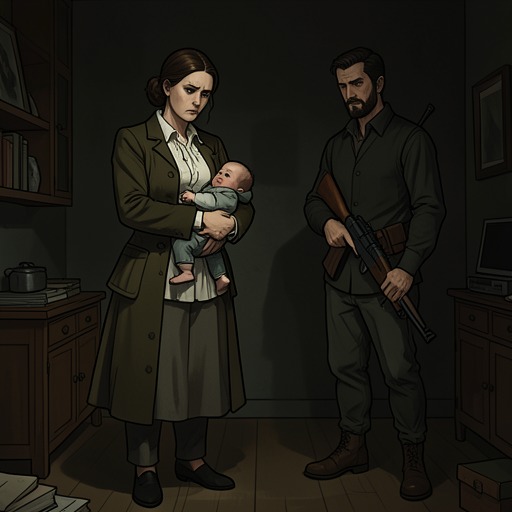
The Poor Woodcutter’s Wife enters carrying the child, who reaches toward the Poor Woodcutter. He takes up his ax and strikes the Wood-Alcohol Distiller, shouting for his wife to flee with the child. He brings the ax down repeatedly on the moleskin cap covering his workmate’s head, then goes outside and fells one militiaman. As the other retreats and fires, the Poor Woodcutter continues forward with the ax. His wife escapes while he falls, urging her to save herself and their child. The narrative records the blows and the Poor Woodcutter’s collapse, but does not subsequently report the Distiller’s condition.
Narrative Role and Significance
The Wood-Alcohol Distiller’s trajectory is defined by a sharp contrast between ordinary proximity and grave consequence. He is a fellow laborer who provides the drink at gatherings, then a familiar figure encountered on a woodland path, and finally one of the armed intrusion’s participants. The text does not supply a private explanation for his actions or establish precisely how the child’s whereabouts came to the attention of the militiamen. Its sequence instead makes the change in his role visible: a seemingly polite question precedes his return with men who intend to take the child.
His home still also connects the men’s shared poverty to the language of persecution. They drink to escape the day’s labor, yet in their company the heartless become the explanation for war and the objects of calls for extermination. The Wood-Alcohol Distiller’s memory of the bounty on animal heads sharpens that connection: the rhetoric of hunting and the classification of victims as vermin are presented not as distant abstractions but alongside the men’s own convivial routine. Against that routine, the Poor Woodcutter’s declaration that the heartless have a heart marks a refusal to join the chorus. The Distiller’s later appearance at the cabin makes the household’s peril concrete, and the Poor Woodcutter’s violent defense turns that refusal into action.