12 September 1980
The Museum of Innocence12 September 1980 is the date of the military coup that transforms the political atmosphere around Kemal’s regular visits to Füsun at the Keskin Family Home. Remembered through his experience, the coup first appears as an uncanny emptiness in the streets; its ten o’clock curfew then imposes a hard limit on the private routine he had built around evening meals in Çukurcuma. The event matters not only as a national rupture but as an interruption measured in lost minutes with Füsun.
The Morning the City Fell Silent
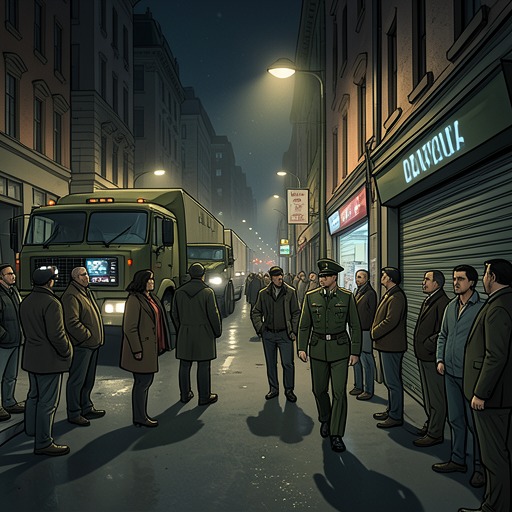
Kemal recalls waking before the others and looking out over Teşvikiye Avenue. The streets leading off it were empty, and he immediately understood what had happened: coups, he thought, came every ten years. Army trucks occasionally passed, filled with soldiers singing martial songs. He switched on the television, watched flags and military parades, and listened to the generals who had seized power before going out onto the balcony.
The stillness brought him an unexpected calm. From the balcony he admired the emptied avenue, while the rustling chestnut leaves in the courtyard of Teşvikiye Mosque soothed him. The view also carried a private echo: exactly five years earlier, at the same early hour, he had stood on that balcony with Sibel after their end-of-summer party and admired the same scene. The coup therefore makes the city’s altered present overlap with an earlier moment in Kemal’s life, before the long sequence of dinners that would bind him to Füsun’s family.
The day’s television coverage and newspapers made the change in public life visible inside Kemal’s home. His mother watched a folk singer perform songs of war and heroism; Kemal spent the day with her reading special newspaper editions that welcomed the coup and watching repeated recordings of the generals’ announcement, interspersed with old images of Atatürk. From the window he watched the streets remain empty. Army trucks suggested that politicians, journalists, and others were being taken from their homes into custody, while rumors of house searches recalled the measures associated with the 1971 coup. His curiosity turned toward how Füsun and her family were faring in Çukurcuma, though the account does not describe him visiting them that day.
The Coup Enters the Evening Routine
The political upheaval changed the terms of Kemal’s visits. He had begun going to Çukurcuma for supper on 23 October 1976, and his record counts 1,593 visits across 2,864 days, ending on 26 August 1984. The coup came four years into that pattern. The visits were not mechanically regular: some weeks he went every day, while at other times he stayed away, but more than ten days without seeing Füsun brought back the misery of his earlier separation. The Keskin family had grown used to expecting him and kept a place for him at the table.
Before the coup, a visit commonly stretched from around seven in the evening until shortly after midnight. Kemal estimates that he spent about five hours at the house on an average visit, though he sometimes stayed longer. The television helped structure those evenings. It had become the household’s practical timekeeper, taking over that role from the wall clock and radio. At seven, when the large clock appeared on screen just before TRT’s news, Füsun checked her wristwatch and Tarık Bey checked one of his pocket watches. Kemal cherished the sight of Füsun adjusting her watch and smiling when she had the time right. The national broadcast that organized the household’s ordinary evening would, after the coup, also carry the generals’ lectures and political denunciations into it.
With martial law came a ten o’clock curfew. Kemal had to leave at a quarter to ten, well before his longing felt satisfied. As Çetin drove him through dark streets that emptied quickly before the deadline, the required journey home sharpened his sense of deprivation: he felt he had not seen enough of Füsun. In later years, news reports about military displeasure with the state of the nation brought back to him, above all, this personal consequence of coups—the forced end of his evenings at the Keskin Family Home.
Political Authority at the Dinner Table
The coup’s reach was not limited to the curfew. During the evening news on the country’s only television channel, the generals attacked politicians and dissident intellectuals and addressed the nation about the bad habits they said had led it astray. The broadcast made the political order an unavoidable presence in the household, alongside supper and conversation. In the surrounding atmosphere, the authorities jailed not only political figures but also common swindlers, brothel keepers, tombala operators selling black-market cigarettes, people accused of traffic violations, wall slogan-writing, and involvement in pornographic films. People linked with terrorism were summarily executed as examples.
When reports of these events reached the dinner table, the family fell silent. For Kemal, that shared silence made him feel closer to Füsun, as though he had become part of the family. Their ordinary gathering thus acquired a second meaning: it was a private refuge, but not one insulated from the state or the violence beyond the home. The coup’s presence could be heard in the news and felt in the abrupt hush around the table.
The household’s small objects and routines sharpen this contrast. Before and around the coup, decorative dogs placed on the television seemed to bring peace by their presence, and the family’s sense of shelter took on added force as gunfire echoed through the neighborhood and the outside world seemed increasingly unreal. The coup did not create every danger around the house, but it intensified the pressure of public events on domestic life. The home’s familiar sights and shared meals offered a fragile counter-rhythm to the emptied streets, military broadcasts, and curfew.
Significance in Kemal’s Recollection
The date links official time to Kemal’s private measurement of life. The state’s curfew sets a departure hour; the television news and its clock mark the evening; Kemal, meanwhile, measures the same period by how long he can remain near Füsun. The coup’s political chronology is therefore registered in a deeply personal unit: the supper cut short and the minutes he believes he is owed.
That emphasis does not erase the wider consequences of military rule. Kemal records arrests, executions, the removal of public figures, and the generals’ authority over television, while also admitting that he and his family were thankful not to have involved themselves in politics. His recollection holds these scales together without making them equivalent. The coup is a national seizure of power, but in the intimate structure of his story it is also an enforced interruption of a daily life organized around returning to Füsun. The balcony’s repeated view, once shared with Sibel and later watched in the silence of the coup morning, makes political change and personal memory occupy the same Istanbul landscape.