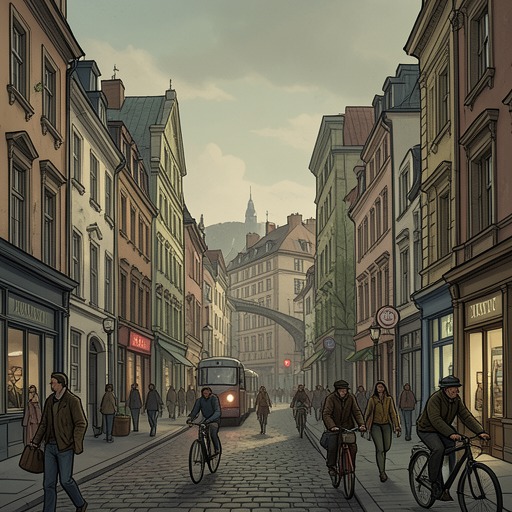
Beyoğlu
The Museum of InnocenceBeyoğlu is a central Istanbul setting in which public life and private memory continually overlap. Its cinemas, shops, bars, and winding streets give Kemal places to seek distraction, pursue the film world, and search for Füsun; later, the district becomes the setting for their long-imagined reunion and the beginnings of their renewed relationship.
District and Everyday Geography
Beyoğlu is presented not as a static backdrop but as a place shaped by movement between neighborhoods and by the different lives conducted along its streets. From the Keskin family home in Çukurcuma, a ten-minute walk up steep, winding streets leads to Beyoğlu and İstiklal Avenue. On some evenings, Çetin drives Kemal, Füsun, and Feridun up the hill after supper. From the back seat, Kemal looks into houses and shops and at people on the sidewalks. Their route passes dilapidated wooden houses and vacant buildings, linking the film-going and social world above the hill to the poorer residential streets below.
The district also carries the social texture of Istanbul’s wealthy neighborhoods. Fuaye, an imitation-French restaurant favored by a small wealthy circle, belongs to a culture that sought a subtle suggestion of Europe rather than the grandiosity of names such as the Ambassador or the Royal. The preference for names such as Fuaye, meaning lobby, suggests a particular social position: Istanbul imagined as being at Europe’s edge. Beyoğlu’s identity therefore includes both the aspiration to Western style and the local setting in which that aspiration is performed.
Its streets also form a network of remembered routes and recognizable landmarks. Kemal walks through Osmanbey and down Cumhuriyet Avenue before being drawn into a cinema by a poster advertising a Hitchcock week; elsewhere he paces between Ağa Mosque and Palace Cinema, sits at a beer-hall window, or approaches İstiklal Avenue from Taksim. These routes give the district a practical geography of shops, theaters, and places to stop, but for Kemal they acquire an additional, emotional map.
Refuge, Search, and the City of Signs
After his separation from Füsun, Kemal tries to avoid the places associated with her. He formally forbids himself from visiting the Merhamet Apartments, waiting for her, or touching objects that recall her. Because earlier efforts at self-restraint had failed, he removes streets and locations from his mental map. His Nişantaşı map marks the Şanzelize Boutique, the Merhamet Apartments, the police station, and Alaaddin’s shop in red as forbidden areas; other streets receive a lesser restriction. This self-imposed geography makes clear how an ordinary city can become organized around the effort not to encounter a lost relationship.
Beyoğlu initially appears to offer some relief because it contains fewer reminders of Füsun. Yet that separation proves impossible to maintain. In one shop window Kemal thinks he sees her reflection; on another occasion he notices a girl moving through a crowd in a way he associates with Füsun and follows her without catching up. Unsure whether the sighting was real, he returns for several days to walk between Ağa Mosque and Palace Cinema. When no glimpse comes, he sits at a beer hall and watches the passing crowds. The search turns public space into an uncertain field of recognition, where a reflection or a passing figure can briefly reorganize his attention.
Kemal knows that these apparitions are not Füsun, but he continues to frequent places where they might occur. He adds such locations to his mental map of Istanbul, until the city becomes a network of signs that recall her. His movement through the district is thus both avoidance and pursuit: Beyoğlu keeps him away from the most direct reminders while offering the possibility, however fleeting, of seeing her again. The streets do not resolve his absence; they give it a route and a recurring form.
That search draws him beyond the affluent social life he once shared with Sibel and his friend Mehmet. He loses interest in the newest restaurants of Nişantaşı and Bebek and in conversations about what their partners are buying in Paris. When Sibel calls, he feels he has nothing to say; even the comfort of her embrace is overshadowed by guilt about his divided loyalties. In contrast, Kemal’s time in and around Beyoğlu increasingly belongs to solitary walks, cinemas, and the effort to recover a connection that is no longer available to him.
Cinemas, Social Life, and Film Work
The district’s cinemas provide both diversion and a structure for Kemal’s anticipation. During a spring visit, he wanders through Osmanbey and is drawn by a poster into a Hitchcock screening. The account associates this cinema visit with the cigarette he smokes during the intermission, the usher’s flashlight, and an Alaska Frigo ice cream that he later displays as a reminder of youth. The screening gives him a temporary interval of solitude before he goes on to see Füsun, and the prospect of meeting her makes the outing emotionally charged.
Beyoğlu is also a gateway to the film industry that Füsun and Feridun hope to enter. The trio visits backstreet haunts, possible production offices, coffeehouses where actors and film workers play cards, and bars where producers, directors, and actors gather in the evenings. Their most frequent destination is Pelür Bar, where aspiring performers, established film people, journalists, critics, and gossip columnists exchange stories and ideas. Kemal accompanies Füsun and Feridun into this community after supper, sometimes collecting them at their door and sometimes walking with them up the hill.
The film world becomes a practical as well as an imagined connection among the three. At Yeni İpek Cinema, while watching two melodramas, Feridun mentions that an actor he knows could take a role in their proposed film. Kemal realizes that entering Yeşilçam solely to stay close to Füsun will be difficult: film production has its own relationships and demands, beyond his private hopes. Later, Feridun begins shooting Broken Lives, and the film’s commercial success changes Kemal’s standing in the industry. When cinemas regain audiences after the years preceding the military coup, Pelür Bar fills again. During an October visit made two hours before curfew, Kemal finds himself treated as a prominent producer, with actors and crew members seeking his company. A place he had entered as an observer and companion now reflects his public success.
An Uneasy Nightscape
Beyoğlu’s public streets do not always feel open to ordinary social life. One evening, Kemal walks along İstiklal Avenue and is surprised by how empty it is. Outside the Palace and Fitaş cinemas, which are showing sex films, he sees only a few men; in Galatasaray Square he sees neither women nor families. When he realizes how near he is to Füsun’s home, he turns away. Continuing past Galata Tower and down Yüksekkaldırım, he encounters the usual crowd near the street of the bordellos. The episode places Kemal’s private effort to resist the pull of Füsun’s home within a broader nightscape marked by uneven access, loneliness, and streets used differently by different groups.
The district’s social life also offers episodes of temporary release. In a crowded park, Kemal encounters Tayfun and Figen, who do not mention the gossip about him. Relieved, he leaves with them, and they drive to one of the new bars in Taksim, where they drink until morning. Such outings do not end his longing, but they show that Beyoğlu and its adjoining areas remain places where he can slip into company, even when that company cannot address the emotional crisis organizing his life.
Reunion and a New Routine
On April 9, 1984, Kemal returns to Beyoğlu anticipating a meeting with Füsun. He asks Çetin to leave him in Taksim early, then walks through İstiklal Avenue among its shops and cinema entrances. The streets bring back childhood memories while also holding out the possibility of a future with Füsun. When they meet, he proposes that they walk together, recalling the years he had spent imagining such a walk in Beyoğlu. The district is no longer only the setting of searches for an absent figure: it becomes the place where the two can meet openly and share a route.
After Füsun sets conditions for their renewed relationship, Kemal arranges for a lawyer to represent her in her mutual divorce from Feridun. Because he can no longer visit her in Çukurcuma, the couple meet every other day in Beyoğlu and go to the cinema. They choose a theater after looking over the posters at Galatasaray, buy tickets, and sit together toward the back, holding hands as they watch the film. The cool, dim theaters that had offered Kemal childhood comfort and solitary anticipation now provide a place for shared time. Beyoğlu’s significance changes with this return: its routes of pursuit and evasion give way, at least for a time, to a repeated practice of meeting and walking together.