Collecting as consolation for grief
The Museum of InnocenceCollecting as consolation for grief is the practice through which Kemal gives material form to loss: he keeps objects connected to Füsun so that moments with her will not vanish into the past. The collection does not restore the relationship or erase grief. It preserves traces, makes private pain legible, and eventually provides the structure for the Museum of Innocence.
Loss and the need for tangible memory
Kemal’s collecting takes shape after Füsun’s death, when the loss of desire changes into the pain of remembrance. During rehabilitation, as he learns to walk again, he understands that Füsun is becoming a figure of the past rather than the object of a future he can still pursue. The idea of a museum first comes to him in this interval between physical recovery and emotional bereavement: a way to give meaning to suffering that no longer takes the form of wanting her.
The impulse to preserve the past has an earlier logic. Looking back on the moment he names the happiest of his life, Kemal recognizes that choosing it as the peak of happiness also means acknowledging that it is gone and cannot return. He argues that people endure this pain through things belonging to the moment, which preserve its colors, textures, images, and delights with a fidelity that even its human participants may not retain. In the scene itself, Füsun’s earring falls onto the blue sheet while they make love. The small, unnoticed object becomes inseparable from the moment Kemal later treats as both lost and uniquely vivid.
His father’s death offers a parallel, though distinct, lesson in how loss changes ordinary things. At the family apartment, Kemal opens his father’s drawers and encounters old phone bills, telegrams, medicines, cedar fumes, and sugary cough syrup. Familiar objects have become vessels of a vanished childhood and a lost world. Elsewhere, his father’s hidden pearl earrings carry the remorse of a man who had failed to express his admiration while the woman he loved was alive. For Kemal, such objects demonstrate how affection and regret can become attached to things, and how late recognition gives them a weight they did not have before.
From private compulsion to repeated practice
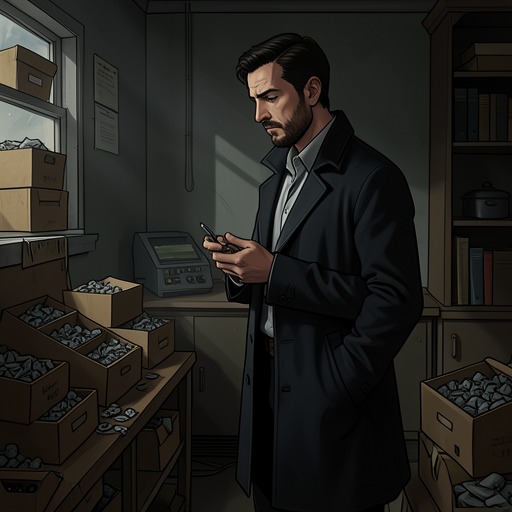
After Füsun’s disappearance, collecting develops through small acts of taking and concealment. Kemal begins with items easy to remove unnoticed: matchboxes, cigarette butts, saltshakers, coffee cups, hairpins, and barrettes. As his attention expands to ashtrays, cups, and slippers, he starts replacing some of what he takes with new things. The repeated substitutions preserve his access to objects associated with Füsun while allowing the household’s daily routines to continue around their absence.
By 1979, the Keskin household has noticed that belongings are disappearing and more expensive replacements are appearing, but nobody openly discusses the pattern. Kemal’s collecting remains bound up with embarrassment: he does not yet want to share it, and he is ashamed of hoarding. A Chinese porcelain dog on the television offers a glimpse of that uneasy exchange between taking and replacing. After Füsun shifts the dog with an impatient flick of her wrist, Kemal later takes it and explains its absence by saying it broke and that he brought a replacement. Nesibe the seamstress welcomes the substitute, unaware—or at least not openly acknowledging—what the exchange means to him.
Objects do not always work as reliable keys to shared memory. On New Year’s Eve 1980, Kemal introduces an antique glass connected to his last rendezvous with Füsun, on the day of his engagement. The family has accepted his habit of taking and replacing things, so the glass appears among ordinary tombala prizes. When Tarık Bey wins it, Füsun does not recognize it as the glass from that painful day. Tarık Bey uses it for raki over the following three and a half years. Kemal wants the glass to return him to a moment of happiness, but at the family table he cannot properly inhabit that memory. The object can carry his private history without making that history shared.
Objects, time, and the limits of consolation
For Kemal, collecting is also a way of gathering moments that time would otherwise carry toward an ending. He thinks of time as the line joining separate present moments; a museum, in turn, can link objects that contain those moments. This preservation does not defeat time. On the contrary, tracing the line through the objects makes its end—and therefore death—harder to ignore. The collection offers consolation precisely because it keeps particular moments close, but it cannot make them recur or undo the loss that gives them significance.
Everyday things acquire meaning through the habits and settings in which they have been used. The tombala gifts of New Year’s Eve, including simple household goods, recall the slow, humble rhythm of the Keskin household’s routines. A saltshaker can be at once a manufactured item and the vessel of a particular family meal. Kemal also sees the objects themselves as part of a broader material world: identical lighters and saltshakers appear in flea markets and ordinary kitchens across cities and countries. Their mass circulation contrasts with the intensely particular memories he attaches to individual examples. A common object may belong to countless households, yet its place in one life gives it an intimate history.
The consolation remains fragile. Objects can preserve details more faithfully than recollection, but they do not guarantee that another person will remember the same event or recognize the same meaning. The antique glass’s history stays with Kemal even as it passes into Tarık Bey’s ordinary use; the collected things make his loss visible to him without requiring the household to name it. Their power lies less in recovering an intact past than in holding evidence of how deeply it mattered.
Making a museum from grief
The turning point comes when Kemal begins to imagine bringing the collection into the open. At the Merhamet Apartments, he sits among the objects and senses that telling his story might ease his pain, but doing so would require revealing the hoard. Paris gives this private possibility a public form. Wandering through small museums rather than only celebrated, crowded institutions, he finds consolation in collections of intimate things: hairbrushes, combs, teddy bears, household objects, and spaces arranged around the traces of individual lives. He begins to imagine a museum that could frame his own story through what Füsun left behind.
The examples he encounters help him rethink what deserves display. At the Musée Nissim de Camondo, domestic plates, forks, and knives appear worthy of preservation; the Musée de la Poste suggests a place for letters; the Musée Maurice Ravel’s toothbrushes, cups, figurines, toys, and iron cage make personal objects feel appropriate to a collection. These visits release Kemal, gradually, from the shame of seeing himself as an oddball who has hoarded things. He can instead understand himself as a collector preparing an account of a life.
That shift does not mean collecting has become an uncomplicated or universally respected practice. Kemal distinguishes collectors who proudly exhibit their holdings from those who conceal them. In a society where collecting is not widely regarded as a contribution to knowledge, the bashful collector may experience the collection as evidence of a private wound. In Istanbul in the 1990s, personal museums are nearly nonexistent, and collectors may be contemptuous of their own obsessions as well as one another’s. When someone asks why Kemal wants the objects, the question exposes the grief beneath his project: the accumulation is not neutral, but a response to heartbreak and distress that he has struggled to make speakable.
The Museum of Innocence gives that hidden wound a narrative and a place in public view. Kemal brings together the objects stored at the Merhamet Apartments, things from the Keskin household, and further pieces gathered during his travels and from other people. He also transfers the bedframe, musty mattress, and blue sheet associated with the room where he and Füsun made love, placing them in the attic. The private collection becomes a museum without ceasing to be personal: it arranges material traces so visitors may encounter the ordinary life that grief has made precious. Collecting consoles Kemal not by closing the past, but by giving its objects, and the story attached to them, somewhere to remain.