Füsun’s childhood handkerchief
The Museum of InnocenceIdentity and provenance
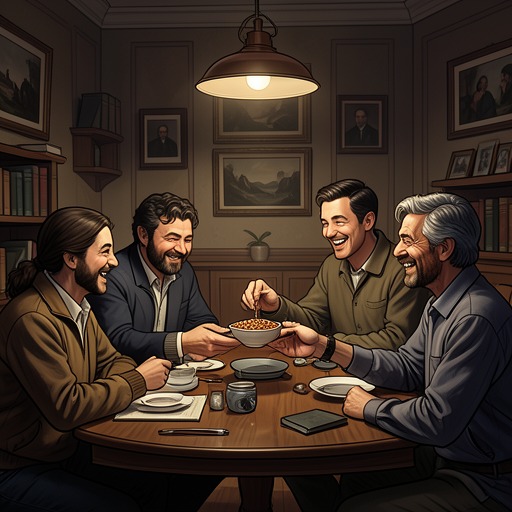
The handkerchief belongs to Füsun’s childhood, as Nesibe explains when she gives it to Kemal. It appears not as a luxury or a deliberately prepared keepsake but as one of the modest presents distributed during the family’s New Year’s tombala gathering. Its history is therefore tied to household routine: a familiar personal object is brought into a game, won as a prize, and carried away by a visitor whose attachment to Füsun makes the handkerchief more than an incidental gift.
The narrative gives the object a particular provenance through that exchange. Kemal wins the game by completing the top line on his card first and calling out “Chinko!” He responds to the handkerchief as a conventional, almost joking prize, repeating the sort of remark adults made when they won something intended for a child: “This is just the sort of handkerchief I needed!” Nesibe then supplies the detail that changes its significance: “It’s one of Füsun’s childhood handkerchiefs.” What might have remained an ordinary game token becomes a named remnant of Füsun’s past.
A gift within the tombala ritual
Nesibe’s gift belongs to a repeated New Year’s practice rather than to a private exchange between Kemal and Füsun. At these gatherings, presents could be simple household necessities, including children’s socks and handkerchiefs. Their limited material value did not prevent the game from making them exciting: the pleasure lay partly in winning, and an everyday object could briefly acquire the heightened status of a prize. The handkerchief’s journey from that communal ritual into Kemal’s pocket begins in this overlap between ordinary use and temporary celebration.
Its presentation also carries a generational echo. Kemal remembers that, as a child, an older guest who won a present meant for a child would say the same thing about needing the handkerchief. His father and friends would wink, implying a meaning beyond the children’s understanding. In the later gathering, Kemal repeats the familiar line himself. The gesture links his adult visit to the household with the childhood New Year’s games he recalls, while Nesibe’s identification of the prize as Füsun’s makes the old joke unexpectedly intimate.
The family’s manner of distributing presents helps explain why the object can move so easily between people. The gifts make useful things feel valuable for a moment, but the household’s possessions are not always treated as the exclusive property of one individual. That shared domestic understanding differs from Kemal’s imagined picture of Füsun’s private belongings: he had tormented himself with dreams of the room she shared with her husband and the wardrobe containing her own clothes and things. Against that imagined private space, the handkerchief is both plainly part of a family world and intensely personal to him because of its connection to Füsun.
Pocketed and claimed
Kemal’s acquisition of the handkerchief is not simply a lucky win. At the end of the 1982 New Year’s Eve, as he is preparing to leave, Ali approaches him and asks to see the handkerchief he won. The boy has grown increasingly admiring of Füsun and knows that the object was hers when she was a child. Kemal pretends not to know where he put it, but Ali has watched him put it into his pocket and points directly to its hiding place.
Ali nearly reaches into Kemal’s pocket. Kemal steps backward, then tries to end the encounter by reminding the boy that it is late and his parents will blame the household. Ali persists, asking whether Kemal will give him Füsun’s handkerchief. Kemal answers in a whisper, frowning: “No. I need it.” The exchange makes the handkerchief’s new status unmistakable. A prize that began as a shared family gift has become an object Kemal claims for himself, and his need for it overrides the child’s request to handle something he recognizes as part of Füsun’s past.
The scene also distinguishes Kemal’s quiet concealment from the open rules of the game. He has won fairly, but the real contest is no longer about the tombala card: it is about who may keep and touch the object. Ali’s knowledge punctures Kemal’s pretense, while Kemal’s retreat and whispered refusal reveal how much he wants to retain it. The handkerchief’s smallness makes it easy to pocket; that same unobtrusiveness allows a private attachment to hide inside an ordinary household gathering.
Memory, collecting, and domestic life
The handkerchief belongs to a broader pattern in which Kemal takes objects from the Keskin home and gives them a private importance. His collecting begins with things easy to remove without notice, such as matchboxes, cigarette butts, saltshakers, coffee cups, hairpins, and barrettes. Over time he reaches for larger household items and sometimes replaces what he takes. The handkerchief’s route is distinct: he receives it openly as a prize, yet his refusal to let Ali have it shows how a legitimate gift can become part of the same possessive practice.
Its value is not presented as a matter of price. At the tombala gathering, small presents make ordinary possessions briefly precious; in Kemal’s keeping, association with Füsun gives the handkerchief a more enduring charge. It connects him not only to the woman he visits but to a version of her that predates their adult relationship. The object therefore carries a double attachment: it remains a household item distributed in a family ritual, while also serving Kemal as a tangible link to Füsun’s childhood.
The handkerchief’s meaning is produced through these changes of context rather than through any unusual physical feature. First it is a child’s useful possession; then a prize in a game; then a recognized piece of Füsun’s history; finally, an object Kemal keeps because he says he needs it. The movement from shared domestic routine to personal possession exemplifies how, in his collecting, familiar things gather emotional force through their connection to remembered lives. Here that process is especially legible because Nesibe names the handkerchief’s origin and Ali recognizes its owner: both details confirm the history that Kemal is trying to hold close.