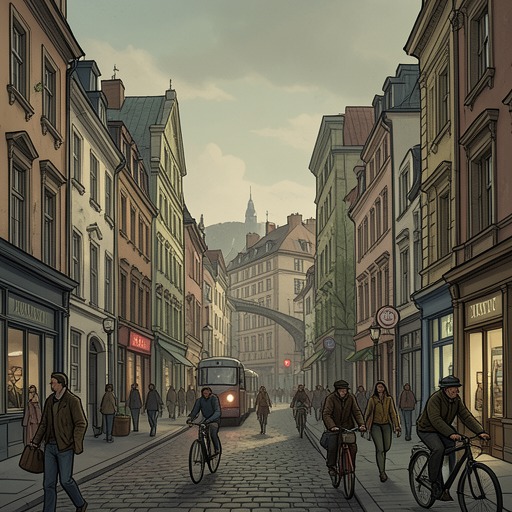
Istanbul’s urban transformation after Füsun’s death
The Museum of InnocenceIstanbul’s urban transformation after Füsun’s death is presented not simply as a change in buildings and neighborhoods, but as a rupture between a city Kemal Basmacı once knew through shared routines and the unfamiliar city he encounters afterward. New districts and commercial habits make that rupture visible; at the same time, memories, lost landmarks, and altered social relations turn urban space into a measure of grief. The city changes around Kemal, but it is also his bereavement that makes its changes feel irreversible.
The City Before the Rupture
Before Füsun’s death, Kemal’s experience of Istanbul was organized by routes, prohibitions, and imagined encounters. During his earlier attempt to forget her, he drew a strict mental map: some streets were forbidden, others could be crossed only in necessity, and even familiar places such as his home and Teşvikiye Mosque were dangerous if he lingered. The Şanzelize Boutique, the Merhamet Apartments, Kuyulu Bostan Street, and the road between the boutique and Füsun’s home became charged locations rather than neutral points on a map. The boundaries were emotional, but their effects were practical: Kemal tried to manage his longing by changing where he could go.
The city also became a field of apparitions. Kemal began visiting crowded places where he thought he might glimpse Füsun’s ghost, then added those locations to his mental map. Istanbul seemed to him a galaxy of signs pointing toward her. When the ghosts appeared in poor neighborhoods such as Vefa, Zeyrek, Fatih, and Kocamustafapaşa, he explored their streets, coffeehouses, and squares, treating even a false sighting as a reason to stay. His searches made urban wandering part of the affair’s afterlife: the city was at once the setting of his pursuit and a pattern of memory he kept redrawing.
Shared routines could briefly make that pattern feel spacious rather than restrictive. In Beyoğlu, Kemal and Füsun met to choose films, then sat together in cool, dim cinemas. During summer double features, a hand could find the other before either person had spoken; between films, they exchanged news in whispers. Such theaters gave their meetings the unhurried quality of a world set apart from ordinary obligations. They show how particular places acquired meaning through repeated gestures, not merely through their architecture.
Change Made Visible
A striking sign of change was the closure of the Şanzelize Boutique, the shop window where Sibel had noticed the counterfeit Jenny Colon handbag nine years earlier. The old display had become a grocery window filled with Italian salamis, hard yellow cheeses, bottled salad dressings, pasta, and soft drinks from European brands newly entering the Turkish market. The replacement was concrete and commercial, yet for Kemal it also marked the loss of a personal landmark. What hurt was not only that the shop had changed, but that life had continued there without him.
Other signs of modern urban life arrived in the form of new districts and altered habits. Bosphorus restaurants were no longer reserved for special occasions; people went on any day of the week. Mehmet introduced Kemal to newer clubs and bars favored by advertisers and wealthy patrons, and to neighborhoods described as the city’s up-and-coming areas. On another outing, Kemal and Nurcihan ate American-style dishes in a large district just beyond Etiler that had emerged within a year. The speed of its appearance made development itself feel startling: a new part of town seemed to have taken shape almost at once.
These changes coincided with social shifts. Mehmet described friends adapting to inflation and debt, changing leisure habits, and disagreements over what counted as properly Turkish. Sibel had criticized Nurcihan for going to gazinos to hear Müzeyyen Senar and Zeki Müren and for fasting during Ramadan. Kemal recognized that this explanation did not account for the deeper strain between the friends. The scene joins urban change to contested habits: the city’s newer venues and districts accompany a world in which old friendships, tastes, and assumptions have also moved out of place.
A City That No Longer Belongs to Him
After Füsun’s death, Kemal could not return to the social world represented by his old friendships. Six months later, Mehmet’s effort to draw him back into that world misread what he wanted. When Nurcihan predicted that he would one day be happy, her confidence sharpened his sense that happiness had become impossible. The unfamiliar restaurant and streets intensified that distance, but the estrangement was not reducible to disliking new surroundings: Kemal felt that the shared past that had once connected him to these people no longer gave him a home among them.
He describes the new concrete neighborhoods as multiplying by the day. Their growth reinforced his conviction that Istanbul had become a different city since Füsun’s death, and he regards that perception as the most important preparation for the many years of wandering ahead. The phrasing makes urban transformation both a visible process and a condition of his future life. A city that had once furnished routes toward Füsun now confronts him with unfamiliar streets and the knowledge that he cannot return to their former meaning.
The change is especially painful because Kemal had long understood ordinary places through memory. After his father’s death, familiar objects in the family home became vessels of a lost past, and even ordinary views of Teşvikiye Avenue seemed irreplaceable. That earlier experience establishes a pattern: a street can remain physically present while becoming emotionally altered. In the later account, the reverse also holds. Buildings and commercial settings visibly change, and their changed surfaces make the losses in Kemal’s private life harder to ignore.
The Old City, Memory, and Distance
Aunt Nesibe’s home offered Kemal an exception to the unfamiliar city. When he visited her, he could still feel the old Istanbul he had loved. She permitted him to go upstairs to Füsun’s room and take whatever he wanted; before doing so, he checked Lemon’s food and water, repeating a familiar ritual. The room and the bird’s cage did not restore the past, but they gave memory a particular place and a repeated action. His access to the old city thus depended less on the preservation of streets than on the surviving rooms, objects, and people connected to Füsun.
Kemal’s journey to Paris provided a different kind of distance. Once airborne, he realized that he could consider Füsun and their story more profoundly outside Istanbul. In the city, he had seen her through the prism of obsession; away from it, he could see both the obsession and Füsun from the outside. The contrast clarifies how thoroughly Istanbul had become bound to his private history: leaving the city did not erase that history, but changed the perspective from which he could view it.
Narrative Significance
The novel makes urban transformation legible through small, specific substitutions: a boutique window gives way to imported food, a new district rises beyond Etiler, and familiar meeting places become markers of a life Kemal cannot resume. These details keep the city’s change from becoming an abstract account of modernization. They show how commerce, construction, leisure, and social custom enter one person’s memory, and how private grief can make the continuation of ordinary urban life feel like exclusion.
Istanbul is therefore neither a static backdrop nor merely a symbol of loss. Its changing streets intersect with the routes Kemal once avoided, the places where he searched for Füsun, the cinemas where they met, and the rooms where he can still touch their shared past. After her death, the city’s altered landscape presses him toward wandering rather than return. Its transformation matters because it makes visible the distance between the life that has gone on and the life he remembers.