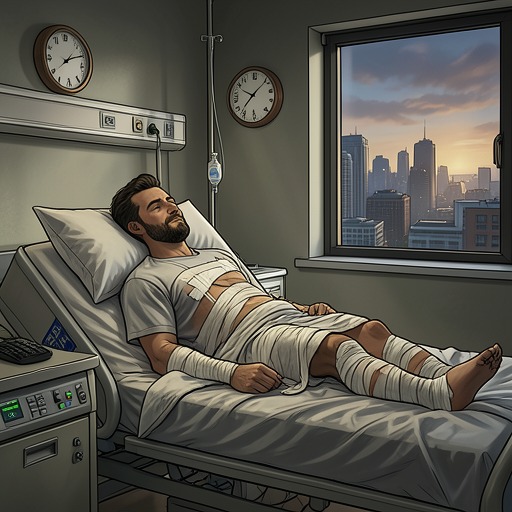
Kemal Basmacı's death
The Museum of InnocenceKemal Basmacı died of a heart attack in Milan in the early hours of April 12, 2007, aged sixty-two, on Füsun’s fiftieth birthday. The death of the Museum of Innocence’s founder gives a final shape to the novel’s central tension: time carries every present toward its end, while collected objects preserve fragments of the life that has passed.
Death in Milan
Kemal was asleep in a large room overlooking Via Manzoni at the Grand Hotel et de Milan, where he stayed on each visit to the city. His death came less than half a day after Sibel and Zaim encountered him on the streets of Milan. Their unexpected meeting, recalled afterward to the narrator, places a last crossing with people from Kemal’s earlier life close beside the account of his death.
Milan had become more than a recurring destination. Kemal went there to experience the Bagatti Valsecchi Museum, which he considered among the most important museums in his life. By the time he died, he had visited 5,723 museums. The scale of that number makes his final hours part of a lifelong practice: he had made the act of looking at collections a way of inhabiting the world.
A Collector’s Final Thoughts
The narrator identifies Kemal as the founder of the Museum of Innocence and records his last thoughts about museums. For Kemal, a museum was not simply a place to stroll through: its collection had to express the experience at its heart, and a building emptied of its objects became only a gallery. The principles unite the institution he founded with the way he had learned to understand memory. Objects mattered not as isolated curiosities but as carriers of lived experience.
The Bagatti Valsecchi Museum embodied that understanding. Its nineteenth-century renovation had recreated the appearance of a sixteenth-century Renaissance palazzo, but Kemal was especially enchanted by the ordinary household things in its collection: beds, lamps, mirrors, pots, and pans. The everyday, gathered and preserved, could make a life present to later viewers. His own museum similarly gave material form to the memories he had spent years collecting.
Funeral and Public Memory
Most of the people named in the novel’s index attended Kemal’s funeral at Teşvikiye Mosque. His mother, Vecihe, watched from a balcony, as she customarily had when funerals passed below, wearing a headscarf. The narrator and the others in the courtyard heard her crying as she said farewell to her son. A familiar public ritual had become an intimate family loss.
That reversal carries particular weight in a city where funerals had long been part of ordinary street life. From his family apartment overlooking Teşvikiye Mosque, Kemal had watched processions for the famous and powerful; as a child, he and his brother imitated the bearers with divan bolsters, turning the funeral march into play. The spectacle that had once seemed a diversion returned at his own funeral as a scene of grief, with his mother looking down from the balcony.
The funeral also changed the narrator’s relationship with Kemal’s circle. Many relatives and close associates had refused to meet him while Kemal was alive. In the months after the funeral, they began approaching him one by one, wary of the belief that his books portrayed Nişantaşı residents mercilessly. Zaim and Sibel, who had feared him without reading his books, received him graciously and insisted that their memories also be heard. Kemal’s death thus opened a posthumous process of testimony: the story associated with him was not to belong to a single perspective alone.
Death, Time, and Objects
Kemal’s account of happiness had already joined memory to loss. He understood that the happiest moment can be named only in retrospect, when life has taken its shape; to call a moment the happiest is also to know that it lies in the past and cannot return. He believed that mementos could preserve the colors, textures, images, and pleasures of such an instant more faithfully than the people who had shared it. His own death makes that belief newly consequential: the collection remains as a material record after its collector can no longer speak.
The same insight governs his reflections on time during his years of dinners at the Keskin home in Çukurcuma. Moments might hold enough happiness to last a lifetime, but the line joining them eventually ends, bringing death into view. Kemal took away objects Füsun had touched in order to preserve those moments for the future. His museum turns that private practice into a place others can enter, where separate objects link a lost life to the people who come to remember it.
The novel also frames collecting as a response to grief that predates Kemal’s own death. After his father died, familiar things in the family home became vessels of a vanished past: Kemal opened drawers, handled old bills and telegrams, and looked at his father’s medicines. Later, after leaving Istanbul to escape reminders of Füsun, he found solace in Paris museums whose quiet rooms seemed to exist outside the city’s ordinary time. These episodes make the museum not an escape from death but a way of giving loss a form that can be seen, revisited, and shared. Kemal’s funeral ends his life; the objects and stories assembled around him keep its particulars available to others.