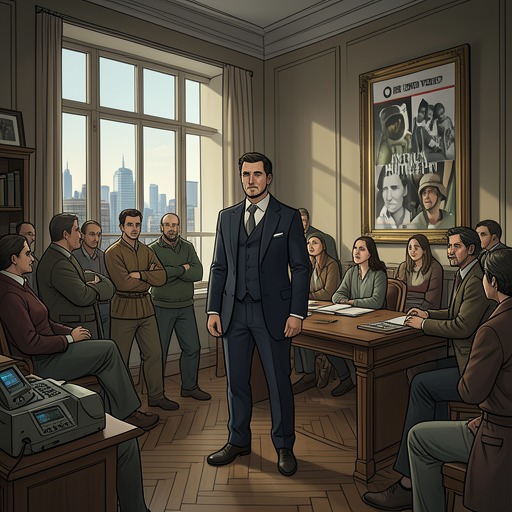
Kemal and Füsun’s First Meeting at the Şanzelize Boutique
The Museum of InnocenceKemal and Füsun’s First Meeting at the Şanzelize Boutique is the encounter that turns a handbag purchase into the beginning of a life-changing attachment. Kemal arrives intending to buy a gift for Sibel, his fiancée, but the young woman behind the counter is Füsun, whom he has not seen in years. Their recognition is unequal: Kemal is startled by her, while Füsun has recognized him from the start. The scene’s small gestures—the boutique bell, a hurried payment, and a bag carefully unwrapped—acquire their weight from everything Kemal will later make them mean.
The purchase that leads to the encounter
The sequence begins on April 27, 1975, as Kemal walks Sibel home along Valikonağı Avenue after an evening that has reinforced the certainty of their impending engagement. They have dined with Kemal’s parents at Fuaye, discussing a party planned for mid-June so that Sibel’s friend Nurcihan can travel from France. Sibel’s engagement dress is to be made by the sought-after Istanbul dressmaker Silky İsmet, and Kemal’s mother has given her pearls for it. Sibel’s father wants the party to be as lavish as a wedding; Kemal’s father is pleased that his future daughter-in-law has studied in Paris. Against this established future, Sibel notices a Jenny Colon handbag in a shop window and admires it.
Kemal returns to the shop around noon the next day. He says he has never been the smooth, chivalrous man who looks for excuses to buy women presents, though he admits that he may have wished to be one. The boutique belongs to a particular social world: affluent, Westernized housewives in neighborhoods such as Şişli, Nişantaşı, and Bebek imported clothes and accessories from Paris and Milan, or sold fashionable copies, at inflated prices. The Şanzelize Boutique takes its name from the famous Parisian avenue. Its proprietor, Şenay Hanım, is a distant relation on Kemal’s mother’s side, as is Füsun.
Recognition in the dim boutique
When Kemal enters, a small bronze camel bell with two knobs sounds. The shop is cool and dark after the spring sunlight outside, and his eyes have not yet adjusted when he realizes that Füsun is there. His first words are an awkward attempt to place her as a grown-up he might not recognize. Füsun tells him that she recognized him immediately, but chose not to interrupt when she saw that he had not recognized her. That brief exchange establishes both the family connection and the difference between their states of awareness: for Kemal, the encounter arrives as a shock; for Füsun, it is already a familiar face appearing in her daily workplace.
Füsun is studying for university entrance examinations and comes to the shop every day, where she is meeting many new people. As she shows Kemal the handbag, she steps out of a yellow high-heeled shoe to reach the mannequin, her red-painted toenails and long bare legs catching his attention. At the counter she removes the crumpled tissue from the cream-colored bag, points out its zippered pocket and two smaller empty pockets, then reveals a secret compartment and the Jenny Colon card inside. Her careful demonstration makes the accessory feel more intimate than an ordinary commodity to Kemal, already unsettled by her presence.
The handwritten price is 1,500 lira, a sum equivalent at the time to six months’ pay for a junior civil servant. Füsun says that Şenay Hanım might offer a special price, but the proprietor has gone home for lunch and is probably asleep, so she cannot call. Kemal declines to wait or bargain. He counts out the damp bills in an awkward motion that Füsun will later mimic at their secret meeting place. Füsun wraps the handbag with evident inexperience, places it in a plastic bag, and hands it over. Kemal asks her to convey his respects to Nesibe and her father, whose name he cannot recall quickly enough. The ordinary transaction is already overlaid with his private fantasy: he imagines his absent self embracing and kissing Füsun, then rebukes the daydream and insists to himself that she is not extraordinarily beautiful.
The immediate return to ordinary life
The scene ends not with a declaration but with Kemal leaving. Outside, he is glad of the heat and pleased with the purchase; he tells himself that he loves Sibel and will forget the shop and Füsun. The statement sets the event’s central contrast in place. His engagement, family approval, and carefully planned celebration belong to a recognizable social future, while the encounter has produced a sudden disturbance that he tries to dismiss before it can alter that future. His purchase is still meant for Sibel, but the act of buying it has attached it to the moment he met Füsun.
The boutique itself would later become part of Kemal’s private record of the affair. Years afterward, when he tracks down Şenay Hanım, she gives him the shop sign that once hung on the door, along with other objects connected to Füsun. Her willingness to do so without questioning his excessive interest suggests to Kemal that details of their story had circulated more widely than he had supposed. The sign turns the closed shop into a surviving piece of evidence: the place where his intended gift and his unanticipated encounter first became inseparable.
From remembered place to city of signs
After losing contact with Füsun, Kemal tries to control his longing by forbidding himself to visit the Merhamet Apartments, wait for her, or touch the objects that remind him of her. Because he keeps finding ways around such prohibitions, he redraws his mental map of Nişantaşı. The Şanzelize Boutique, near the crossing of Teşvikiye Avenue and Valikonağı Avenue, is among the locations marked as absolutely forbidden, alongside the Merhamet Apartments and streets associated with Füsun and her family. Other places receive less severe restrictions: he may cross certain orange-marked streets only when sober, quickly, and without lingering. The map is an attempted regimen of recovery, but it also records how thoroughly his memories have taken possession of the city.
The attempt to banish reminders does not hold. Kemal begins frequenting crowded places where he might see what he knows to be Füsun’s ghost, and adds those locations to his mental map. Istanbul becomes, in his description, a galaxy of signs pointing back to her. In poor neighborhoods across the Golden Horn, an apparition can keep him wandering even after he realizes it is not Füsun; the hope that her double appeared nearby persuades him that the real woman might be close. What began at a single shop window thus grows into a way of moving through the city, in which streets and chance sightings sustain his attachment even as they intensify his pain.
Much later, Kemal remembers the cool, dim Beyoğlu cinemas where he and Füsun meet, hold hands, and sit as though they had all the time in the world. Those scenes of renewed closeness belong to a different stage in their story, but sharpen the first encounter’s significance: the purchase that began as a courteous gesture toward Sibel opens onto a private history with Füsun. The boutique meeting is the first turn from the life Kemal believes he has chosen toward the life he will organize around remembering her.