Keskin family television
The Museum of InnocenceThe Keskin family television is both a fixture of domestic life and the household’s main link to public time. Always on during Kemal Basmacı’s visits, it supplies the evening’s programs and official clock, while giving shape to the dinners at which he watches Füsun. Its broadcasts make the family’s hours legible to the outside world; their ending exposes how difficult it is for Kemal to leave the private world he has come to inhabit.
Place in the Household
The television has taken over a role once served by the radio: it keeps time as well as providing entertainment. The large wall clock remains in the house, but it no longer sets the practical rhythm of the evening. Instead, viewers follow the programs, and the on-screen clock matters chiefly because it signals what is about to be broadcast. The screen makes the household’s routine part of a wider, shared schedule without making that routine any less intimate.
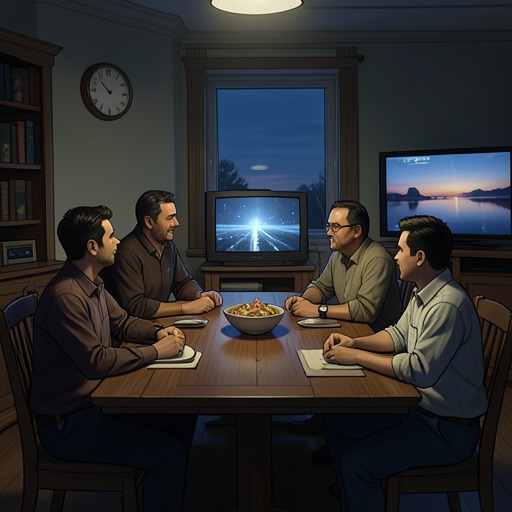
That distinction becomes visible at seven o’clock. A minute before TRT begins the news, an enormous clock appears on the screen. Füsun checks her wristwatch against it, while Tarık checks one of the pocket watches he uses over the years. Kemal watches her concentrate, squinting and pressing her tongue against her cheek as she adjusts the time. Once her watch is set, she looks at him and smiles; she knows he has been watching. The public clock thus becomes the occasion for a private exchange between them, conveyed through attention and a look rather than an open declaration.
The television’s place in the room also shapes Kemal’s view of Füsun. During meals, she carries plates and pots between the kitchen and dining area, passing between him and the screen. Her parents may see her as interrupting their view, but Kemal experiences her movement as the scene itself. Films, quiz shows, weather reports, political speeches, sports, and public ceremonies continue on the television; his attention repeatedly shifts from that program to Füsun crossing the room.
Official Time and Private Time
For Kemal, the televised clock is not simply a tool for punctuality. He interprets Füsun’s act of adjusting her watch as an acknowledgment of the state’s official time, rather than a practical response to work or appointments. The nightly clock and the flag shown at the end of the broadcast connect the family to millions of other households and to the nation. In front of the screen, the family’s irregular domestic life briefly meets the formal order represented by national television.
That public measure contrasts with the time Kemal experiences at the Keskin home. From October 23, 1976, to August 26, 1984, he makes 1,593 supper visits across 2,864 days. He averages four visits a week, though the pattern varies: sometimes he sees the family every day, and sometimes he stays away while trying to convince himself he can forget Füsun. The television does not erase the calendar or the years, but its recurring evening schedule helps create a world that feels separate from them. Kemal comes to understand that he visits not only to see Füsun, but also to spend time in the world she inhabits.
The broadcasts’ ending makes that contrast especially sharp. Between about half past eleven and midnight, the program gives way to a closing ceremony: soldiers march and salute the flag as the national anthem plays. Afterward, the screen fills with blurred dots. The family watches the static for a while, as though another program might begin by mistake, until Tarık or Füsun switches the television off. The household’s shared evening has ended, but Kemal’s reluctance to leave persists. He remains seated, unable to make himself stand, while the clock ticks in the silence.
A Nightly Measure of Separation
The television also gives Kemal a way to calculate the duration of his visits, though he admits that shame makes him underestimate how long he stays. He usually arrives around seven and leaves soon after the midnight sign-off, making an average visit about five hours. The program schedule therefore measures both his repeated access to Füsun and the approaching end of each evening with her family.
The 1980 military coup changes what that ending means. Martial law brings a ten o’clock curfew, forcing Kemal to leave at a quarter to ten, before the broadcasts and supper have run their usual course. As Çetin drives him through dark, quickly emptying streets, Kemal feels that he has been deprived of time with Füsun. The state’s schedule, already present in the televised clock and national ceremonies, now directly interrupts the private routine he has built around the household.
The Screen as a Focus of Memory and Collection
The television is also part of the material setting Kemal remembers and collects from. The Keskin family’s porcelain dogs sit on top of the set, making it a display surface as well as a source of moving images. Füsun once shifts a dog with an impatient flick of her wrist. Later, as the dogs change position and disappear, the family comes to suspect that Kemal is taking objects from the house. He has begun collecting small belongings, including matchboxes, cigarette butts, saltshakers, cups, hairpins, and barrettes, and sometimes replaces what he removes.
When one dog is broken at Kemal’s home, he brings a replacement and explains its arrival as an accident followed by a purchase at the Spice Bazaar. Nesibe responds to the new figure as a street dog, praising its black ears and saying that it brings peace. The episode shows how an ordinary ornament on the television can acquire multiple lives: a household possession, an object Kemal covets, a missing item whose absence is noticed, and a replacement incorporated into family routine.
More broadly, the television’s recurring clock and sign-off make it an instrument for remembering the evenings that otherwise seem to merge. Kemal later associates the objects he has gathered with particular moments at the dinner table, and sees the collection as a way to recall the whole experience of sitting with Füsun and her family. The screen’s official time measures those evenings from outside; the collected objects preserve their private texture. Together, they show how routine can feel timeless while remaining vulnerable to separation, political interruption, and the passage of years.