Keskin family tombala set
The Museum of InnocenceThe Keskin family tombala set is the game set used during eight consecutive New Year celebrations at the Keskin Family's Home in Çukurcuma. More than a device for playing tombala, it gathers the recurring gestures, gifts, and family company that Kemal later treats as evidence of a happiness he wants to keep. Its place in the Museum of Innocence turns an object of seasonal amusement into a material record of private time.
The Set and Its Components
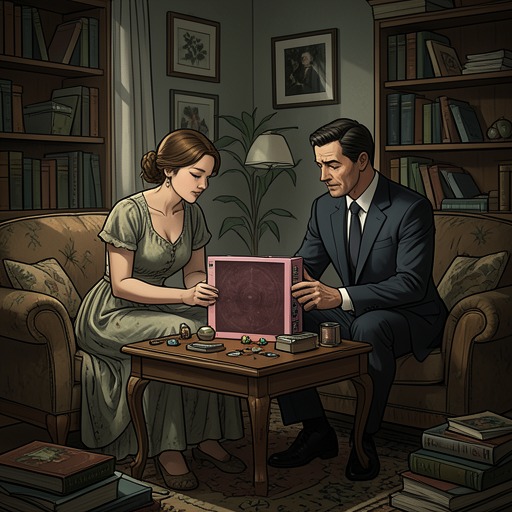
At the end of each New Year’s Eve party, Nesibe gathered the set’s pieces and prepared them for the next year. She returned the pieces to a velvet pouch, counted the ninety numbered wooden tiles, tied the numbered cards together with a ribbon, and put the dried beans used to mark numbers into a plastic bag. This careful packing made the game ready to be repeated, preserving not only its equipment but the small routine that closed each gathering.
Kemal identifies the set as the one used at Füsun’s house for eight New Years in succession. He distinguishes it from the similar set his mother used over roughly forty years, from the late 1950s to the late 1990s, first to entertain Kemal, his brother, and their cousins, and later her grandchildren. The parallel sets connect two family traditions without making them the same object: each belonged to a household’s repeated celebrations, while the Keskin set became part of Kemal’s years of visits.
New Year's Ritual at the Keskin Home
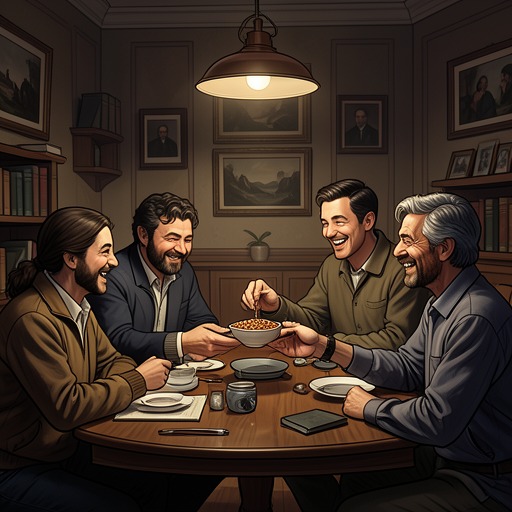
The game’s recurring place in Kemal’s visits begins with a New Year’s gathering. He arrived anxious but happy, carrying presents his mother had prepared for the tombala winners. Nesibe had prepared prizes of her own, and the two collections were mixed together at the end of the table. The play that followed became a yearly custom, with the gifts from both households returning alongside the set.
A rainy New Year’s Eve in 1982 supplies a particularly vivid instance of the ritual. Kemal completed the top line of his card first and called out the game’s winning cry; Nesibe congratulated him and gave him a child’s handkerchief. The handkerchief was one of her customary prizes, and the moment preserves the adults’ participation in a game associated with childhood: Kemal wins by playing eagerly, rather than standing outside the gathering as its observer.
A Transmitted Istanbul Custom
Tombala’s family setting sits within a broader history of New Year customs in Istanbul. Kemal traces the game’s origins to Naples, where Italian families still played it at Christmas, and describes its passage through Italian and Levantine families in Istanbul into wider use after Atatürk’s calendar reform. In this account, the game is both intimate and shared: a household pastime whose familiar annual place reflects a custom that crossed communities.
The Keskin gatherings also joined the two households through an exchange of preparation and gifts. Kemal brought his mother’s prizes; Nesibe added her own; together they formed the rewards for play at Füsun’s home. The set therefore belongs to more than the mechanics of the game. Its repeated use marks a pattern of visits in which Kemal’s family tradition and the Keskin family’s hospitality met each New Year.
Memory, Repetition, and the Museum
Kemal presents the set while explaining that, years later, he is trying to make his love intelligible by discussing objects one by one. For him, tombala captures the strange spirit of those years. The set’s annual return gives a concrete form to the repeated happiness he sought during his visits; its counted tiles, tied cards, and stored beans retain the practical details of an evening that could otherwise recede into general recollection.
That function belongs to Kemal’s broader understanding of memory. He argues that present moments become painful when they are seen as part of a line of time that eventually ends, and that objects touched during happy moments can help preserve them. In the Museum of Innocence, the tombala set makes this idea visible through an ordinary family ritual rather than a grand event. Its significance lies in the contrast between the game’s modest materials and the emotional weight Kemal assigns to the eight New Years they accompanied.