Kuyulu Bostan Street
The Museum of InnocenceKuyulu Bostan Street is the Nişantaşı address of Füsun’s family home and the place Kemal Basmacı first visits when he can no longer bear not knowing where she is. Its importance lies in the reversal it brings about: a street that offers him the possibility of seeing Füsun becomes one he later forbids himself to enter. In Kemal’s private geography, the address is not merely a route through Istanbul but a point where longing, hope, and self-imposed restraint meet.
The Family Home and Kemal’s Arrival
In July, Kemal runs to the family’s apartment house, approaching from the corner where Alaaddin has his shop. He imagines the relief of seeing Füsun before he arrives, but that anticipation gives way to fear: she may not be home, and he may have to explain himself to her mother. He briefly considers turning back to retrieve the childhood tricycle, then decides that an encounter with Füsun would make an excuse unnecessary. The approach captures how strongly the street draws him even before he has confirmed that she is there.
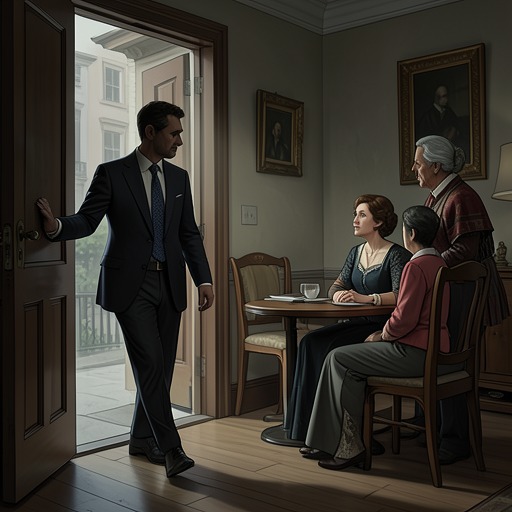
Kemal enters the cool foyer like a ghost, climbs to the second floor, and rings the bell. A birdlike door chime sounds; the novel’s museum framing invites visitors to press a button beside the exhibit to hear the chirping sound that was fashionable in Istanbul at the time. The small detail makes the threshold memorable: Kemal’s own heart seems to flutter as he waits. The street leads him not to Füsun but first to her mother, who initially mistakes him, in the dim foyer, for a tired stranger, then recognizes him and welcomes him inside.
The Apartment and the Absent Füsun
Kemal explains his visit by saying he was passing by and had noticed that Füsun no longer worked at the shop. He asks after her university examination, presenting his arrival as a casual inquiry rather than admitting the urgency that brought him there. Her mother invites him in to share their troubles. Kemal does not stop to consider what she means; he enters the apartment, whose ordinary interior becomes charged with the significance he gives it through Füsun.
He notices slipcovered armchairs, a table, a buffet with a candy bowl, crystal tumblers, and a television topped by a sleeping china dog. He finds the furnishings beautiful because, in his view, they have all helped make Füsun. In a corner, sewing scissors, colored thread, pins, cloth, and a dress being assembled by hand show that her mother is still working as a seamstress. Füsun herself appears to be absent. Yet the mother’s presence, and the sense that she is waiting as if to bargain or present a bill, gives Kemal hope. The visit therefore turns the family home into a place of both frustrated expectation and intimate discovery: its objects offer him a way to imagine Füsun even when she is not there.
A Red Zone on Kemal’s Mental Map
Afterward, Kemal concludes that normal daily life cannot continue unless he makes a plan to forget Füsun. His melancholy is visible to employees at Satsat; his mother assumes that he and Sibel are having trouble and warns him about drinking; and he fears that the pressure on his engagement will end in an explosion. He has tried before to stop himself from visiting the Merhamet Apartments or touching reminders of Füsun, but finds ways around his own rules. Even setting out to buy Sibel flowers near the Şanzelize Boutique can bring him close to the places he is trying to avoid.
He responds by redrawing Istanbul in his mind. On the modified Nişantaşı map he describes, Kuyulu Bostan Street is marked red: entry is absolutely forbidden. It shares that category with the Şanzelize Boutique, the Merhamet Apartments, the police station, and the corner by Alaaddin’s shop. The rules are not uniform across the city. Orange streets may be crossed only in an absolute emergency, while yellow ones require caution; even his home and Teşvikiye Mosque are orange because staying too long might intensify his suffering. Familiar roads and side streets become potential snares, linked to his old route between Satsat, the boutique, and his meetings with Füsun. The street’s red mark makes his first hopeful visit into a boundary he must later enforce against himself.
From Address to Emotional Geography
Kemal’s map also records other places associated with his brief history with Füsun, including the empty lot where lambs were sacrificed when they were children and the corner of a mosque courtyard where he once watched her from afar. He keeps the restrictions in mind as an ascetic regimen meant to cure his distress, however slowly. The map does not describe Istanbul as it appears on an official plan; it organizes the city according to what Kemal can bear to encounter. Kuyulu Bostan Street matters within that system because it contains the family home and the possibility of contact that he both desires and attempts to deny himself.
His effort to avoid painful locations never wholly removes Füsun from the city. He later begins frequenting crowded places where he might glimpse her ghost, and adds the sites of these imagined sightings to his mental map. Istanbul becomes a galaxy of signs that remind him of her; a false glimpse can offer a brief consolation before he recognizes that the figure is not Füsun. In the poor neighborhoods of Vefa, Zeyrek, Fatih, and Kocamustafapaşa, he searches for her among the streets and coffeehouses, sometimes treating even an apparition as a reason to believe she is nearby. These episodes extend his emotional geography beyond the red-marked street, but do not erase its particular role as the place where he first went looking for her at home.
Later, after Füsun has set conditions for their renewed relationship and is separating from Feridun, Kemal meets her every other day in Beyoğlu to see films. Their meetings in the cool, dim cinemas allow them to sit together and hold hands, a shared urban routine unlike his solitary visit to Kuyulu Bostan Street. The contrast clarifies the street’s place in the story: it holds the first threshold of his search, where Füsun’s absence sharpens his longing, while the later cinema outings make closeness possible again. Across these different routes, the city registers changing access to Füsun—first sought at her family’s door, then evaded as a source of pain, and eventually approached through a renewed life together.