Mümtaz
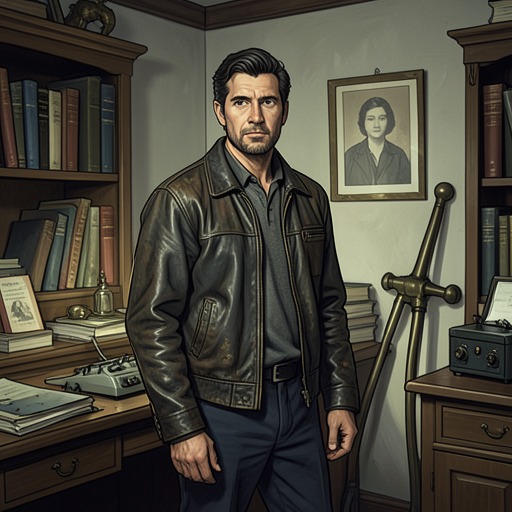
The Museum of InnocenceMümtaz, Kemal’s father, is both a keeper of long-concealed regrets and a source of hard-won counsel. Near the end of his life, he tells Kemal about an eleven-year relationship he never resolved by marrying the woman he loved; he then urges his son to treat women well before it is too late. After Mümtaz’s death, ordinary traces of their shared life become entangled with Kemal’s grief, making the father’s absence another presence in the story.
Identity and Character
Mümtaz is a husband and father who has spent much of his life concealing private anguish. He acknowledges that he had other affairs, but distinguishes the unnamed woman in his confession from those earlier escapades: he says he never fell for anyone as he fell for her. His recollections emphasize her beauty, sensitivity, intelligence, and goodness, and he keeps returning to the thought that he did not praise her enough while she was alive and within reach.
The care he takes in telling the story is itself revealing. He insists that Kemal once saw the woman, though Kemal cannot remember doing so. To make her real to his son, Mümtaz produces a small black-and-white photograph: she stands on the back deck of a City Line ferry in Karaköy, looking sorrowful. He is dissatisfied that the image fails to convey the beauty he remembers, and asks Kemal to recognize it. His wish is not simply to recount an old affair; he wants his son to witness the person he believes he failed to honor.
The Affair and the Choice He Avoided
Mümtaz says that the relationship lasted eleven years. He had thought seriously about marrying his lover, but could not imagine leaving Kemal’s mother and his two sons. At the same time, he admits that he kept the woman waiting for years, unable to imagine life without her and suffering when they were apart. His account resists the easy shape of a noble sacrifice: he explicitly says he is not claiming to have made a sacrifice for his children’s happiness. The woman, he acknowledges, was the one who wanted marriage, while he postponed making a decision.
Eventually, she demanded that he choose between leaving his family to marry her and losing her. She had received a marriage proposal from an engineer and warned that she would accept it if Mümtaz did not decide soon. He did not believe she would follow through. When he refused to leave Kemal and his brother, she left him. The relationship therefore ends not through a settled compromise but through the consequence of his delay: the family he could not abandon remained intact, while the woman he loved was gone.
Mümtaz describes the aftermath as a private torment. He hid his anguish from Kemal’s mother, who had sensed that a serious affair was taking place but said nothing. He likens the household, which also included Bekri and Fatma Hanım, to a cast of characters pretending to be a happy family in a hotel room. He feared that continuing in this way would drive him mad, yet could not bring himself to do what he believed necessary. In his account, secrecy does not spare anyone pain; it leaves him suffering alone while the woman suffers too.
Remorse, Counsel, and the Pearl Earrings
Mümtaz makes the confession because Kemal is about to become engaged and, he says, it is fitting for his son to know him better. What he most wants to convey is remorse. He says he would give anything to tell the woman repeatedly how precious and charming she was, and regrets that he failed to treat her as she deserved. His advice to Kemal follows directly from this self-accusation: women should be treated well in the present, not only appreciated after it is too late. His confession turns private regret into a warning about what neglect and postponement can cost.
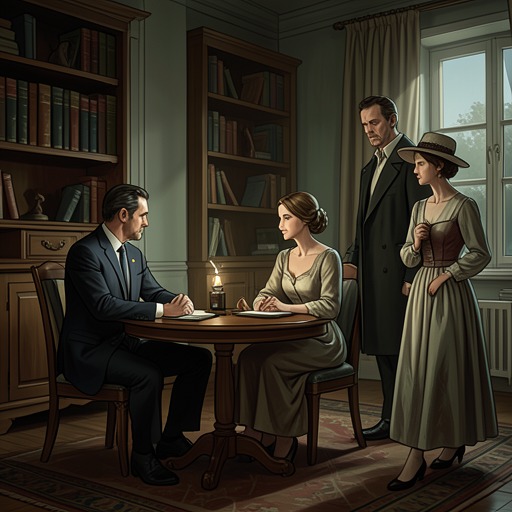
He gives the warning a physical form by producing a faded, velvet-covered jewel box. He had bought the pearl earrings for his lover during a visit to the İzmir Fair, hoping they would keep her from being angry with him and help her forgive him. Fate, as he describes it, prevented him from giving them to her. He hid the earrings for years and now passes them to Kemal, explaining that he does not want Kemal’s mother to find them after his death. He suggests they will suit Sibel, whom he assumes will become his son’s wife. Kemal corrects him: Sibel is not his mistress but his intended wife. The exchange places Mümtaz’s unresolved past beside Kemal’s imminent marriage, while the earrings carry the consequences of an apology that came too late for its intended recipient.
Happiness and Advice to His Son
At Kemal’s engagement celebration, Mümtaz watches Sibel and two friends greeting one another and showing off their jewelry. He reflects that intelligent people know life is beautiful and happiness is its purpose, yet seems to observe that happiness often belongs to fools. His remark unsettles the occasion: Kemal’s mother points out that the day should be one of the happiest in her son’s life and urges him to go to Sibel. Mümtaz’s reflection does not prevent the celebration, but it gives the scene a shadow of doubt about whether outward beauty and social happiness can guarantee inward contentment.
Later, when Kemal cannot sleep because of his own pain, Mümtaz speaks softly to him from the other chaise longue. He tells his son that the distress will pass and that it is too early in life for him to lose sleep over it. At Mümtaz’s age, he explains, regrets can keep a person awake until dawn; Kemal should beware of choices he may later regret. The advice is compassionate, but it comes from a man whose own experience gives the warning its weight. His earlier confession has shown that regret is not an abstract possibility: it is the continuing cost of failing to choose and to express love in time.
Death and Presence in Kemal’s Memory
Mümtaz dies of heart failure in early March, a few minutes after seven in the morning, as the prayers are being sung. Kemal’s mother wakes believing that her husband is still asleep beside her; when she realizes he is dead, she becomes hysterical and is given a Paradison tablet to calm her. In the bedroom, Mümtaz lies rigid in the pajamas he had shared the bed with his wife in for almost forty years. Kemal recognizes his father’s familiar hands, which had caressed him as a child, but their whiteness frightens him, and he cannot bring himself to kiss them.
As Kemal pulls at the blanket, his father’s left foot emerges. He notices that Mümtaz’s big toe is identical to his own, a resemblance first pointed out by Mümtaz’s old friend Cüneyt twelve years earlier on the Suadiye shore. Cüneyt had turned it into a recurring joke, greeting them with, “How are the father-and-son toes doing?” The detail is intimate and almost comic, but in the bedroom it becomes proof of a bodily likeness that survives the father’s death. Kemal later describes the collar of Mümtaz’s pajamas and one of his slippers as objects whose sight makes him sad.
At the funeral, Kemal looks for Füsun among the mourners and feels each absence sharpen his grief. After learning that neither she nor her parents has come, he leaves his family and goes to the Merhamet Apartments. There, Füsun’s lead pencil and the unwashed teacup she left behind console him. He understands the pain of his father’s death and the pain of Füsun’s absence as inseparable, each capable of awakening the same underlying wound. Mümtaz’s story of love deferred thus remains active after his death: it gives Kemal a language for regret even as Kemal continues along a path his own reason tells him will deepen his suffering.