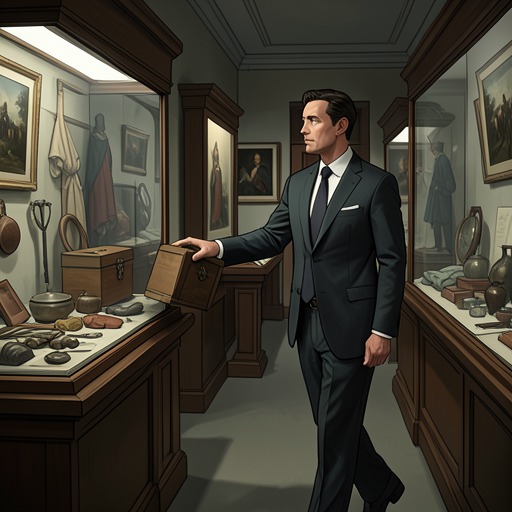
Musée de la Vie Romantique
The Museum of InnocenceThe Musée de la Vie Romantique is a museum in Paris whose display of George Sand’s personal belongings becomes one of Kemal’s most affecting encounters during his museum travels. Seeing intimate remnants of a life preserved as exhibits, he shivers; the visit brings the emotional charge of his own collecting into focus and resonates with the museum he is making around his life with Füsun.
Setting and Recorded Visit
Kemal encounters the museum while traveling through Europe and visiting collections that prompt him to imagine how the Keskin family’s possessions might be displayed. In Paris, he gazes at length at George Sand’s lighter, jewels, earrings, and locks of hair stapled to a piece of paper. The account gives no architectural description or broader history of the museum; its significance in the narrative rests on this concentrated moment of looking.
The visit belongs to a sequence in which museums repeatedly call up Füsun and the objects associated with her. Elsewhere on the same travels, Kemal searches for her scent in a perfume museum and sees everyday objects that make him think about the Keskin household. At the Musée de la Vie Romantique, the response is more intimate still: personal effects, presented together, bring their absent owner close enough to make him shiver.
Personal Effects and the Work of Memory
The objects Kemal sees are neither grand monuments nor an abstract account of George Sand’s life. The lighter, jewelry, earrings, and hair preserve personal traces in material form. Their arrangement makes private history visible through small, specific things, an idea that accords with Kemal’s belief that mementos can hold the colors, textures, images, and pleasures of a past moment more faithfully than memory alone.
That belief shapes his own collecting. He takes objects from the Keskin home, at first small things easily overlooked—matchboxes, cigarette butts, saltshakers, coffee cups, hairpins, and barrettes—and later replaces some household items as his attention turns to larger objects. At the New Year’s Eve gathering in 1980, he gives the family an antique glass connected to his last rendezvous with Füsun, though she does not recognize it. In his collection, as in the display that moves him in Paris, an object’s importance lies not only in what it is but in the life and memory attached to it.
Place in Kemal’s Museum Project
The Musée de la Vie Romantique offers a point of comparison for Kemal’s ambition to turn private experience into a public collection. He eventually brings together objects from the Keskin household, his travels, and other sources in the Museum of Innocence; among them are the bedframe, mattress, and blue sheet associated with his first sexual encounter with Füsun. The Paris visit does not establish a direct plan or single model for that museum, but it shows Kemal encountering another collection in which intimate belongings carry the presence of a person.
His project also differs from the kind of imitation he criticizes. Kemal argues that Turkish museums should show Turkish lives rather than reproduce Western art, and describes his own museum as the totality of the life he shared with Füsun. The Musée de la Vie Romantique matters within that tension: its presentation of personal relics makes visible a way of preserving memory, while Kemal’s eventual museum turns that impulse toward the ordinary objects and shared experiences of his own Istanbul life.