Museum of Innocence Lovers’ Welcome Policy
The Museum of InnocenceThe Museum of Innocence Lovers’ Welcome Policy directs the museum’s guards to leave kissing couples undisturbed and keeps the institution open to lovers who have nowhere else in Istanbul to kiss. The rule gives the museum a public role beyond displaying Kemal Basmacı’s collection: it makes room for private affection within a space otherwise designed to preserve, interpret, and reverence the story of his love for Füsun.
The Rule and Its Scope
Kemal’s instructions distinguish between protecting the collection and policing visitors. Guards must preserve objects associated with Füsun, but they are not to warn couples for kissing or visitors for chewing gum. The policy does not exclude lovers from the museum or require them to conceal their affection; it explicitly welcomes couples who cannot find another place in Istanbul to kiss.
That welcome is part of a broader direction about the guards’ work. Their task is to explain the history of the Kemal Basmacı collection, the love he feels for Füsun, and the meanings invested in her possessions. The policy therefore treats visitors’ conduct not as the primary object of supervision but as one aspect of how people inhabit the museum.
Guards and the Museum’s Public Character
Kemal rejects the familiar image of the guard as someone whose main duties are to hush visitors, protect displays, and issue warnings. He wants the guards to speak about the collection with dignity and to make the museum feel like a place of worship, awakening humility, respect, and reverence. His welcome for kissing couples sits alongside, rather than replacing, that ceremonial conception of the institution.
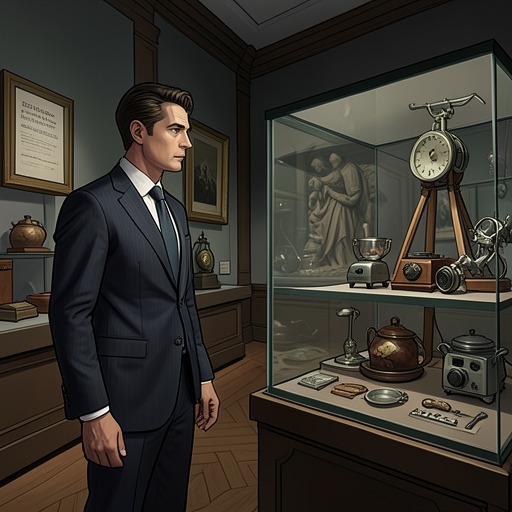
The guards’ prescribed appearance reinforces the museum’s carefully composed atmosphere: velvet business suits the color of dark wood, light pink shirts, and special ties embroidered with images of Füsun’s earrings. Yet the same instructions that define this formal role also limit its authority over visitors’ intimate behavior. The guards are to interpret and care for the collection, not to intervene in a couple’s kiss.
Memory, Pride, and Access
The policy belongs to a museum built from personal attachments. Kemal brings together objects that recall Füsun and their shared life, and asks that the collection’s meanings be made legible to visitors. His larger aim is to transform objects that might bring shame into possessions that can be displayed with pride. In that setting, welcoming lovers extends the museum’s private history into a public invitation: visitors are not merely asked to look at preserved memories but are allowed to bring their own affection into the space.
The museum’s design likewise resists a purely passive form of looking. Kemal wants the entire collection and all the display cases to be visible from wherever a visitor stands, so that the story can be apprehended together and ordinary time may recede. The lovers’ welcome policy complements this spatial ideal by allowing the museum to be used as well as viewed. It makes visitor access an active part of Kemal’s conception of the institution, not an afterthought to the display.
Significance
The rule gives concrete form to a tension between reverence and openness. The museum asks visitors to approach Füsun’s possessions with seriousness, while refusing to make that seriousness a pretext for regulating every human gesture. Its guards are custodians and interpreters, but not moral sentries. By making a place for couples who lack one elsewhere in Istanbul, the institution turns a collection rooted in one man’s longing into a space that also accommodates other people’s present-tense attachments.