Museum of Innocence Visibility Principle
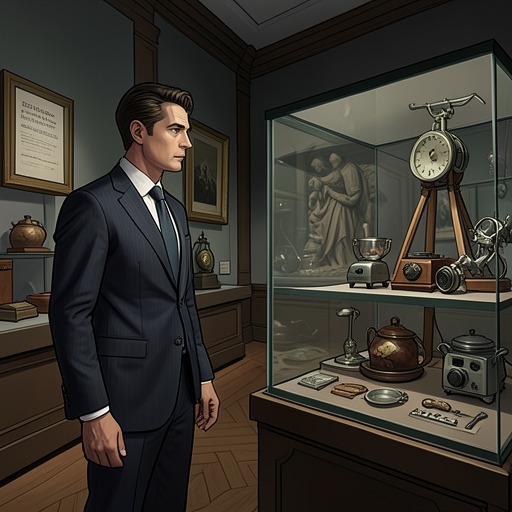
The Museum of InnocenceThe Museum of Innocence Visibility Principle is Kemal Basmacı’s rule that the entire collection, every display case, and everything else in the museum should be visible from wherever a visitor stands. It is more than an architectural preference: the design makes the museum’s objects and the story of his love for Füsun apprehensible at once, turning remembered time into a space that can be surveyed.
Definition and Design
Kemal insists on a comprehensive view from every position inside the museum. The requirement extends beyond individual objects to the collection as a whole, including all its display cases. Architect İhsan’s design for the building’s interior reinforces this spatial conception: a great opening between the upper and lower levels lets Kemal see into the heart of the building and spend the night among the collection as a connected whole.
The principle makes the museum’s arrangement carry an argument. A visitor is not meant to encounter the collection only as a sequence of isolated exhibits; the design should allow its parts to remain present together. In Kemal’s account, the objects are inseparable from the story they tell, so making the whole collection visible also makes the total shape of that story available to the eye.
Objects, Memory, and Time
Kemal connects visibility to the way memory preserves a life. Looking back, he identifies one moment with Füsun as his happiest, while recognizing that naming it as such confirms its distance and irrecoverability. He argues that mementos belonging to that moment can preserve its colors, textures, images, and pleasures more faithfully than the people who shared it. The museum gathers such things into an arrangement where private recollection can be encountered through material objects.
His account of time supplies the principle’s logic. He distinguishes the indivisible present moments from Time, the line linking them, and describes the line as painful partly because it ends in death. The objects in the museum likewise carry moments within them; collecting and connecting them gives that line a visible spatial form. During his years of dinners at the Keskin household in Çukurcuma, Kemal took objects Füsun had touched in the hope of preserving happy moments for the future. Their simultaneous visibility offers, in his interpretation, a way to lose ordinary time—not by confusing memory with the clocks and calendars that regulate social life, but by entering an arrangement in which the accumulated moments can be seen together.
Interpretation and Museum Practice
The visibility rule belongs to a larger plan for how visitors should understand the collection. Kemal wants museum guards to explain the history of the collection, his love for Füsun, and the meanings invested in her possessions. He imagines the museum as a place of reverence, while explicitly welcoming lovers who have nowhere else to kiss. The guard’s interpretive role and the open view of the exhibits together shape what the visitor sees and how the collection is to be received.
Kemal also asks Orhan Pamuk to include a map at the end of the novel so that readers can walk through Istanbul and recall Füsun as they encounter its streets and prospects. A ticket in each copy of the book is to grant free admission on the reader’s first visit. These arrangements extend the museum’s account beyond its interior: book, map, city, and collection become connected ways of approaching the same remembered story.
Significance
The principle converts a private accumulation of objects into a public display without discarding its intimate origin. Kemal says that objects which bring people shame can become possessions in which they take pride when displayed in a museum. Visibility is therefore also a change in status: what might have remained hidden or private is exhibited, given an interpretation, and offered to visitors as a source of dignity and recognition.
The rule’s central paradox is that a complete view of the collection does not restore the past. Instead, it gives loss a form that can be looked at. By making the objects and their connections available together, the Museum of Innocence turns the finite line of lived time into an encompassing space, and presents that loss of ordinary time as a consolation for Kemal’s grief.