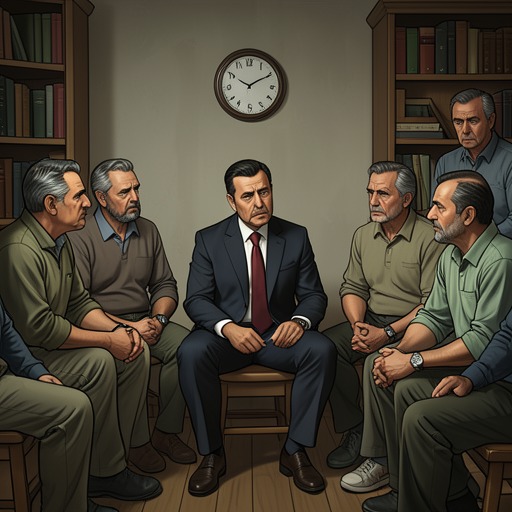
Necdet Adısez Is Crushed to Death by His Hoarded Belongings
The Museum of InnocenceNecdet Adısez Is Crushed to Death by His Hoarded Belongings is a grim episode in Kemal Basmacı’s account of collecting: a man dies beneath the objects he has accumulated, and the news turns private hoarding into a public warning. The death also binds an apparently isolated tragedy to Füsun’s memory, showing how even a report about a stranger could become part of Kemal’s intimate history.
The Death in Tophane
In December 1996, Necdet Adısez lived in a small house in Tophane, only a seven-minute walk from the Keskin Family's Home in Çukurcuma. Piles of paper and old objects pressed against his front door. He was crushed beneath them, but no one discovered his body for four months. Only when the summer stench from the house became unbearable did the death come to light; because the accumulated heaps blocked the entrance, firefighters had to enter through the windows.
The delay gives the incident its especially stark shape: the hoard concealed both its owner and his death. Necdet was not found in time to be mourned, and the house’s contents had become a physical barrier between the dead man and the outside world.
The Link to Füsun
The report carried a private significance for Kemal. At the end of the engagement party at the Hilton Hotel, Istanbul, Füsun had mentioned Necdet while séances were being discussed. She had believed that this friend was dead. The man crushed beneath the hoard was the same Necdet she had spoken of, joining the newspaper account to a moment in Füsun’s life that Kemal had preserved in memory.
Kemal notes that he could think about everything connected to Füsun at once. That habit turns the coincidence into more than a biographical footnote: the death enters his account through the web of associations by which he collects not only objects but also the places and incidents attached to her.
Hoarding, Collecting, and Public Shame
The newspapers described the death in a mixture of mockery and alarm, increasing Istanbul residents’ apprehension about collectors. The episode makes a sharp distinction between Necdet, whom Kemal calls a hoarder rather than a collector, and the collectors whose work he later acknowledges. Their accumulations could be treated by neighbors as evidence of eccentricity or disgrace, even when they were made with care and purpose.
Kemal’s own collecting is therefore shadowed by the possibility of social ridicule and physical ruin. Earlier, he had tried to manage his longing for Füsun by banning himself from streets and places that recalled her, including the route to the Merhamet Apartments and the street where her family lived. Later, he searched Istanbul’s neighborhoods for her ghostly likenesses, allowing remembered attachment to redraw the city in his mind. Against that pattern, Necdet’s death makes the material consequences of accumulation impossible to ignore: objects may preserve a life’s associations, but their mass can also seal a person away.
Significance in Kemal’s Account
The incident anticipates the shame surrounding collectors that Kemal describes among people who contributed to his museum and to Füsun’s memory. He recalls collectors whose objects connected private lives to the shared city: postcards of its streets, doorknobs and keys touched by countless hands, and photographs of ships passing through the Bosphorus. Their collections could be exhibited and given meaning, but Necdet’s fate shows how readily the public might collapse such distinctions and see only a dangerous accumulation.
The death is thus both a warning and a point of retrospective connection. It exposes the vulnerability of a person hidden behind his possessions, while revealing that the supposed stranger had already entered Füsun’s story. In Kemal’s narration, the objects and the city do not remain background: they hold memories, prompt associations, and sometimes determine what can be seen or reached.