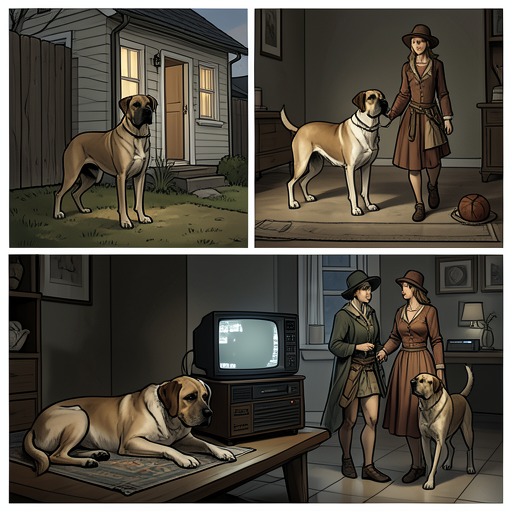
Porcelain dogs on the television
The Museum of InnocencePorcelain dogs on the television recur in the Keskin household as ornaments, imagined guardians, and objects Kemal quietly collects. Their history—from the radio sets around which families once gathered to the television sets that later dominate their attention—mirrors a change in domestic life. In the Keskin home, the dogs also register Kemal’s growing attachment to the family and his habit of taking their belongings: he removes figurines, supplies replacements, and turns an ordinary decoration into a record of repeated visits, concealed longing, and the household’s endurance amid political violence.
The dogs in the Keskin home
The dogs first catch Kemal’s attention when he enters the Keskin apartment on Kuyulu Bostan Street in Nişantaşı. They sit on handmade lace doilies atop the television, sometimes beside a small vase or seashell, sometimes propped against a cigarette box as if on guard. Their arrangement is part of the family’s lived-in interior rather than a formally explained display. Kemal suspects that Aunt Nesibe tends to their placement, but he cannot be certain: one evening in December 1979, he sees Füsun shift a dog with an impatient flick of her wrist while the family waits for dinner. That brief intervention makes the ornaments part of the household’s ordinary gestures, not merely fixed decorations.
The dogs’ domestic history reaches further back than television. Before television arrived in Turkey, one of them had stood atop the radio around which the family gathered every evening. Once television became the focus during meals, the figurine moved to the new appliance, although the family’s attention no longer fell on it as it had on the radio. Kemal connects this shift to a change in how people look: when listening to a radio, a person might turn toward it and then let the eyes wander to a nearby object; with eyes fixed on the television screen, the little dog becomes easy to overlook. Its continued presence preserves an earlier arrangement of family attention inside a changed room.
Guardians, comfort, and a changing city
The dogs suggest protection as well as decoration. Some appear threatening, ugly, or without charm, yet their presence can make the room feel guarded. Aunt Nesibe calls the black-eared dog a creature that brings peace, and Kemal reflects that the figurines’ quiet watchfulness may offer comfort while militants’ gunfire echoes through the neighborhood and the outside world feels increasingly surreal. Their small scale stands against the surrounding unrest: the dogs do not stop violence, but they help make the family room feel sheltered from it.
The political setting sharpens this domestic meaning. On September 12, 1980, after another military coup, Kemal wakes to empty streets, watches military images on television, and sees the city silenced. Later, after a troubled evening at the Keskin home, he thinks about the dogs and the delay in noticing their disappearance: it had taken the family eleven months to realize one was gone. He associates their belated attention with the coup and a prevailing impulse to put houses in order. The political rupture thus becomes a moment through which he reconsiders the dogs’ former place in the home and his own freedom to take them unnoticed.
Kemal’s substitutions and collecting
Kemal’s relation to the dogs belongs to a larger, secret practice. He has already taken small, easily missed things such as matchboxes, Füsun’s cigarette butts, saltshakers, coffee cups, hairpins, and barrettes; he then begins taking larger objects, including ashtrays, cups, and slippers, and replacing some with new ones. He is ashamed of hoarding and does not want to share the collection. The dogs make that private habit visible to him in a particularly clear form: their repeated disappearance and replacement leave a trace in the Keskin home even when the family does not openly discuss his collecting.
After reflecting on the missing dog, Kemal brings two porcelain dogs to the family from a shop in Beyoğlu. Aunt Nesibe welcomes the pair, and Tarık Bey proposes that one should face the family while the other faces its companion. In his arrangement, the dogs can be friends, keep watch, and belong to the family. The suggestion gives the figurines a place within the household rather than treating them simply as Kemal’s gifts. Their orientation becomes a small shared decision, even as Kemal’s unspoken desire is to touch and possess them.
He keeps his hands off that pair for more than a year. By 1982, when he finally takes them, his method has changed: he leaves money discreetly to cover the cost or brings an expensive replacement the next day. Other objects of similar form but different uses—dogs that double as pincushions or tape measures—also take their turns atop the television. The sequence turns collecting into an exchange among removal, compensation, and renewed display. A dog may leave the family room, but another object occupies its place, keeping the television’s small ceremonial landscape in motion.
Memory, circulation, and the collection
The dogs connect Kemal’s private attachments to a much wider world of ordinary things. Years later, as he visits museums and walks through cities, he notices that porcelain dogs sit atop televisions in homes across many countries. His recollection of the Keskin apartment is thus set beside domestic scenes in places including Tabriz, Tehran, Lahore, and Bombay. The repeated ornament suggests a shared habit that crosses borders, even though the specific dog in the Keskin home remains bound to that family’s arrangements and Kemal’s memories of Füsun.
In the later account of his collection, the dogs appear alongside saltshakers, thimbles, pencils, barrettes, and ashtrays: small objects that travel, recur, and enter the routines of households far from where they were first made. A saltshaker that had sat on the Keskin table for two years appears in restaurants and shops across several countries, while similar lighters and mass-produced goods turn up in flea markets abroad. The dogs belong to this same world of familiar forms dispersed through ordinary life. Their significance does not depend on rarity; it grows from the homes in which they stand, the gestures that move them, and the memories they gather.
For Kemal, a porcelain dog can be an overlooked ornament, a reassuring presence amid gunfire, a replacement for something secretly taken, or a piece of a household he wants to preserve. That range gives the motif its force. The figurines make the novel’s collecting practice visible at domestic scale: attention settles on what other people barely notice, and an object becomes a bearer of attachment through its repeated presence, absence, and return.